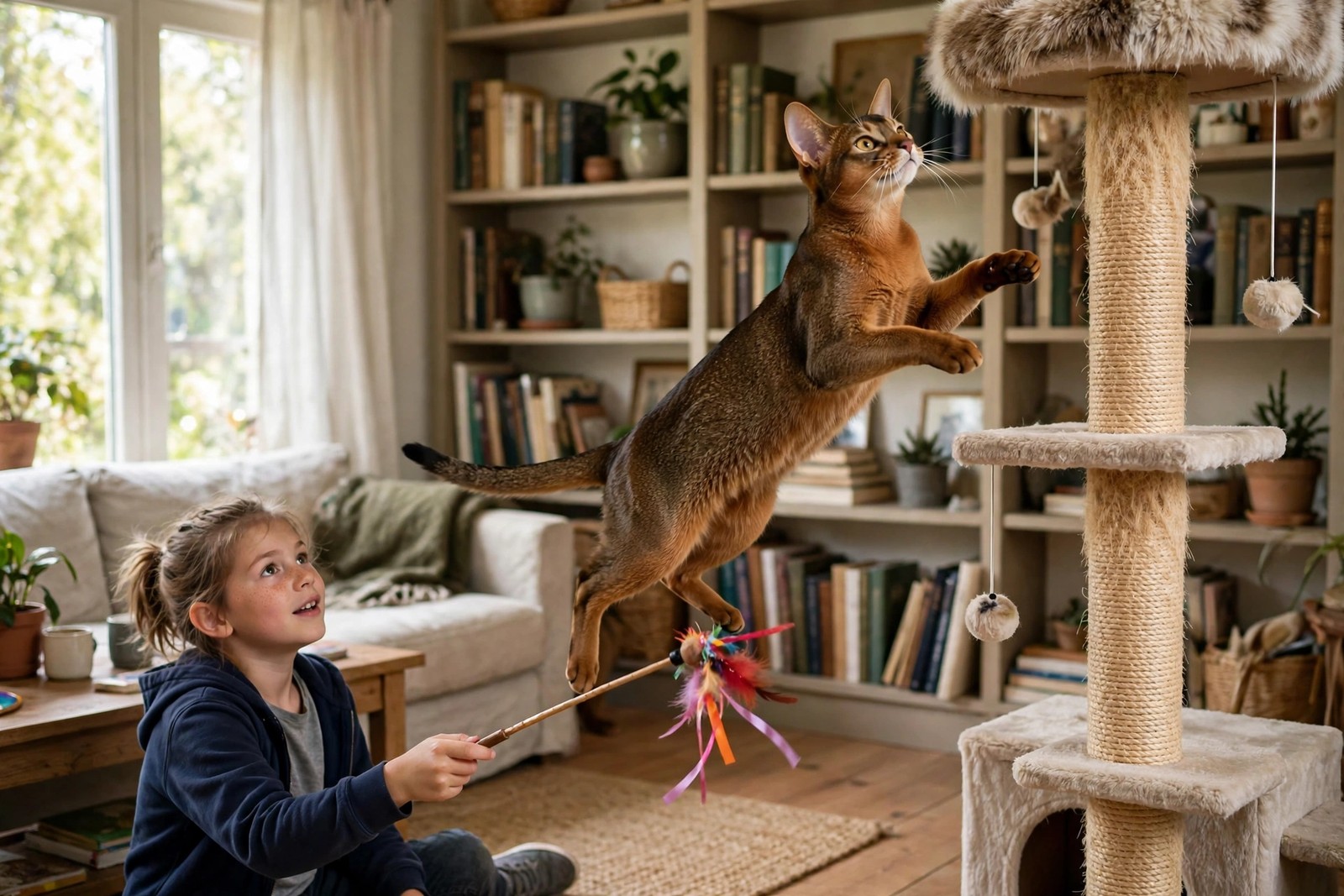
Yes — with the right children. An Abyssinian is not a placid lap cat who tolerates whatever comes; it is a lean, muscular athlete that climbs to the top of the bookcase, investigates every open cupboard, and wants to be involved in whatever the household is doing. That temperament pairs beautifully with school-age children who have energy to match, and poorly with a household expecting a calm cuddle toy.
Why Abyssinians and Older Children Click
Abyssinians are famously dog-like in their involvement: many follow their people around, greet visitors, and insert themselves into games. For a child of seven or eight and up, that means a genuine play partner. Wand toys, fetch with a soft ball down a hallway, cardboard-box obstacle courses and food puzzles built together can occupy both of them for half an hour at a time. Because the breed is intelligent and quickly bored, a child who plays with the cat daily is not entertainment on the side — that child is meeting one of the cat's core needs.
Their athleticism cuts both ways. An Abyssinian will leap onto shoulders, ride door tops, and treat a running toddler as part of the landscape. Very young children, who grab, squeeze and lunge, are a mismatch at this stage: the cat is fast enough to escape, but repeated ambushes teach it to avoid children altogether.
Setting the Rules That Make It Work
Teach children how this breed prefers contact: play first, hands second. Stroking is welcome when the cat approaches; picking up and carrying usually is not, and an Abyssinian will simply launch itself out of arms, which risks scratches for the child and a fall for the cat. Give the cat high retreat routes — shelves, a tall tree, a room children do not enter — because a cat that can leave rarely feels the need to swat.
- Two interactive play sessions a day, roughly 10 to 15 minutes each, with children taking turns as the designated player
- No chasing, cornering or pulling the cat out from under furniture — if it leaves, the game is over
- Gentle handling practice on a calm adult cat first, before a child handles a kitten
- A child-free quiet zone for sleeping, since Abyssinians nap hard between bursts
Choosing the Individual Cat
Within the breed, ask breeders or rescues for a confident, people-focused kitten or adult rather than the shy one hiding at the back — shyness plus a noisy household is the combination that struggles. Kittens raised underfoot in a busy home usually transfer that confidence. An adult Abyssinian whose history with children is known can actually be the safer first choice for a family, skipping the fragile, mouthy kitten months entirely.
With energy matched, retreat space guaranteed, and children who play rather than grab, an Abyssinian often becomes the most engaged four-legged member of the family — and KinsLe's Care Teams helps keep that true by letting you assign and tick off each day's play sessions, meals and litter duties across the whole family, so this busy, involved cat gets its activity even on the household's busiest days.