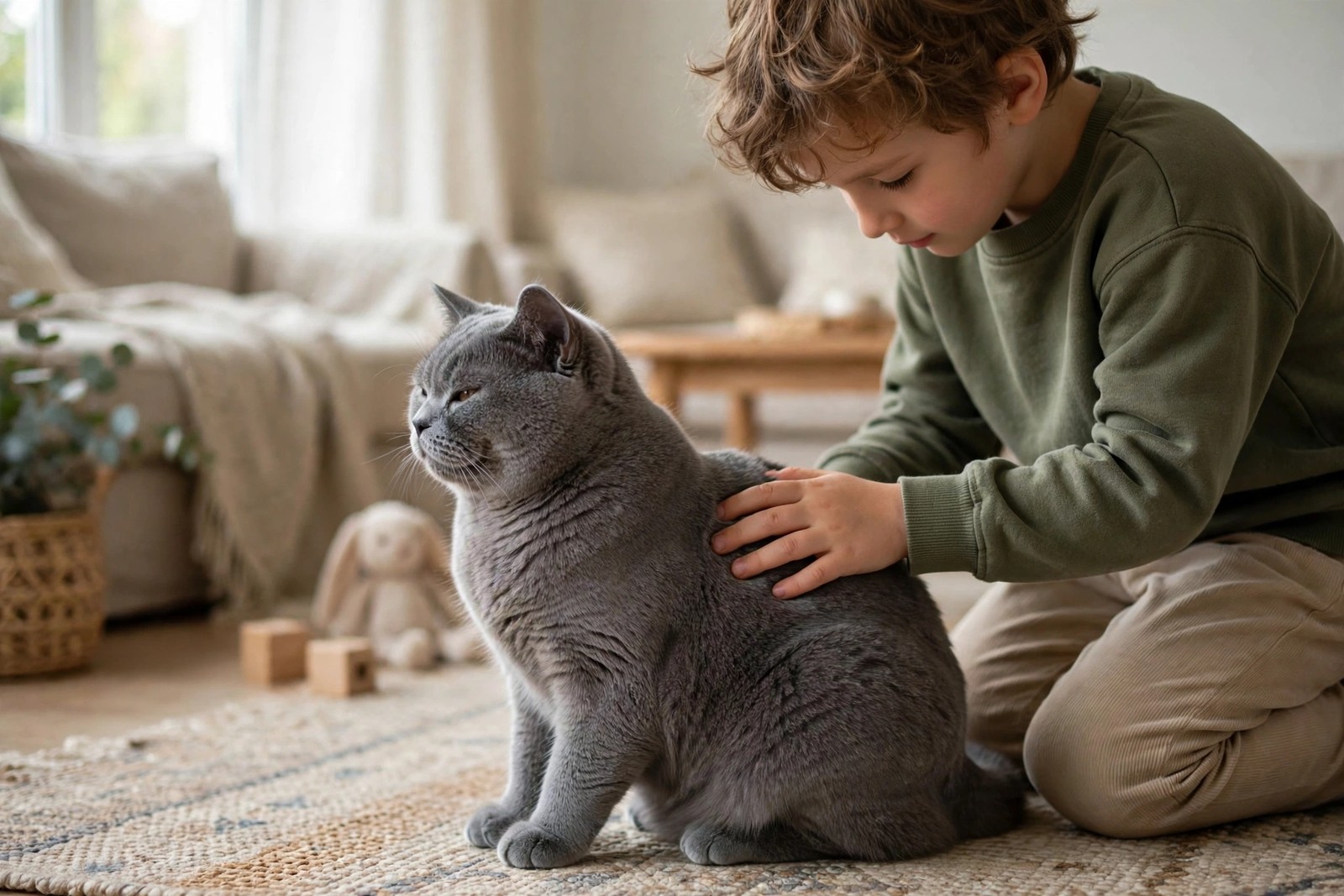
Yes — provided the children in question can accept affection on the cat's terms. The British Shorthair is a calm, solid, unflappable breed, the sort of cat that observes a noisy household from the arm of the sofa with an air of mild supervision. For families who want a steady presence rather than a whirlwind, that temperament is close to ideal. The single friction point is handling, and it is worth understanding before you commit.
Calm, Tolerant, and Not a Cuddle Toy
British Shorthairs typically tolerate a great deal: household noise, visitors, other pets and the general unpredictability of children. They are not easily startled, rarely dramatic, and happy to sit beside a child for stroking during a film or a story. What they are not is limp. Most strongly dislike being picked up, carried around or held in arms — unsurprising in a dense, heavy breed that can weigh 4 to 8 kilograms, with the males at the top of that range. A British Shorthair wants four paws on a surface and the freedom to leave.
A child who keeps scooping the cat up will not usually get scratched; they will get a cat that quietly relocates whenever the child enters the room. The relationship is lost to avoidance rather than conflict, which is sadder and harder to fix.
Teaching the Ground-Level Rule
Reframe how children show love to this breed:
- Sit on the floor and let the cat walk onto a lap by choice — lap-sitting offered is usually accepted and enjoyed
- Stroke the cheeks, chin and back; stop when the cat moves away, every time
- Play with wand toys and rolling balls, which suits a breed that plays in short, dignified bursts
- Never chase, carry or retrieve the cat from a hiding place — if it has left, the interaction is over
Because these cats are placid, also watch that children do not treat them as furniture to lean on or dress up. Tolerance is not consent, and a cat whose signals are never tested is a happier long-term companion.
A Serene Fit for the Right Household
For school-age children who are past the grabbing stage, the British Shorthair is an easy, low-drama companion: playful in moderation, affectionate without neediness, and typically content with indoor family life. Toddlers are workable with supervision precisely because the cat removes itself rather than retaliating, but the happiest matches start once children can reliably follow the no-carrying rule.
Making that rule stick means every adult, grandparent and babysitter enforcing the same handling style, visit after visit. Through KinsLe Family Sharing, her profile can be shared with the relatives you invite, so a grandparent arriving for the weekend can open it before meeting her.