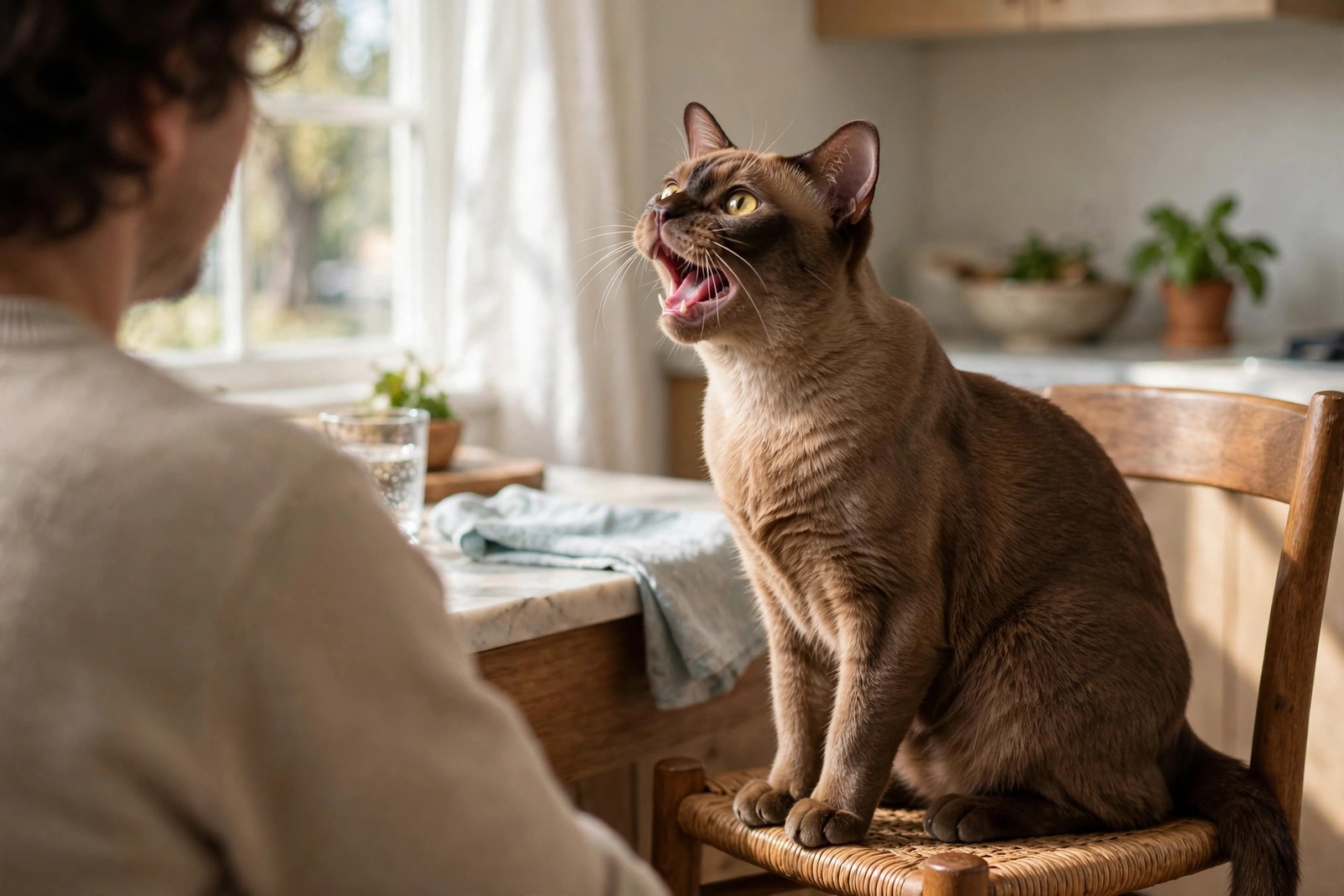
Yes. A Burmese will talk to you — not occasionally, but as a running feature of living with one. The good news for your ears and your neighbours is how they talk: where their Siamese cousins are famous for a piercing yowl that carries through walls, the Burmese voice is typically softer, lower and slightly husky, more conversational murmur than alarm. The persistence, though, is entirely Siamese in spirit.
What Burmese Conversation Sounds Like
Expect a commentary track on the shared household day. Typical Burmese vocalising includes short, soft meows and chirruping calls as the cat arrives in a room, polite but repeated requests at the food cupboard, conversational answers when spoken to — many Burmese will reliably reply in kind — and low-key grumbling monologues while settling on a lap or following you from task to task. The talking peaks around transitions: your arrival home, meal times, bedtime, and any moment the cat judges that attention has been directed elsewhere for too long.
Because these cats are so people-oriented, the voice is mostly social glue. A Burmese talks to stay connected to its humans, which is why the breed's chattiness charms owners who wanted an involved companion and wears down anyone who actually wanted a quiet, independent cat. Be honest about which of those you are before choosing the breed.
When Talking Means Something Else
A baseline of daily chatter makes changes meaningful, in both directions:
- Louder, more urgent or more frequent calling than usual, especially with restlessness, appetite change or litter-tray changes, deserves a vet check — pain and several common illnesses announce themselves first as changed behaviour in a vocal cat
- Calling that clusters at night in an older cat is worth mentioning to your vet at the next visit, and sooner if other signs accompany it
- A normally talkative Burmese going quiet and withdrawn is as significant as a quiet cat crying — never dismiss either as mood
Most increased talking, though, has a simpler explanation: an under-occupied Burmese. This is a playful, intelligent breed, and vocal demand rises sharply when company and games run short.
Living With a Conversationalist
You will not train the talking out of a Burmese, and owners who try mainly succeed in teaching the cat they are hard of hearing. Work with it instead: greet the cat back, keep feeding and play times predictable so requests come on schedule, add an evening play session to discharge the day's commentary before bed, and never reward genuinely antisocial-hours calling with food or fuss, which installs it as a routine.
For most Burmese homes, the talking ends up on the asset side of the ledger — it is hard to feel alone in a house narrated by a cat. When the household's most reliable narrator suddenly changes its tune — louder, longer, or not at all — put your question to KinsLe's Kinny in KinsLe: he replies out of the same Answers library, giving you breed background to set beside what you have observed yourself.