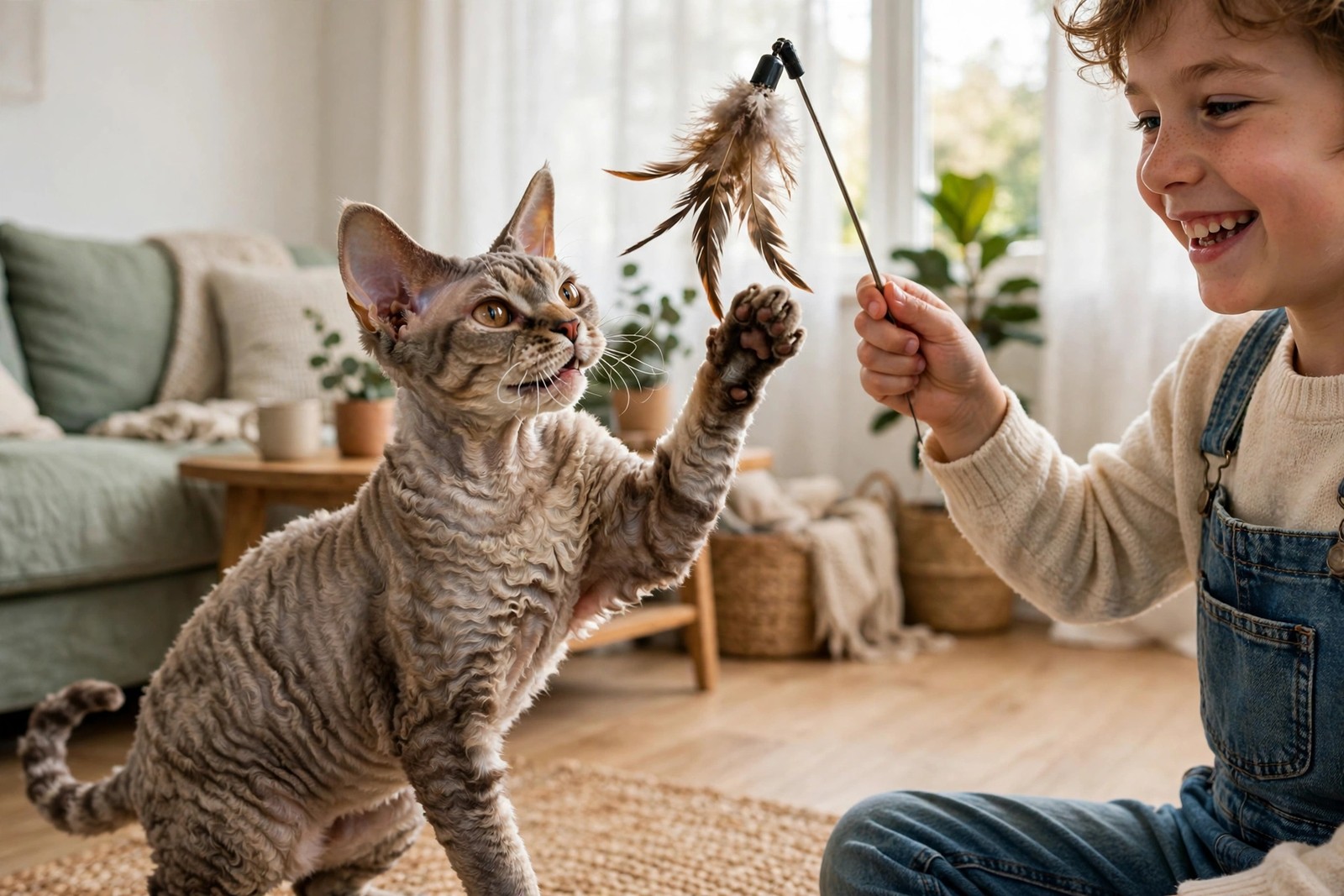
Yes — if you want a cat that participates in family life instead of observing it from another room, the Devon Rex is one of the strongest candidates. Devons are famously people-focused: they follow their humans around, ride on shoulders, supervise homework, and insert themselves into whatever is happening. For children, that means a cat who actually plays back.
A Temperament Built for Interaction
Most cats tolerate children; a well-socialised Devon tends to seek them out. The breed is playful well into adulthood, learns games like fetch and hide-and-seek, and often greets visitors instead of vanishing under a bed. They are also highly food- and attention-motivated, so school-age children can genuinely train them — walking on a harness, coming when called, doing simple tricks — which builds a relationship based on cooperation rather than on the child simply being allowed to stroke a sleeping cat. Devons usually cope well with a busy household's noise and movement, provided they have somewhere to recharge.
The Gentle-Hands Caveat
The caution is physical, not temperamental. A Devon Rex has a fine, wavy, surprisingly delicate coat and sensitive skin; rough stroking, coat-grabbing, and tight hugging can genuinely hurt, and a hurt Devon will wriggle, scratch, or learn to avoid the child. Their large ears are also delicate and not handles. So the teaching points for children are specific: stroke softly in the direction of the coat, support the cat properly if picking up is allowed at all, let the cat end every interaction by walking away, and never chase a Devon that has retreated to its high perch or quiet corner. Toddlers, who cannot yet moderate their grip, need full supervision and short, structured meetings — the breed's friendliness makes it a good grow-up-together cat, but the early years are managed, not free-range.
Energy Matching
Devons are boisterous. Expect midnight zoomies less than dawn-and-evening play festivals, toys delivered to your feet, and a kitten-like intensity that delights older children and can overwhelm a quiet, shy child who wanted a lap ornament. A Devon also demands company: a household where everyone is out all day may find the cat's social needs the bigger issue, because a lonely Devon becomes a mischievous, sometimes destructive one. Budget two interactive play sessions a day — which children are usually thrilled to provide — plus climbing space, since Devons love height and will claim the top of every bookcase.
Choose a breeder or rescue whose kittens are raised underfoot in a family home rather than in a quiet cattery room, and the temperament you read about is the one you will meet.
KinsLe's Family Sharing helps a Devon Rex household stay in step, keeping feeding amounts, play routines, and the gentle-handling rules in one shared profile so children, parents, and cat-sitters all treat this sociable cat exactly the same way.