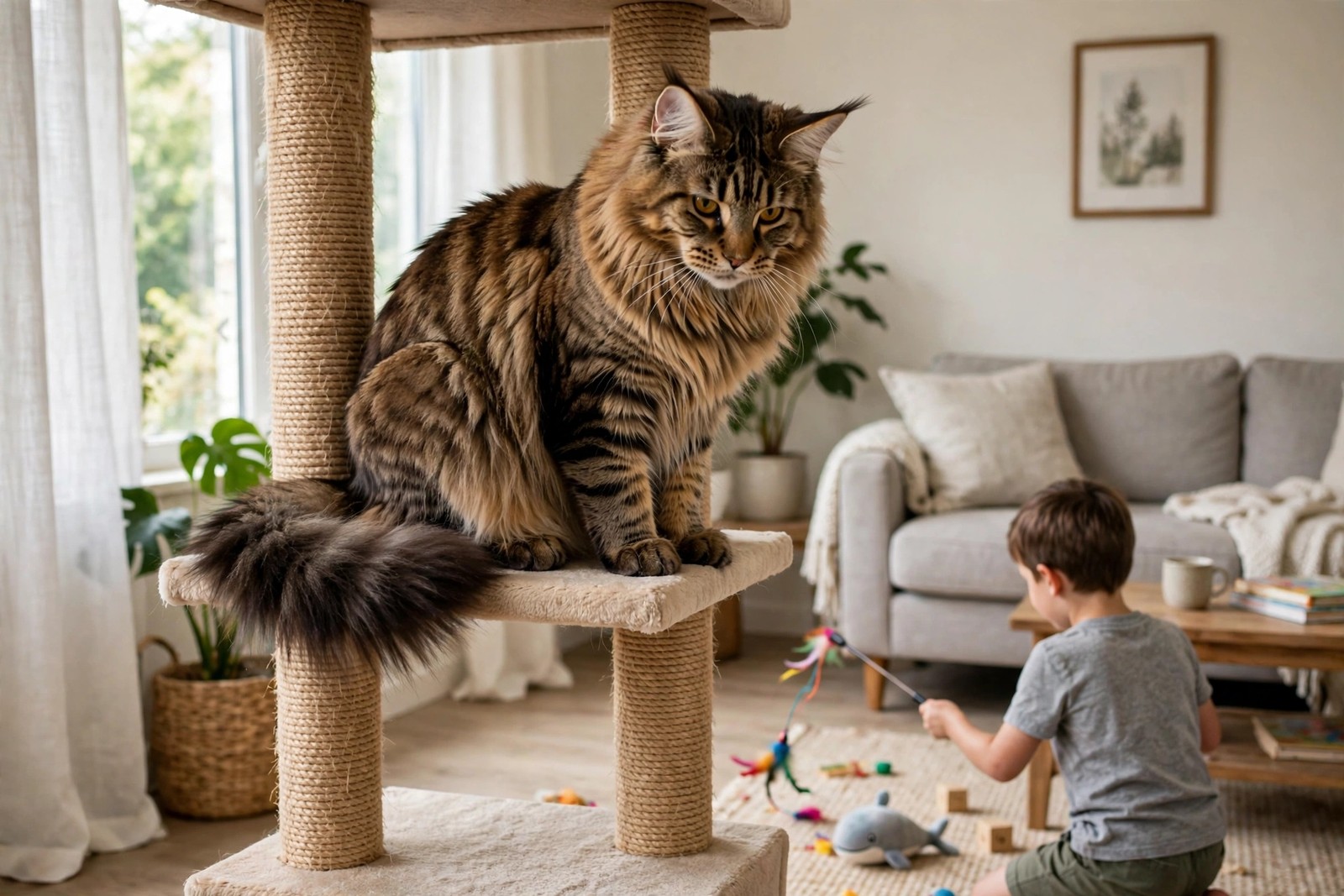
Usually yes — Maine Coons are among the more child-tolerant cat breeds, and for a particular reason: they tend to be interested in people rather than merely tolerant of them. Many follow their families from room to room, greet visitors, trill and chirp in conversation, and stay involved in household life long after a shyer cat would have retired to a quiet room. That sociable, dog-like quality makes them rewarding companions for children old enough to interact respectfully.
Temperament Around Children
A typical Maine Coon is patient, playful well into adulthood, and not easily startled by ordinary household noise. Many enjoy fetch-like games, wand toys, and supervising homework from the desk. They are rarely the type to scratch first and leave — more often they simply walk away when they have had enough, which is exactly the signal children need to learn to respect.
That patience has limits worth naming. Maine Coons bond strongly and can become stressed by chaotic, unpredictable handling. A toddler who grabs fur, squeals directly in the cat's face, or chases it from room to room will not get the best of this breed. The sweet spot is the school-age child who can sit, let the cat approach, and play interactively without grabbing.
Size Changes the Handling Rules
This is the point most breed summaries skip. Maine Coons are one of the largest domestic breeds — males commonly reach 6 to 8 kilograms or more, with a long, muscular body. A five-year-old simply cannot lift that safely. A dropped cat can be injured, a struggling cat can scratch badly while trying not to fall, and one bad experience can make a previously confident cat wary of the child involved.
So set the rule early: children do not carry the Maine Coon. If the cat wants lap time, the child sits on the floor or sofa and lets the cat climb up by choice. Support the whole body, chest and hindquarters together, on the rare occasions an older child is allowed to hold the cat while standing still and supervised. Floor-level play — wand toys, rolling balls, cardboard boxes to investigate — suits this breed better than being carried about like a doll.
Making the Match Work at Home
Give the cat height and escape. Maine Coons love high perches, and a tall, sturdy cat tree — it must be sturdy, given their weight — lets them watch family life from safety and leave the floor whenever they choose. Teach children that a cat on its perch or in its bed is off duty.
Introductions go best slowly: let the cat sniff the child's belongings first, keep early meetings short and treat-based, and never place the cat into a child's arms as a presentation. Within days most Maine Coons are choosing their spots in the middle of everything.
Supervise food and grooming jobs shared with children. Brushing that long coat together, a few strokes at a time, is a calm bonding activity older children often love, as long as tangles are left to an adult.
With those ground rules, this is one of the strongest breed-and-children pairings in the cat world: big-hearted, engaged, and built to be part of the family rather than decoration in it. At the end of that setup, KinsLe Family Sharing gives the relatives you pick their own access to the cat's profile.