
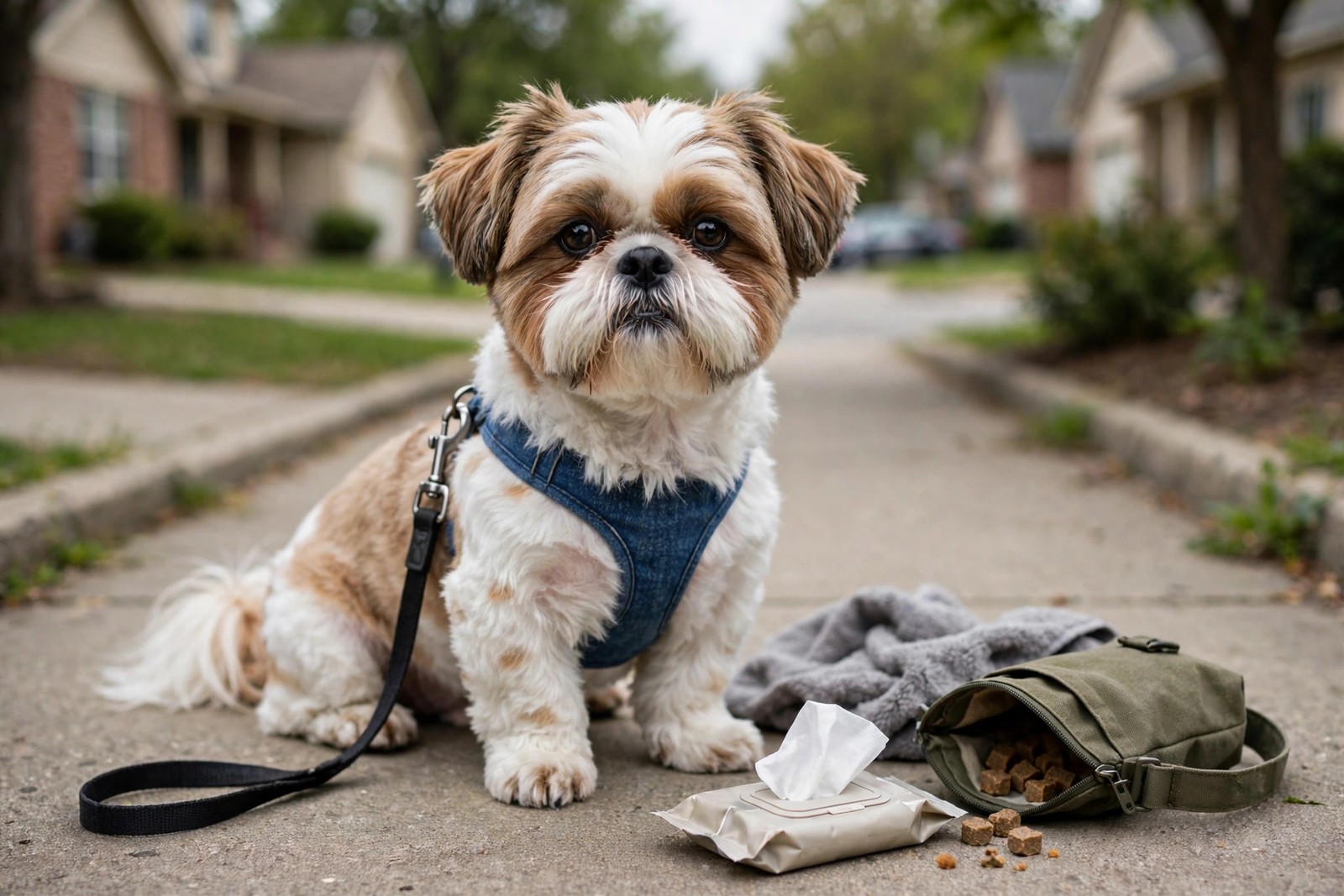
Yes, a Shih Tzu can be a warm, steady companion for children, and the breed's history explains why. Shih Tzus were bred as indoor companions, and most carry that job description in their temperament: friendly, patient, and happiest in the middle of household life. The match works best when the children are old enough to handle a small dog carefully, because the risk in this pairing usually runs toward the dog, not the child.
Small, Sturdy, and Still Easily Hurt
A Shih Tzu is more solid than many toy-sized dogs, with a compact body and a confident way of moving through a home. Solid is not the same as unbreakable. A dog dropped from a child's arms, fallen on during rough play, or squeezed hard around the ribs can be seriously hurt, and toddlers fall, grab, and lurch as a normal part of being toddlers. That is why this breed pairs more safely with school-age children who can sit on the floor to play, let the dog come to them, and lift it correctly with both hands supporting the chest and rear when lifting is needed at all.
Teach children that the dog is never a doll or a parcel. No carrying it around the house, no dressing it up against its will, no pulling the topknot or tail, and no waking it by grabbing. Floor-level games, gentle brushing the dog enjoys, and treat-based training sessions give children real contact without risky handling. An adult stays within reach during play until the children's careful habits are proven over months, not days.
The Coat Is Part of the Bargain
A Shih Tzu's long coat needs regular brushing and trimming, and a family choosing the breed is also choosing that work. Children can help with gentle brushing if the dog enjoys it, which doubles as calm, supervised contact. Keep the grooming routine steady and the dog mat-free, because a dog sore from tangles is a dog with a shorter temper for handling of any kind.
Eyes and Face Need Daily Attention
A Shih Tzu's large, prominent eyes sit shallow in the face, which makes them easy to irritate and easier to injure than the eyes of a longer-nosed breed. Keep the hair around the eyes trimmed or tied up so it does not brush the surface, wipe away the daily tear staining gently, and watch for squinting, pawing at the face, or a cloudy look, any of which earns a prompt vet call rather than home experiments. Children can learn this check as part of greeting the dog, provided their hands are slow and the dog is free to turn its head away.
Temperament and Its Limits
The typical Shih Tzu is tolerant of household noise, affectionate without being frantic, and content with moderate exercise, which makes daily life with children easier than with a wired, high-drive breed. Tolerance still has edges. A dog that is chased, cornered, or handled roughly every day may start avoiding children or snapping when escape fails, and that outcome is a handling problem, not a breed failure. Give the dog a retreat space children do not enter, watch for it choosing distance, and respect that choice every time.
Meet the individual dog whenever you can. Some Shih Tzus adore children and seek them out; others prefer a calmer house. Through KinsLe's Transferrable Profiles, notes from the people who know a dog best travel with it: how it responds to children, whether it dislikes being picked up, what handling it accepts for grooming, and the routines that keep it relaxed. That history lets a family match their children's ages and style to a real dog rather than a general reputation. Reading one small dog's handling notes, coat routine, and child history through the Transferrable Profiles in KinsLe gives parents the real animal to judge, not a breed promise.