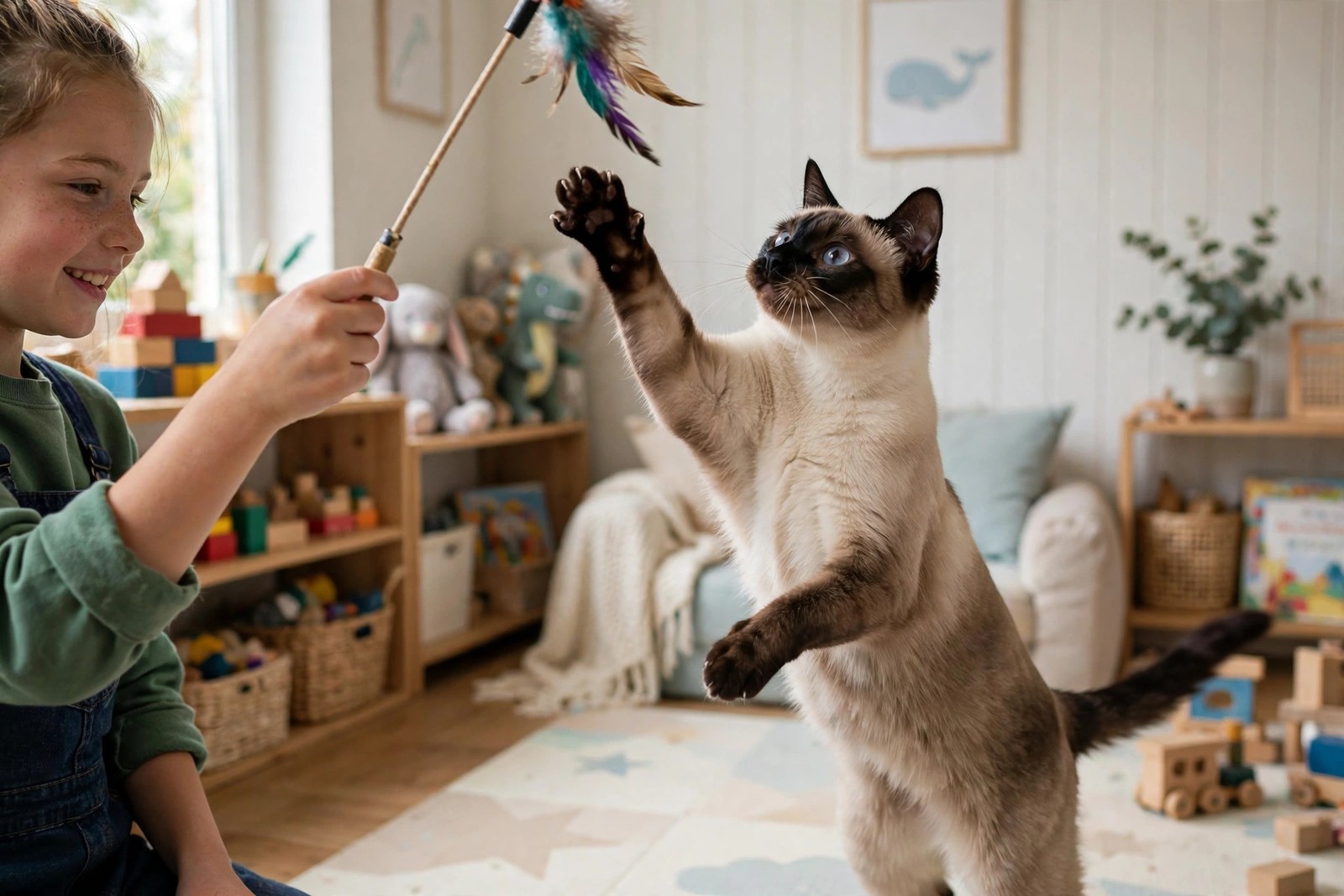
Siamese cats can be superb with children — as long as the children understand the deal. A Siamese does not want to be a beautiful ornament in a child's home. It wants a relationship: games, conversation, involvement in everything, and a person or two who are unmistakably its own. Give a Siamese an engaged school-age child and you often get one of the closest cat-and-child bonds of any breed. Give it a household where it is ignored, and you will hear about it — literally.
Social, Vocal, and All-In
Siamese are famously talkative, holding forth in a loud, distinctive voice about meals, closed doors, your late return, and the general running of the house. They follow their people, ride on shoulders when allowed, insert themselves into homework, video calls, and board games, and many learn fetch and lead walking because interaction itself is the reward. For a child who wants a cat to play with for an hour at a time and chat to while they play, this is a delight.
That intensity has edges. Siamese bond hard, often to one favourite person, and can be possessive about that person's attention. A new baby, or a child who suddenly has no time, can produce a jealous, unsettled cat who protests vocally and shadows the rival. It is rarely aggression — it is a social animal whose central relationship has been disrupted. Families coping with a new baby should keep the cat's routines, play times, and access to its favourite person as steady as possible rather than exiling the cat from the nursery commotion entirely.
The Children Who Suit a Siamese
Energetic, interactive children of school age are the sweet spot. Toddlers are a harder fit — not because the Siamese is fragile, but because grabbing, tail-pulling, and unpredictable squealing annoy a cat who expects to be treated as a social equal, and a Siamese is quicker than a placid breed to swat and leave. Supervise young children, teach no chasing and no carrying against the cat's will, and provide the cat with high routes out of toddler territory.
Older children should be warned about the real commitment they are accepting: a Siamese needs daily interactive play, ideally two good sessions, plus the ambient company of being where the family is. Long school days are manageable; long school days followed by everyone on screens in separate rooms, with the cat shut out, is the recipe for night-time yowling and attention-seeking chaos at midnight.
Living With the Volume and the Brain
Prepare children for the noise honestly — some families find the commentary charming, others find a full-volume 5 a.m. opinion wearing. You cannot train the voice out of a Siamese, so decide as a household that you find it funny before the cat arrives. Channel the intelligence: food puzzles, trick training with treats, and rotating toys keep a clever cat from inventing its own projects, which tend to involve cupboards, curtains, and unravelling things.
Choose a well-socialised kitten or a known adult, introduce the cat gradually to the children's noise and routines, and let early meetings be play-based with treats.
Matched with children who give time and attention, a Siamese repays it with loyalty, comedy, and constant companionship. KinsLe Care Teams helps a busy family guarantee that attention by assigning daily play sessions, feeding, and litter care to named people, so your Siamese's social needs are met even when the children's schedules get hectic.