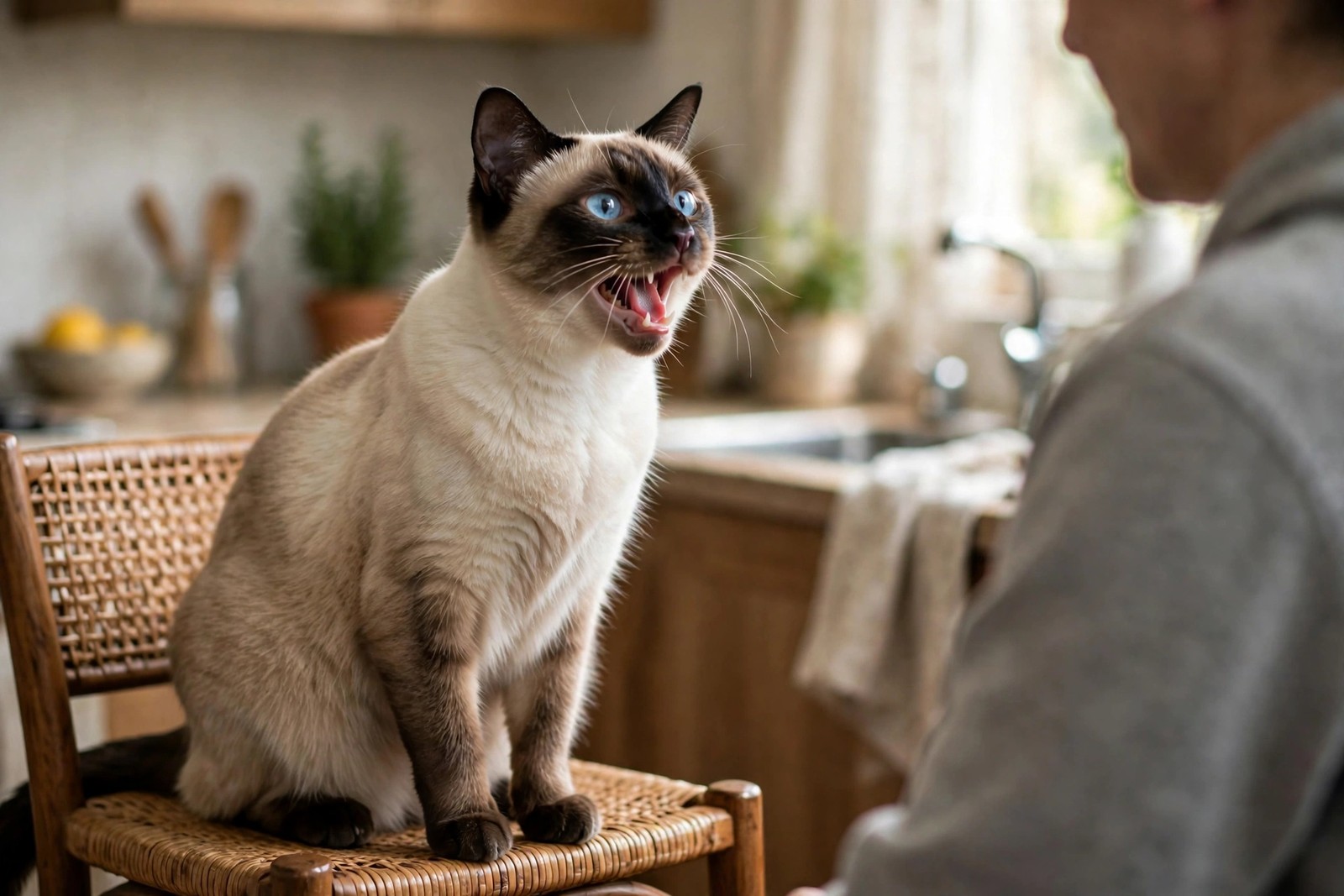
Yes. If you choose a Siamese, you are choosing a cat that talks, and it is better to know that plainly before the cat comes home than to discover it at three in the morning. Talkativeness is not a quirk of a few individuals in this breed; it is a known Siamese trait, as much a part of the breed's character as its color points and blue eyes. Owners who love it describe a cat that holds conversations. Owners who did not expect it describe a cat that never stops having opinions.
What the Voice Is For
A Siamese meow is rarely random noise. It is demand and conversation in roughly equal measure. The cat announces hunger before the bowl is due, protests a closed door, greets a returning person with a full report, and answers when you speak to it, often matching your sentence with one of its own. Many owners fall into genuine back-and-forth exchanges, and the cat clearly treats those exchanges as social contact worth seeking out. Ignoring the voice does not usually end it; the cat tends to repeat the message louder, because from its side of the conversation, you simply have not answered yet.
Volume deserves its own warning. A Siamese voice carries. It is a full-throated, sometimes raspy call that travels through walls and down hallways, not the soft chirp some breeds make. Kittens start early, adults keep it up for life, and an elderly Siamese may talk as much as ever. In a house with thin walls, a light sleeper, or a baby whose naps run the household schedule, that volume is a real cost to plan around rather than a detail to discover later.
Living Well With a Chatty Cat
The workable approach is answering the need behind the noise. A cat calling because it is hungry, bored, or shut away from its people quiets when the need is met: food on a predictable schedule, play sessions that burn energy, doors open where the cat is allowed, and attention given before the demands escalate. Talking back helps, too; a few minutes of real engagement often ends a calling session that an hour of ignoring would have stretched out. What does not help is punishing the vocalizing. You would be punishing the breed for being the breed, and the cat learns only that its people are unpredictable.
When a Change in the Talking Deserves Attention
A lifelong talker that suddenly goes quiet, turns hoarse, or sounds strained is showing you a change, and changes in an animal's normal pattern are worth a vet's attention rather than a shrug. The same goes for calling that arrives with other changes: eating less, hiding, breathing noisily, or seeming unsettled in a way that is new for that cat. Ordinary Siamese conversation needs no fixing at all. A voice that changes character is information, and the safe move is to have it checked while you keep notes on when it started and what else shifted alongside it.
Consider the individual as well as the breed. Through KinsLe's Transferrable Profiles, the people rehoming a Siamese can record how vocal that specific cat is: whether it comments all day or saves its voice for mealtimes, what triggers its loudest rounds, and which responses settle it fastest. One cat's record might describe a cheerful greeter; another's might warn of long dawn choruses. That voice record matters because a record kept in the Transferrable Profiles within KinsLe lets an adopter learn one cat's noise level, triggers, and settling habits before the first midnight conversation.