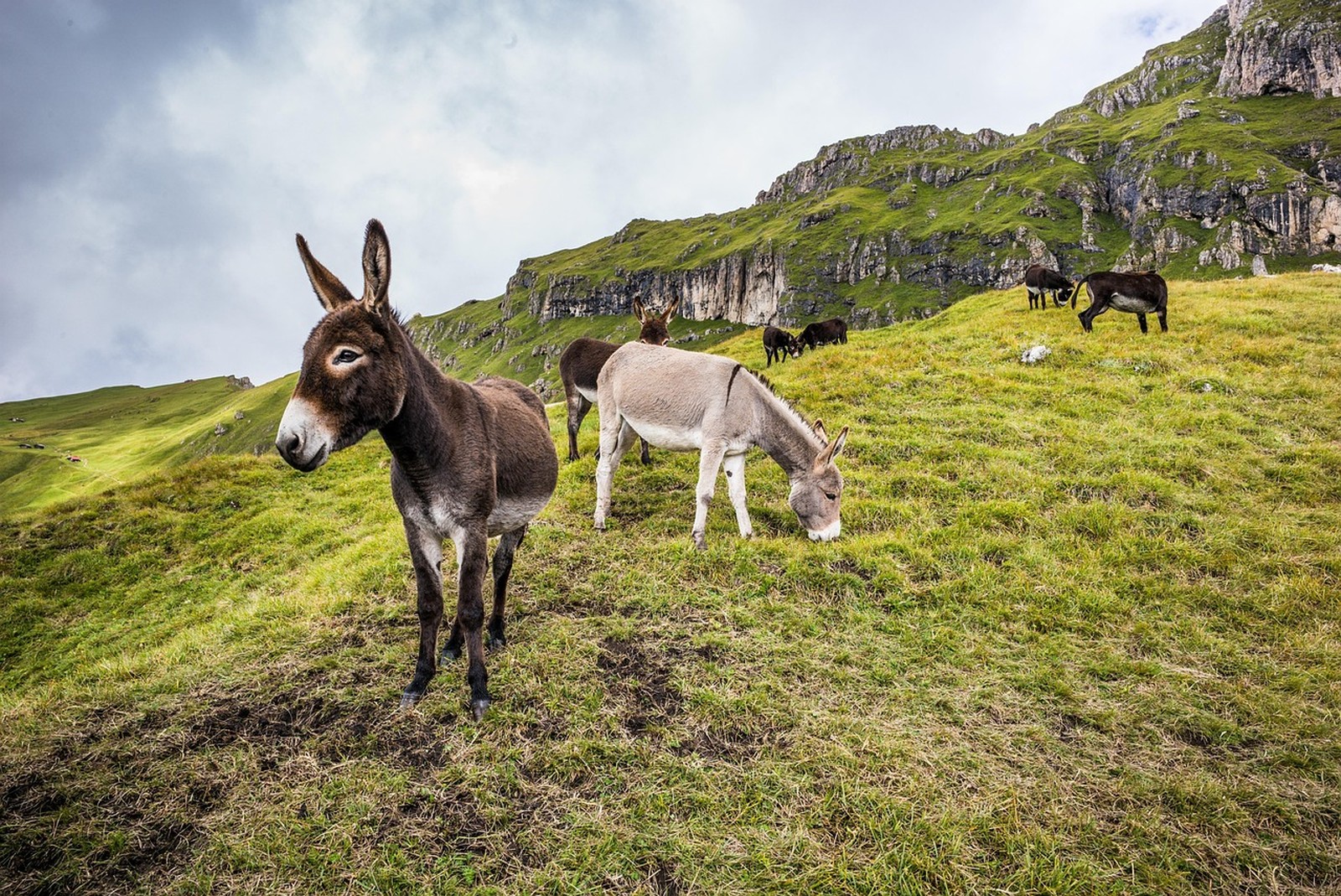
Solitude is the one housing arrangement this species handles badly. Donkeys are herd animals with unusually strong pair bonds, and a donkey kept by itself often spends long stretches standing at the gate, braying, pacing the fence line, or refusing to rest properly. Some cope quietly rather than dramatically, which makes the problem easy to miss: the donkey eats, yet stays tense, withdrawn, and hard to handle. Company is not an extra for this species. It is part of basic welfare, alongside forage, shelter, hoof care, and room to move.
Why Another Donkey Usually Fits Well
Two donkeys communicate in ways other species only partly match. Bonded donkeys graze side by side, rest head to rump so each can swish flies from the other, groom each other's necks and backs, and settle more readily because a trusted partner is on watch. A second donkey also shares the same diet needs, hoof schedule, and tolerance for sparse forage, so daily care stays simpler than mixing species with different feeding rules.
A calm horse or pony can be genuine company, and many donkeys live contentedly alongside one. Watch the pairing honestly, though. A much larger horse can bully a donkey away from hay, and a donkey can be injured by a playful kick it cannot dodge. Goats and sheep may provide background company, yet they do not groom, play, or rest with a donkey in the same sustained way, so they are a partial answer rather than an equal substitute.
Signs a Lone Donkey Is Struggling
Look for repeated braying when people or other animals leave, fence walking, weaving at the gate, and a new reluctance to lie down. Some lone donkeys go off their forage, while others eat constantly and gain weight because grazing fills empty hours. Aggression during handling, bolting toward any visiting equine, and clinging to a stablemate through a fence are also clues. A donkey that has just lost a partner may grieve openly, calling and searching for days, and that donkey needs company arranged promptly rather than a long trial of solitude.
Introducing a Companion Safely
Choose a companion of similar size, age, and energy where you can, and let the two meet across a sturdy fence first. Keep separate hay piles, water, and shelter space during the early days so neither animal has to compete while they learn each other's signals. Short shared turnout in a neutral paddock, supervised, usually tells you more than a long unsupervised session. Separate them again if one pins its ears, chases persistently, guards every resource, or prevents the other from resting, and seek advice from an experienced equine keeper or your vet if the tension does not ease.
Planning for Two From the Start
Budget and build for a pair: two sets of hoof trims, dental checks, feed measured for each animal, and enough shelter that a lower-ranking donkey can rest out of the wind without standing beside a bully. Donkeys thrive on high-fibre, low-sugar forage, so a lush paddock suited to a horse may need grazing limits for both. Keep handling individual as well as shared; each donkey should lead, stand for the farrier, and load separately, so an emergency trip for one does not become a crisis for the pair.
A well-matched companion changes daily life more than any toy, mirror, or extra human visit can. People come and go on a human schedule, while a bonded partner is present through the night, the weather, and the quiet hours when loneliness bites hardest. On KinsLe, Care Teams helps you divide the pair's daily jobs — feeding both animals, turning them out, checking water and shelter — between helpers — each job stamped with the time it was finished — so a bonded donkey's routine stays steady even when your own day changes.