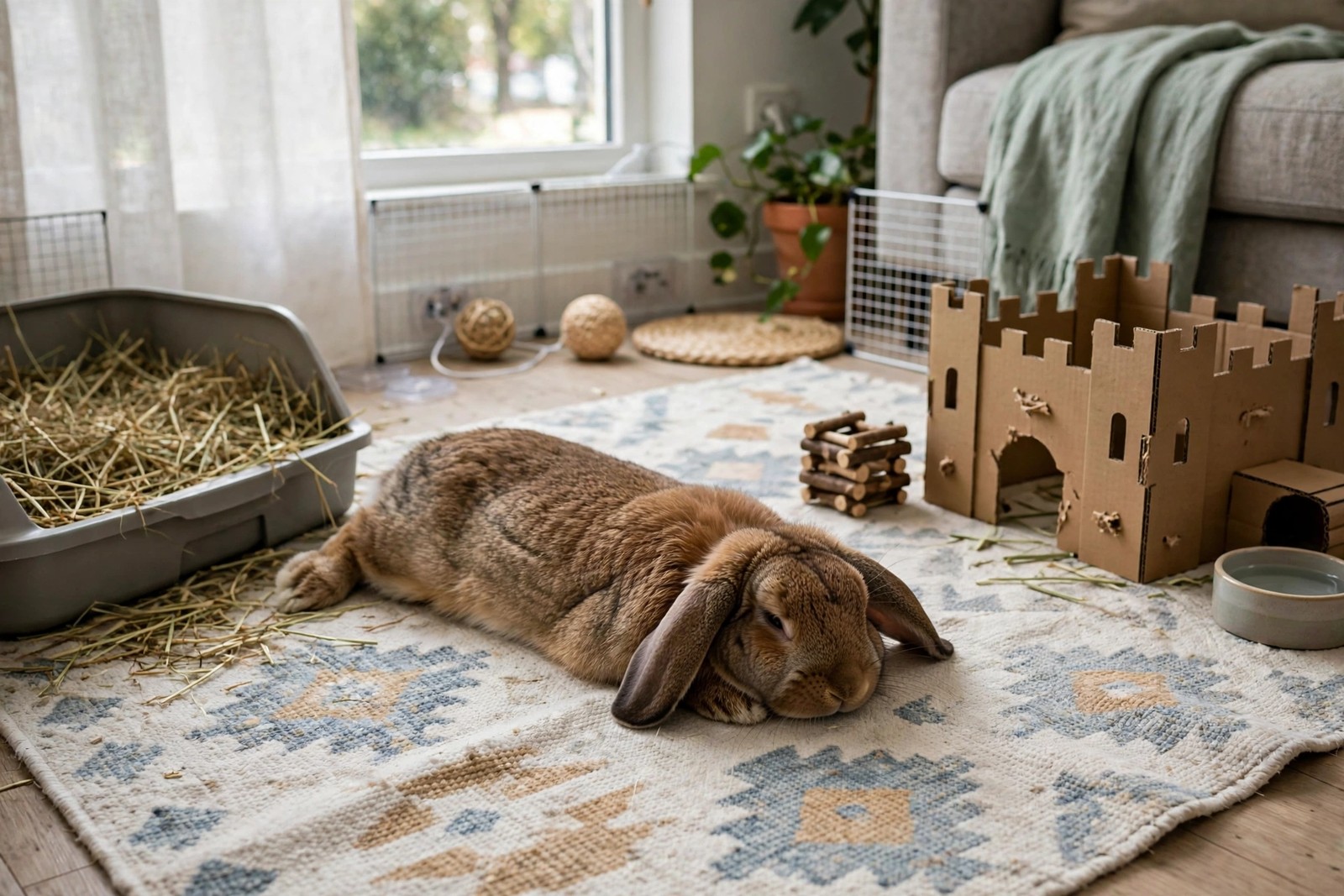
Yes — a rabbit can live free-roam in the house, and for many rabbits it is the best quality of life you can offer: room to run, binky, flop, and choose where to spend the day. But rabbits are not small cats. They are prey animals who chew as a biological necessity and can injure themselves in gaps a cat would ignore. Free-roam works when the house is set up for a rabbit, not merely tidied for one.
Start with a home base, then expand
Even a fully free-roam rabbit needs a home base: a large pen or roomy enclosure that is never used as punishment, holding unlimited hay, a water bowl, a litter tray, a hideaway box, and chew toys. Keep the rabbit based there while you proof the first room, then allow supervised time out, then unsupervised time in that room, then further rooms one at a time. A rabbit who fails in a whole house usually succeeds when the territory grows gradually, because litter habits and confidence are easier to build in a smaller area.
Litter training a rabbit
Most rabbits naturally toilet in one or two corners, which makes training realistic. Put a large tray where your rabbit already goes, fill it with a paper-based litter, and pile hay at one end or hang a hay rack above it — rabbits like to eat while they toilet. Move stray droppings into the tray at first, wash urine accidents with a pet-safe cleaner, and expect a young or unneutered rabbit to mark more; discuss neutering with your vet, as it usually improves litter habits as well as health and behaviour. A free-roam rabbit may still use more than one tray, so larger homes often need a tray on each floor or at each end of the rabbit's territory.
Chewing: cables, skirting, and furniture
A rabbit's teeth grow continuously, and chewing keeps them worn — your cables are simply attractive, bendy stems to a rabbit. Run every cable in the rabbit's rooms through hard split-loom tubing or behind furniture the rabbit cannot reach, lift chargers off the floor, and protect skirting boards and table legs with guards, panels, or by rearranging furniture against the most chewed stretches. Provide legal alternatives everywhere: willow and apple-wood sticks, seagrass mats, cardboard boxes and castles, and hay-stuffed cardboard tubes. A rabbit who chews the wall usually has too few permitted targets nearby, not a behaviour problem.
Gaps, floors, and other animals
Block gaps behind sofas, bookcases, and appliances with panels or storage boxes — a rabbit can squeeze into a surprisingly small space and become trapped or reach cables you thought were safe. Cover slippery floors on main routes with washable rugs, because rabbits lack paw pads and can injure joints when skidding. Keep houseplants and cleaning chemicals out of reach, and introduce free-roam time around cats or dogs only under supervision, however friendly those animals seem — a rabbit should always have a route back to its home base that other pets cannot follow.
KinsLe Family Sharing helps by keeping your rabbit's safe-room list, hay and greens routine, and proofing rules in one shared profile, so a partner, housemate, or sitter never opens the wrong door or offers the wrong room.