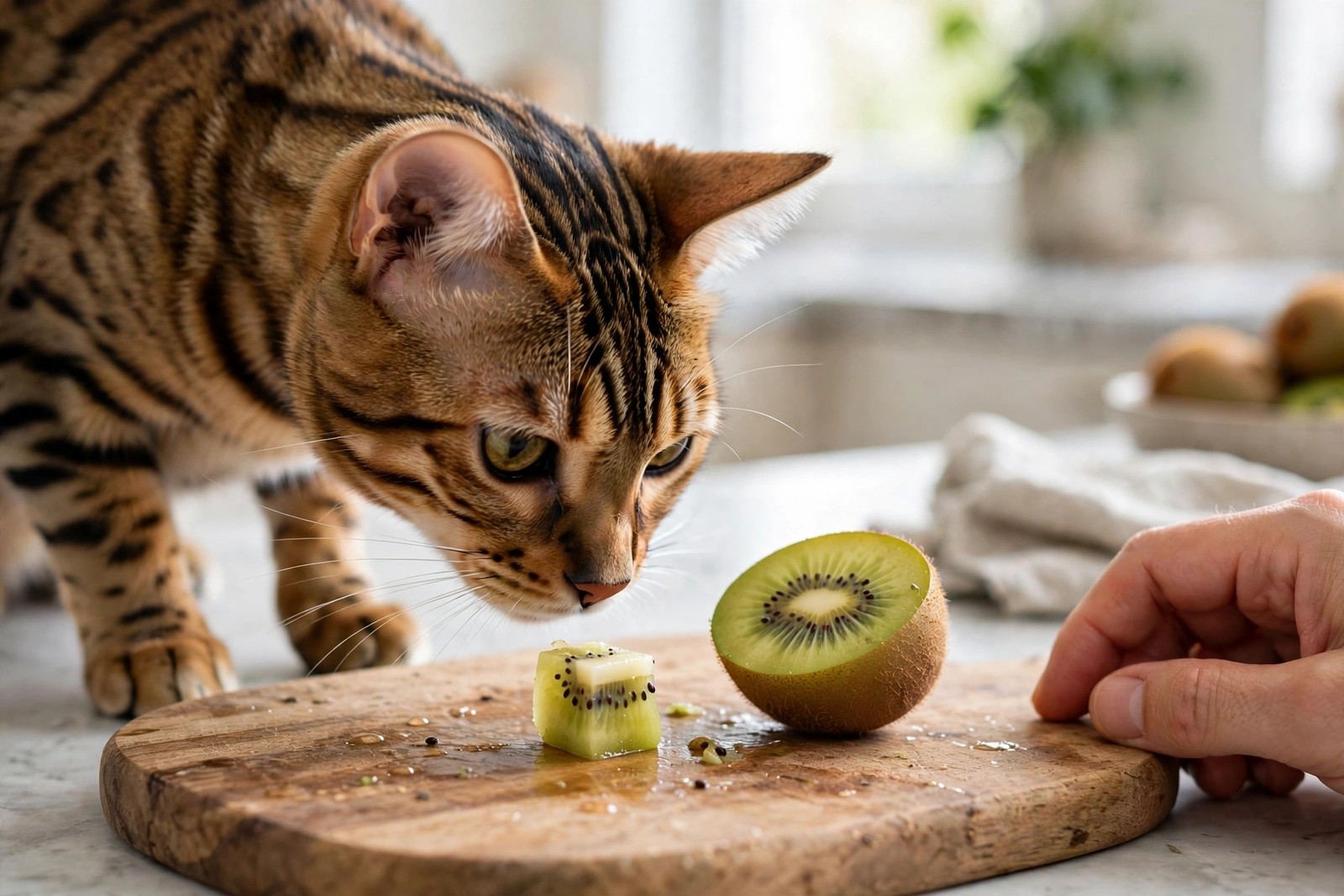
A tiny piece of kiwi flesh is safe for most cats as a one-off taste, peeled and with no skin, but cats have no need for it and most show little interest. Fruit should stay a curiosity-sized nibble for an obligate carnivore. The interesting part of this question is not danger — kiwi is not a toxic fruit for cats — it is how completely unnecessary it is.
A Fruit Built for Nutrients Cats Already Handle
Kiwi is praised in human diets chiefly for vitamin C and fibre. A cat's body manufactures its own vitamin C, so the fruit's headline nutrient is one your cat is already supplying internally. And because cats lack the taste receptors for sweetness, the flavour you enjoy is mostly lost on them; a cat who investigates kiwi is usually responding to texture, moisture and smell, or simply to the fact that you are eating something with focus. Golden and green kiwi follow the same rule — the golden type is sweeter to you, which makes no difference at all to the cat.
Preparing the One Piece You Might Offer
If you do share, share correctly: wash the fruit, peel away all of the fuzzy brown skin, and offer a pea-sized piece of soft flesh, seeds and all being less important than size — the tiny seeds in a pea-sized piece are not the concern, the portion is. Skin is the part to keep out of the bowl; its rough texture is harder to digest and is the part most likely to come back up. Cut the piece small enough that a cat cannot gulp a slippery chunk whole.
Dried kiwi is a different food from fresh. Drying concentrates the sugars and acids, and commercial dried fruit is often sweetened further, so it has no place as a cat treat. Kiwi in fruit salads, smoothies or desserts should also stay human food, because the company it keeps — grapes in a fruit salad, sweetened yoghurt, juices — changes the risk entirely.
How a Cat's Gut Answers Too Much Fruit
More than a nibble, and the likely reply is digestive: the fruit's acidity and fibre can produce drooling, lip-smacking, vomiting or loose stool, especially in a cat with a sensitive stomach. Offer one piece only, then wait a full day before even considering another, and read the litter tray honestly. A cat who walks away after a sniff has given you the simplest possible answer — do not persist, coax or hide kiwi in food to make a point. Many cats prefer a small piece of plain cooked meat as a treat, and they are nutritionally right to do so.
If a cat eats a larger amount scavenged from a worktop, remove the rest and watch for repeated vomiting or diarrhoea, calling your veterinarian if those signs persist or the cat stops eating.
Keeping Curiosity From Becoming a Course
Novel foods get repeated when each person in the house wants to see the reaction for themselves. In KinsLe, Care Teams lets the first person record that single kiwi taste as done, timestamped on the cat's duties, so the experiment ends with one piece instead of one per family member.