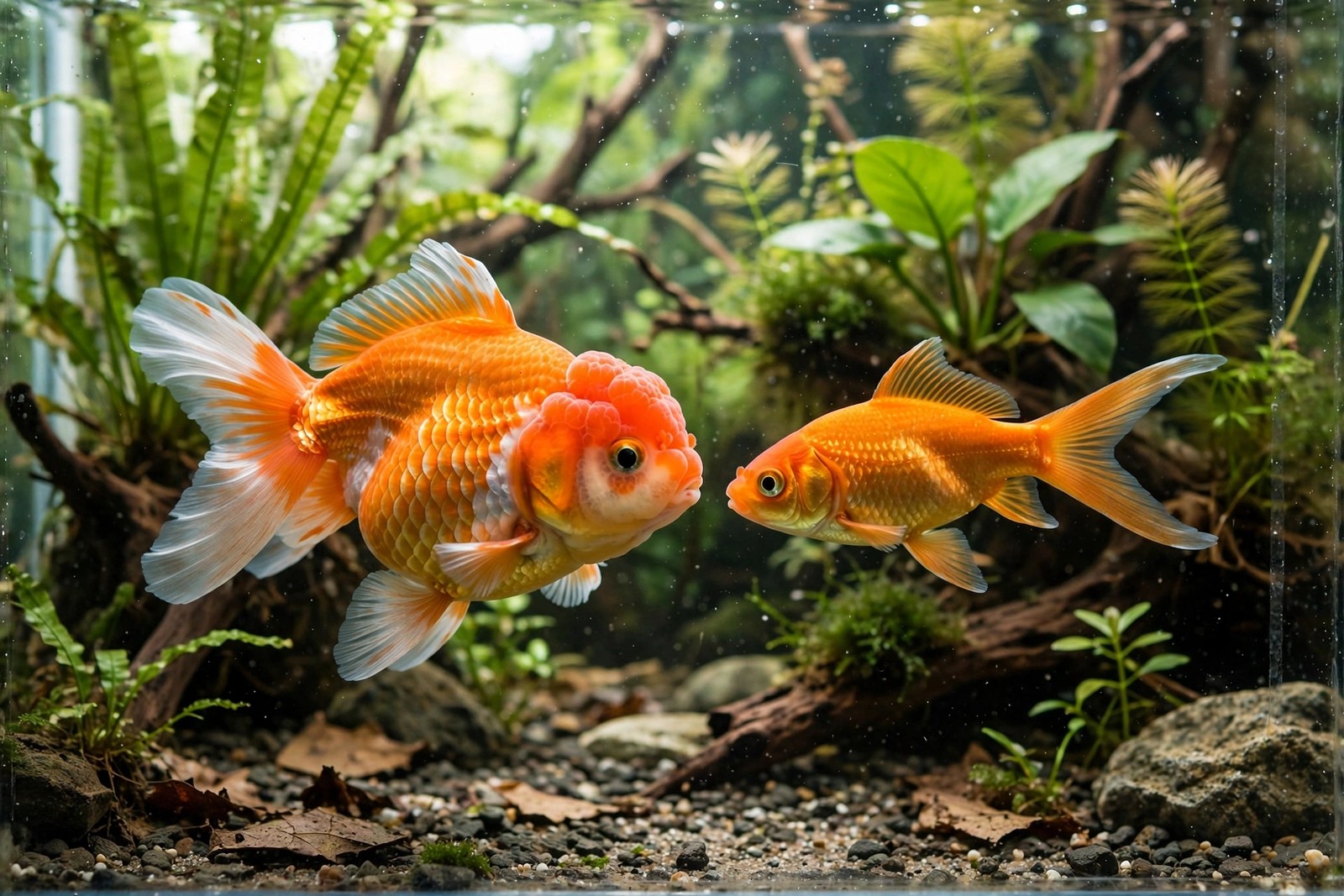
For most home aquariums, no — not well, and not for long. Standard and fancy goldfish are the same species, so they share water temperature and basic chemistry, but their bodies ask for opposite things. That mismatch, not aggression alone, is why experienced keepers generally discourage mixing them.
Two very different athletes
Standard goldfish — commons, comets, and shubunkins — have single tails, torpedo bodies, and strong, continuous swimming. Fancy varieties such as fantails, orandas, ranchus, and telescope-eyes have double tails, compressed round bodies, and in some cases impaired vision or a head growth that makes precise feeding harder. Put them at the same flake or pellet and the standard fish arrives first, eats faster, and circles back for the fancy fish's share.
Over weeks the pattern shows as a plump, fast-growing comet and a fancy fish who stays thin, hovers hopefully, or develops stress-related problems from constantly losing the race. Target-feeding fancies in a corner, with sinking food delivered right in front of them, can help in the short term, but it is daily extra work and easy to get wrong.
Space makes the gap wider
Single-tail goldfish grow large — often well over 25 centimetres — and belong in very large tanks or ponds as adults. Fancies stay smaller but still need generous volume and strong filtration because goldfish produce heavy waste. A tank sized for two fancies is rarely sized for the adult comet sharing it, and as the standard fish grows, water quality, swimming room, and competition all worsen together. Crowding also raises the chance a boisterous single-tail will knock or nip a delicate fancy, damage telescope eyes, or tear flowing fins.
When mixing is attempted anyway
If the fish are already together and rehoming is not immediate, reduce the harm rather than pretending it has gone. Feed in two places at once, with the fancies fed first at their usual corner using sinking pellets they can find by smell. Watch bellies and growth weekly: a fancy who is not gaining, or who is being left hollow behind the gills, is losing. Add visual barriers and plants to break up chasing, keep filtration and water changes rigorous, and have a divider or second tank ready if fins are torn, eyes are injured, or one fish stops eating. Juveniles together for a month are not evidence it will work at adult size.
The simpler, kinder setup
Keep fancies with fancies of similar speed and vision — a telescope-eye with other slow, visually limited fish, for example — and give single-tails the long swimming room or pond they need. Both groups then eat at their own pace, and you can judge portions by looking, not by refereeing.
Feeding that favours the slower fish only works if everyone in the household does it the same way, every time, which is why KinsLe's Care Teams help here: you can assign the fancy tank's targeted feeding and water checks to specific people, with each completion timestamped, so a well-meant extra scoop for the fast fish never quietly becomes the routine again.