
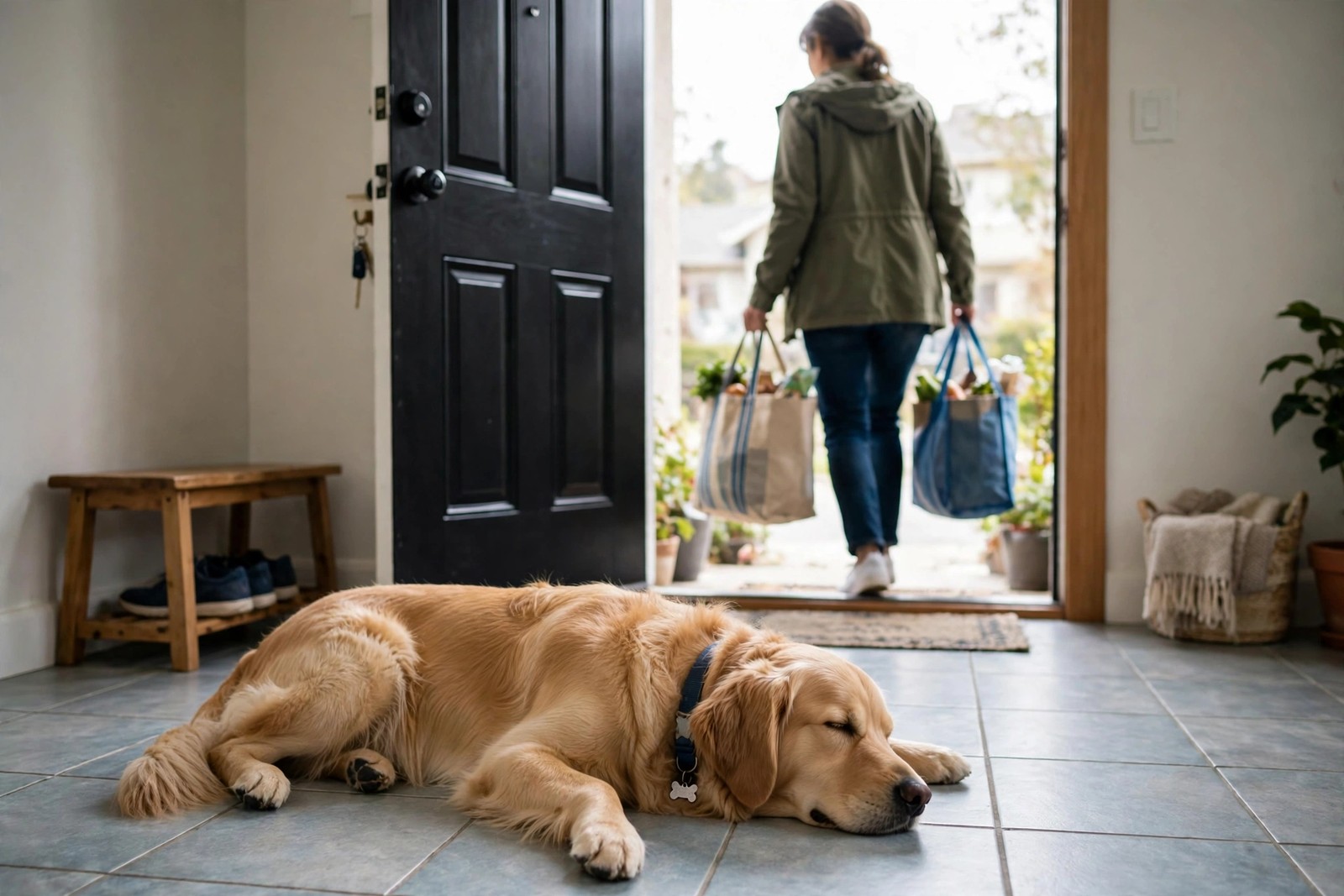
No, there is no safe “just a few minutes” for leaving your dog in a parked car. On a mild 75-degree day, the inside of a car can climb past 100 degrees in well under half an hour, and much of that rise happens in the first ten minutes — roughly the time a checkout line, a coffee order, or a quick pharmacy stop actually takes. Cracking the windows barely changes the outcome.
Why Cars Heat So Fast — and Why Dogs Suffer First
A car acts like a greenhouse. Sunlight streams through the glass, heats the seats and dashboard, and that heat has nowhere to go. Shade helps only a little and moves as the sun moves. A breeze outside does not ventilate a closed cabin inside.
Dogs are far more vulnerable to that trapped heat than people. They cool mainly by panting, they cannot open a door or call for help, and many will get anxious as well as hot — pacing, barking, and working themselves up, which generates even more heat. Puppies, seniors, flat-faced breeds like French Bulldogs and Pugs, overweight dogs, and dogs with thick coats are at the highest risk, but a healthy young retriever is not safe either. She is just slower to show it.
Every summer, dogs die in cars whose owners genuinely believed the errand would be short. The pattern is almost never cruelty; it is an ordinary delay — a slow register, a chatty neighbor, a prescription not ready — added to an already dangerous starting point.
“But I Left the Air Conditioning Running”
It is a better instinct, but it is not a guarantee. Cars stall, air conditioning fails, a dog can knock a control or step on a button, and in many places leaving a pet unattended in a vehicle carries legal consequences regardless of your setup. Remote-start systems time out. If your plan depends on a machine never failing while your dog is alone and locked in, the plan itself is fragile.
Also consider theft and escape: a visible dog in an idling car is a target, and a panicked dog can injure herself trying to get out through a cracked window.
The Safer Alternatives Are Mostly About Planning
The simplest rule works: if your dog cannot go inside with you, she stays home. Most dogs are genuinely happier napping in a cool house than waiting in a car, even if they love the ride itself.
When the day is more complicated, try:
- Split the trip — drop your dog home before the non-dog-friendly errands, or do those first
- Use curbside pickup, drive-throughs, or delivery for the stops where she cannot come in
- Bring a second person who stays with the dog outside, in shade, on a leash
- Choose dog-friendly stores and patios when you want her along, and call ahead to confirm
If you see someone else's dog in distress in a hot car, note the vehicle, try to have the owner paged in nearby stores, and contact local animal control or police — laws on intervening vary by place, so get authorities involved quickly.
Making the Stay-Home Plan Easy
Leaving your dog home works best when whoever is there knows the routine — when she ate, where her leash and water are, what door to use, and who to call with a question.
That handoff is exactly what KinsLe Care Pass is for: a temporary, scoped link that shares your dog's care needs with a trusted person, who needs no KinsLe account or app to view it. Care Pass on KinsLe keeps feeding times, leash details, and your emergency contact in one shared view for whoever stays behind, so the stay-home plan does not rely on memory alone.