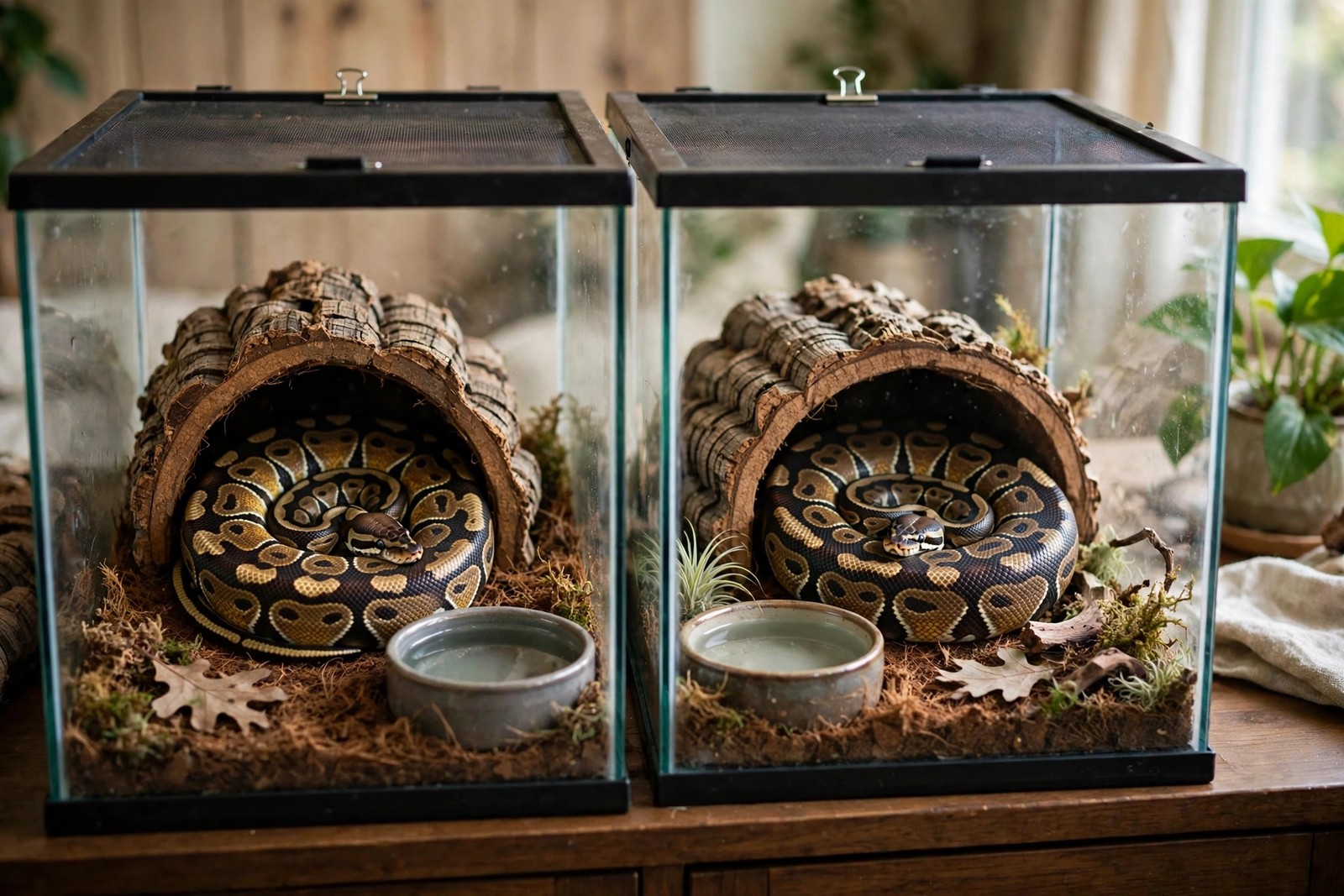
No. Housing two ball pythons together is one of the most common beginner mistakes, largely because the harm is quiet. There is usually no dramatic fight to warn you. Instead, one snake slowly eats worse, hides more, and loses condition while the other takes the good spots — and by the time the difference is visible, the stress has been running for months.
Solitary Is Their Normal
In the wild, ball pythons spend their days alone in burrows and termite mounds and encounter each other mainly to breed. Nothing in their behaviour is social: they do not groom each other, hunt together, or rest together for comfort. When two captive pythons coil in the same hide, each is trying to occupy the one spot with the right temperature and cover. The snake underneath is not being comforted; it is being displaced. Keepers call the subtle hierarchy that forms dominance, and its signs are easy to miss — one snake always in the warm hide, the other always at the cool end; one feeding confidently, the other starting to refuse.
Feeding Time Is Where It Turns Risky
Ball pythons hunt by scent. On feeding night, an enclosure full of rodent smell holds two aroused snakes, and one can strike at the other in mistake for prey, especially if both were offered food in the same space. Even without an injury, the bolder snake may take both rodents while the shyer one gets nothing, week after week. The shared tank spreads other problems just as efficiently: mites move freely between the two snakes, a respiratory infection in one becomes an infection in both, and regurgitated or abnormal droppings cannot be attributed to either animal, which makes a vet visit far less informative. There is also the pairing mistake — two snakes sold as the same sex sometimes are not, leaving an unprepared owner with eggs.
What Two Pythons Actually Need
Budget and build for two complete enclosures, each with its own warm and cool hides, thermostat-controlled heat, water bowl, and thermometer. That doubles equipment cost, and it is the honest price of owning two snakes. Feed each python inside its own enclosure and log meals separately, so a refusal pattern belongs to one named snake. If your pythons are already sharing, separate them promptly rather than waiting for a problem, watch both appetites and weights over the following weeks, and see a veterinarian who treats reptiles if either snake is losing weight or refusing persistently. Because two identical-looking routines are easy to cross, KinsLe's Family Sharing feature lets you share each python's own profile and feeding log with everyone who helps with care, keeping clear whose meal, shed, and enclosure a note belongs to.