
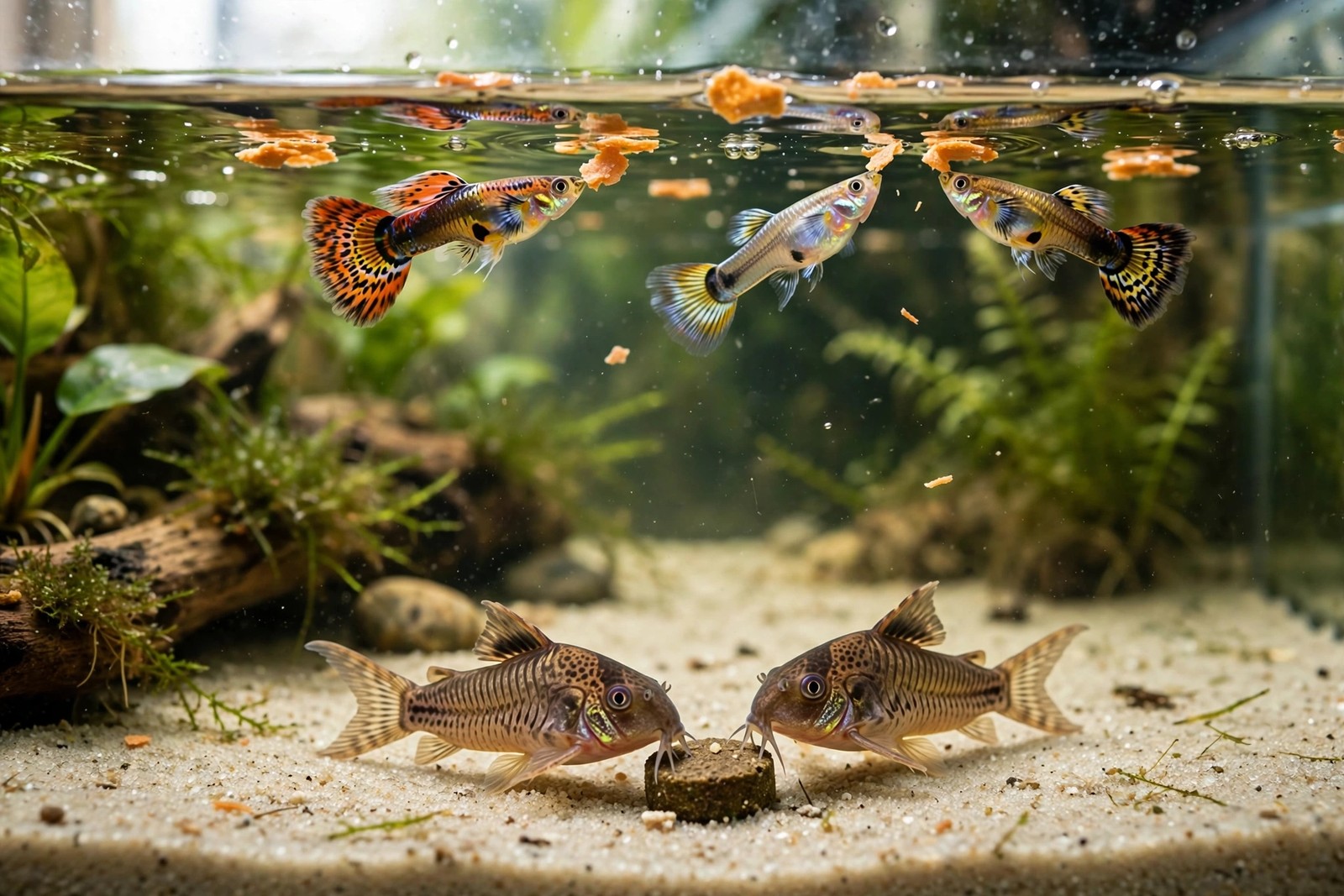
Not quite. A single food rarely serves every fish in a community tank well. Top swimmers like guppies and hatchetfish do best on flakes or small floating pellets they can grab from the surface, mid-water schoolers like tetras and rasboras take slow-sinking micro-pellets, and bottom dwellers like corydoras need sinking foods that actually reach them. One staple plus an occasional treat covers most mixed tanks, but matching food to feeding zone matters.
Feeding zones are feeding jobs
Think of your tank in three layers. The surface is where floating foods disappear fastest — hungry mid-water fish will often crowd upward and eat everything before it sinks. That is exactly why bottom feeders starve in mixed tanks fed only flakes: the top layer never lets food fall through. Feeding a sinking pellet or wafer specifically for the bottom, ideally after lights-out when shy species are braver, guarantees the lower layer actually gets fed. It is not extra generosity; it is basic distribution.
Herbivores, omnivores, and the protein question
Most community staples are omnivore mixes, but some species need targeted nutrition. Mollies and many livebearers graze on algae and vegetable matter in the wild and do better with flakes that include spirulina or vegetable content. Bottom feeders like corydoras and loaches are often assumed to be algae eaters, but most are primarily carnivorous scavengers — they need sinking foods with real protein, not algae wafers alone. A varied rotation — flakes, micro-pellets, sinking wafers, plus frozen daphnia or brine shrimp once or twice a week — covers nearly every community combination.
Watch for the food hogs
Even with the right foods, tank dynamics decide who eats. Bold livebearers and barbs will muscle shy species away from food; a large school of tiger barbs can leave quieter tank mates chronically underfed. Spread food across the surface instead of dropping it in one spot, feed the sinking food at the opposite end from the flakes, and drop a second sinking wafer if you have several bottom dwellers. If one species is consistently losing out, add a second feeding spot rather than more total food.
Treats are seasoning, not the meal
Frozen and freeze-dried treats — bloodworms, brine shrimp, daphnia — are excellent conditioners that bring out color and breeding condition, but they should stay occasional. Bloodworms in particular are rich and fatty; a steady diet can cause digestive problems in species not built for it. Treat day once or twice a week, in two-minute-rule portions like everything else. Daphnia doubles as a gentle laxative for constipated fish, which makes it a useful staple-sidekick for fancy goldfish and bettas.
Keep every species' menu on record
A mixed tank is a menu-management job, and memory is a poor filing system. KinsLe's Pet Passport lets you note each species' food, feeding quirks, and any sensitivities in the tank's records packet — so if a sitter, a housemate, or a future version of you needs to know that the corydoras get sinking pellets after lights-out, it is written down and shared with vets or sitters in one place.
Feed the tank in layers, vary the menu, and write it down — your whole community will show it. Pet Passport on KinsLe turns a layered feeding routine — floating flakes up top, sinking wafers after lights-out — into written directions a housemate can follow species by species.