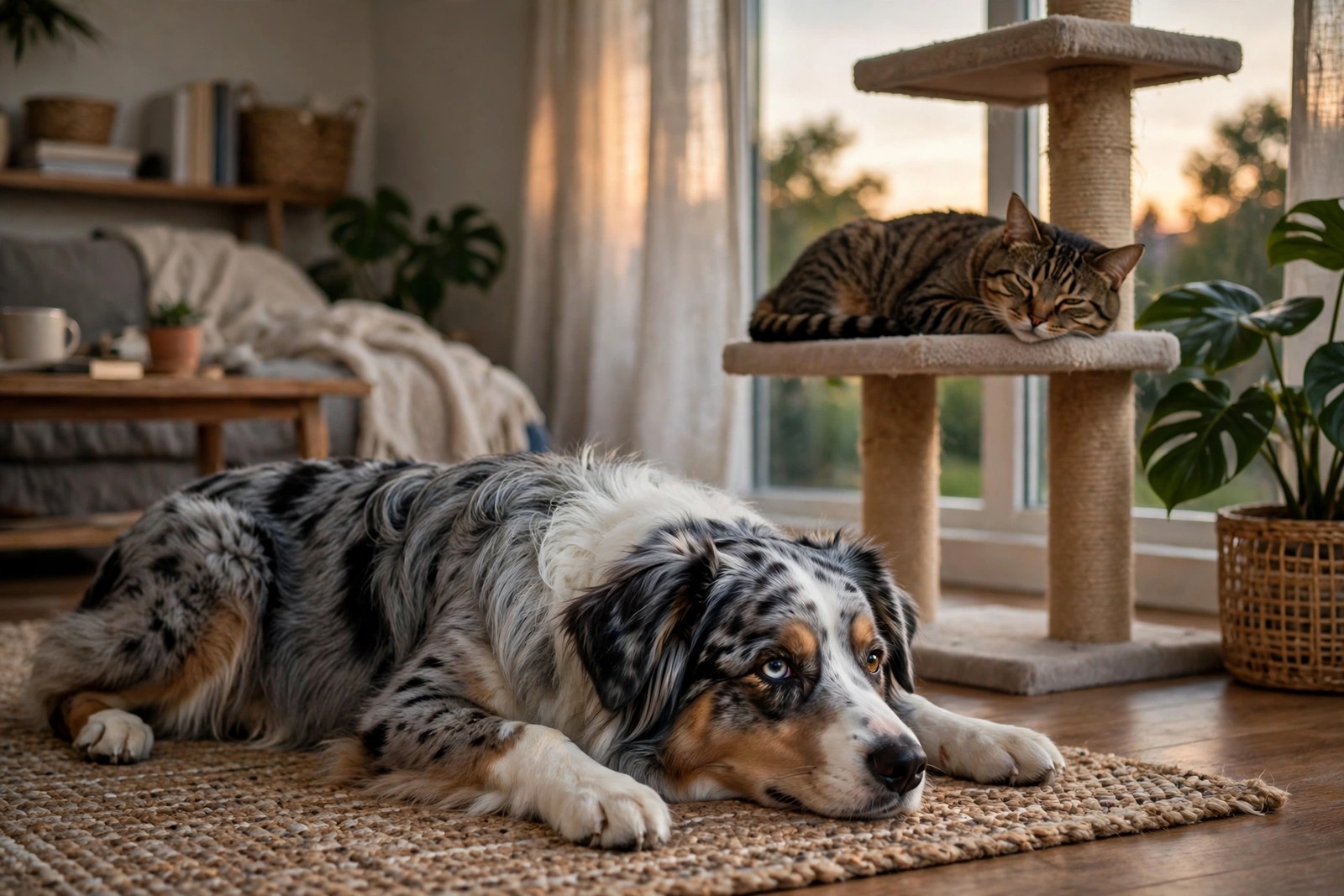
Australian Shepherds can be steady, affectionate housemates for cats, and many live peacefully with them for years. The breed was shaped to move livestock, though, and that wiring does not switch off in a living room. A cat who strolls is usually uninteresting; a cat who bolts can trigger the full herding sequence of hard staring, crouching, stalking and chasing. Success depends less on whether your Aussie likes the cat and more on whether you interrupt that sequence early and teach a different response to feline movement.
The Herding Instinct Is the Whole Issue
An Australian Shepherd controls stock with an intense, fixed stare trainers often call eye, followed by pressure: stepping toward the animal, circling to turn it, and sometimes nipping at heels to keep it moving. Directed at a cat, that behaviour is frightening even when no bite follows, and a cornered cat may slash at the dog's eyes. Watch for the early signals rather than the chase itself: freezing mid-stride, weight shifting forward, ears up, tail stilling, and a stare your dog will not break when you call his name. Those signs mean arousal is already too high for a useful meeting, so increase distance calmly instead of repeating cues louder.
An Introduction Built for a Herding Dog
Give your Aussie a proper outlet before every early meeting: a brisk walk, a fetch session in the garden, or ten minutes of scent games and known cues, so he arrives settled rather than loaded. Keep the first meetings behind a baby gate or a cracked door secured so it cannot swing wide, with the dog on a light leash and the cat free to approach, watch or leave. Reward every glance at the cat that turns back to you, every loose body and every settled lie-down.
Move to same-room meetings only when the gate sessions look boring, and keep the leash dragging so you can step on it if the stare locks in. Let the cat cross the room at her own pace; never carry her toward the dog or hold her in place for a sniff. If a chase does happen, separate them without drama, return to the barrier stage for several days, and make the next meeting shorter and farther apart.
Teaching Leave-It Around Movement
Leave-it for a herding dog has to work against motion, not just against a treat on the floor. Build it in stages: a still toy, a toy rolled slowly, then a person walking past, rewarding your dog generously for choosing you at each stage before you raise the difficulty. Add a recall away from exciting things outdoors, practised on a long line where a real chase cannot start. For a dog who winds up instead of settling, scent work and trick training are the safer outlets.
Living Together Day to Day
Set the house up so the cat never has to run the gauntlet: a gated room, high shelves or a cat tree, and a litter tray and feeding station the dog cannot reach. Feed the two apart, because an Aussie who would never chase the cat may still guard a bowl from her. Keep them separated when nobody is home until you have weeks of relaxed, uneventful time together, and supervise garden time too, since a cat sprinting for the fence is a stronger trigger than the same cat asleep indoors. Adolescent Aussies, roughly from six months to two years, often test rules they seemed to know, so expect to revisit the leash and barrier briefly during that stage rather than treating it as a failure.
Handled this way, many Aussies settle into an easy truce that warms into companionship, with the dog learning that the cat is family rather than a job. KinsLe's Care Teams keeps that shared routine honest, letting you assign supervised meetings, separate feeding and daily notes on staring or chasing to different family members, with every finished task marked complete with a timestamp.