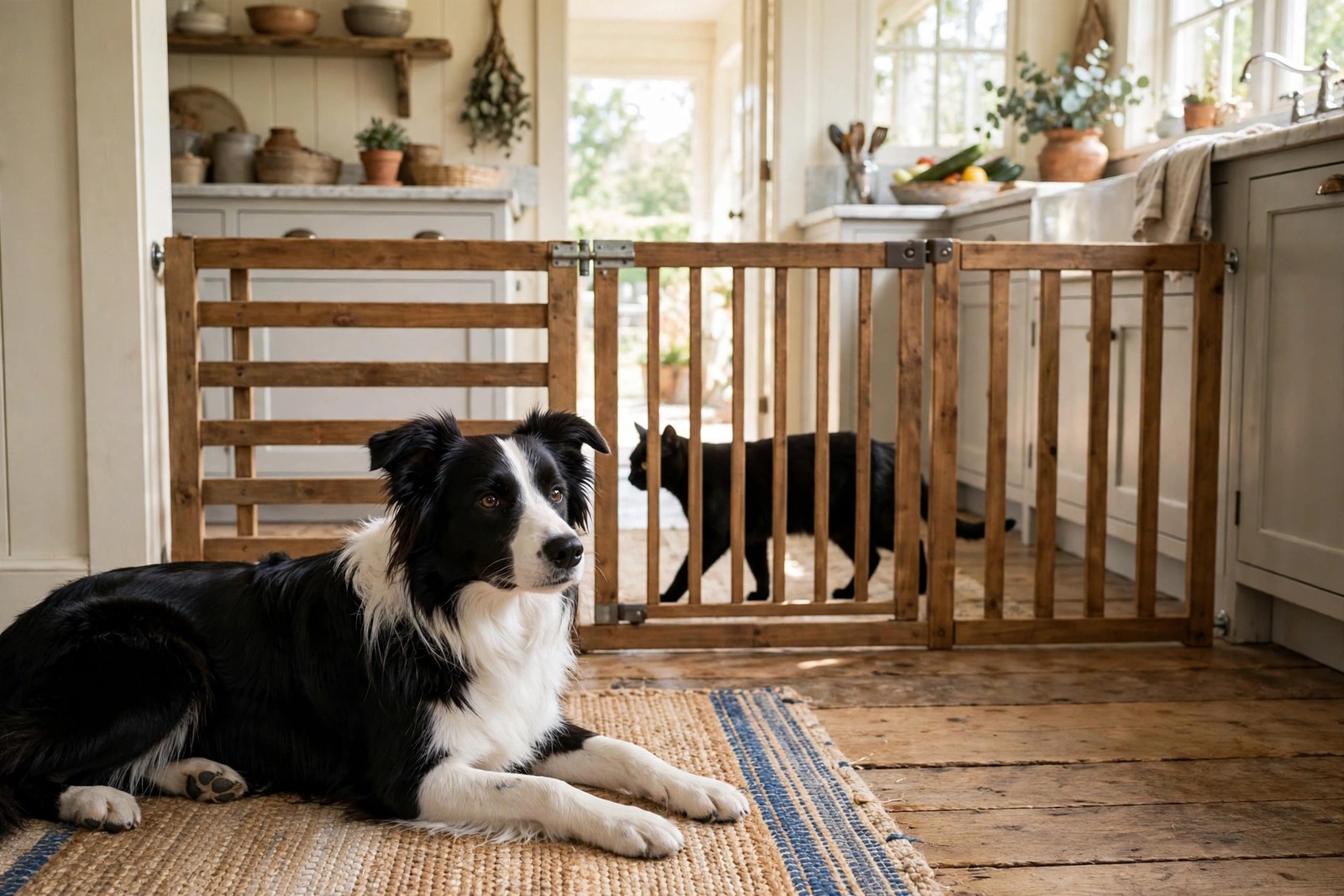
Border Collies and cats can and do share homes happily, but this is one of the pairings where the honest answer is: it depends on management. The Border Collie was bred to gather sheep over large distances using eye, stalking posture and precisely judged pressure, and the breed notices movement the way other dogs notice smells. Indoors, the movement on offer is often the cat: crossing the room, jumping off furniture, dashing up the stairs. A Collie who cannot switch that focus off will spend the day monitoring the cat, and a cat who is monitored all day is a stressed cat, whether or not a chase ever happens.
Reading a Collie Around a Cat
Learn the sequence in its mildest form, because intervention works early and fails late. It begins with orientation: head and ears turn, body goes still. Then comes the stare, hard and fixed, often with the head lowered. Next the crouch and the slow stalk, then an attempt to get around the side to turn the cat, and finally a chase if the cat runs. A dog showing soft, brief glances and then turning back to you is coping; a dog who freezes, lowers and cannot answer his name is already over threshold, and the meeting should end with distance, not with a scolding.
Mental exercise matters enormously for this breed: a Collie whose brain has been used on scent games, trick training or obedience practise rests far more easily beside a cat than one who has only been walked.
An Introduction That Respects the Trigger
Exercise your dog and give him a training session before early meetings, so he meets the cat in a settled state. Begin behind a secure barrier, with the dog on a leash, at whatever distance lets him notice the cat and still take treats and respond to cues. Reward disengagement specifically: the look away, the turn of the head, the choice to lie down. Keep sessions brief and finish before arousal builds.
Progress to same-room meetings with a trailing long line you can step on, and position yourself between the dog and the cat's escape route so the cat never has to run past the dog to leave. If a chase happens, go back to barrier work for several days and increase distance when you restart.
Outlets and Rules That Make It Sustainable
Give the herding drive a legal job. Structured games with a clear start and stop, such as fetching with a steadiness rule, tug with a reliable drop, scent searches and scatter feeding, all let a Collie use his brain and body without rehearsing control of the cat. Teach a rock-solid settle on a bed or mat and pay it well, because a dog who can hold a settled position while the cat moves around the room has a practical alternative to stalking.
At home, protect the cat's geography permanently: a dog-free room behind a gate, high routes across busy rooms, and feeding and litter stations the dog cannot enter. Feed the animals apart, since a Collie guarding a bowl is a separate problem from herding, and keep them apart when the house is empty until you have a long, boring history of calm, including during the dog's adolescence, when previously solid behaviour often unravels for a few months.
Knowing When to Get Help
Persistent hard staring that you cannot interrupt, repeated chasing, or nipping at the cat's heels means the dog is practising exactly what you need to prevent, so pause introductions and bring in a qualified behaviour professional; a vet check is also worthwhile if the fixation appeared suddenly, since pain and illness can lower a dog's tolerance sharply.
The households that succeed with this pairing tend to be the ones where every person enforces the same distances, the same cues and the same quiet endings to sessions. KinsLe's Care Teams supports that shared discipline, letting you assign barrier sessions, pre-meeting exercise and daily training practice to different family members, with every completed task marked complete with a timestamp.