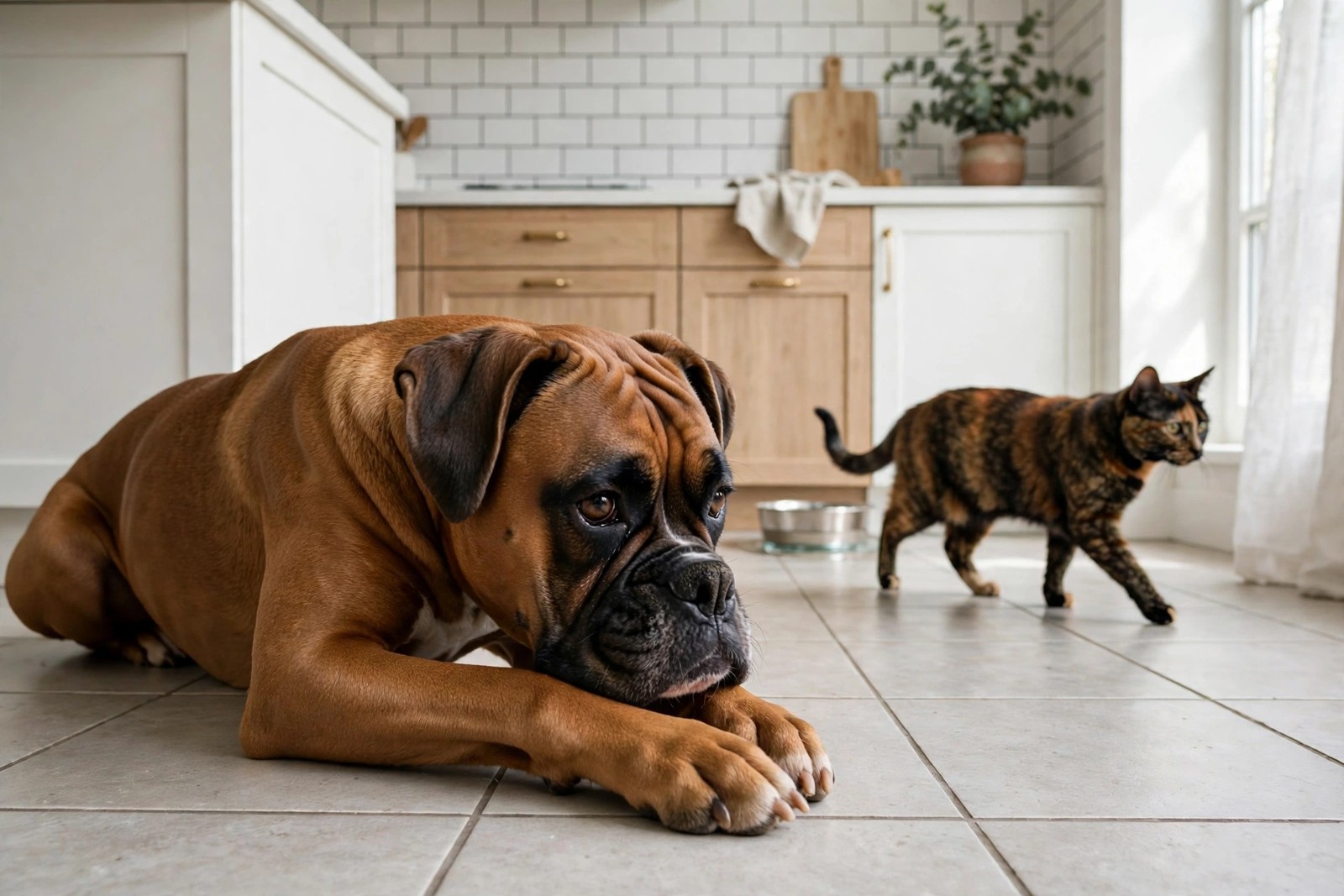
Boxers and cats can be a genuinely happy pairing, and many Boxers live as devoted companions to the household cat, washing her face and sleeping curled around her. What the pairing has to survive is the Boxer's youth: this breed matures slowly, plays at full volume and uses its front paws like a boxer in the ring, batting, swatting and bouncing on the spot. None of that is aggression, but a cat does not grade intentions; she grades impact, and a paw swipe or a joyful body slam from a dog several times her weight can injure or terrify her.
The Real Risk: Arousal, Size and Those Paws
Watch arousal, not friendliness. A Boxer who is whining, quivering and pulling toward the cat with a high, fast-wagging tail is not being sociable; he is over threshold, and over-threshold play tips easily into chasing and grabbing. Loose, wiggly movement, play bows followed by pauses, and a dog who can look away and take a treat are the signs of a meeting that is going well. Boxers also run hot during excitement because of their shortened muzzle, so in warm weather a play session should end early, while the dog is still able to listen.
A confident, dog-savvy cat often does well with a Boxer, holding her ground and using height. A nervous cat who runs at every bounce is the hard match, because running invites pursuit even from a dog who was only playing a second earlier.
Introductions for a Dog This Physical
Tire the dog out first with a walk and some training, then meet through a sturdy gate, because a Boxer can shoulder a flimsy barrier aside without noticing. Keep him on a leash, reward calm behaviour and every voluntary look away from the cat, and keep sessions short enough to end while he is still composed. Let the cat approach or leave freely, and never let the dog rush the gate to greet her nose to nose.
In the same room, use a trailing house line you can step on, and build in pauses: call the dog away every minute or so at first, reward him, let his arousal fall, then release him again. Teach a settle on a mat as a separate skill and pay it generously, since a Boxer who will lie on his mat while the cat crosses the room has a job that competes with bouncing after her. If he does chase, separate them calmly and return to barrier sessions for several days; repeated chases teach the dog that chasing is the game, and teach the cat that the dog is unsafe.
Rules That Protect the Cat Long Term
Feed the two apart and keep the cat's food and litter tray somewhere the dog cannot enter. Give the cat vertical territory, shelves, a tall tree and a gated room, because height is how a cat opts out of a game without leaving the household's shared spaces. Keep the pair separated when nobody is home until you have a long run of dull, relaxed days.
Teach everyone in the house, children included, not to wind the dog up around the cat: no rough games in her room, and never pick the cat up and present her to the dog for a sniff.
What Success Looks Like
A settled Boxer and cat usually reach a warm arrangement: shared sunny spots, supervised play the cat can leave at will, and a dog who has learned to be gentle on purpose, lowering himself and softening his paws around her. If your Boxer still cannot disengage after several weeks of gradual work, or fixates silently rather than bouncing, ask a qualified behaviour professional for help.
None of that consistency happens by accident in a busy house, where different people supervise at different times of day. KinsLe's Care Teams lets you assign the barrier sessions, the mat practice and the separate feeding to named family members, with every completed task marked complete with a timestamp.