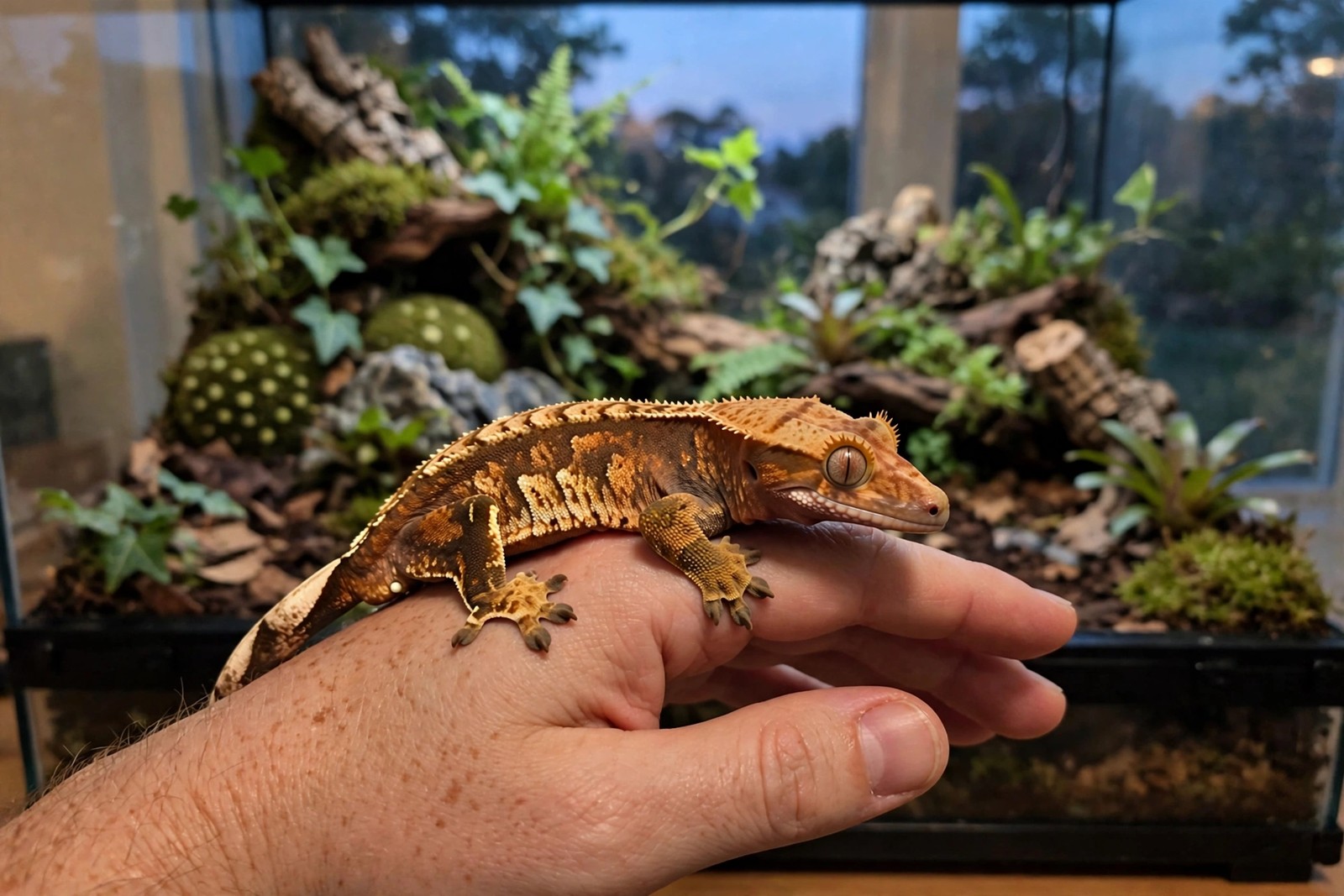
A crested gecko will never greet you like a dog, and it does not need to. What these nocturnal climbers offer instead is a quieter kind of recognition, earned over weeks: the gecko that once leapt away from the opening door now steps onto your hand, tastes your skin with a slow flick of its tongue, and settles. Nothing about that change is accidental. It is learning, built from what a gecko's senses actually gather — smell and taste, vibration, timing, and the memory of every previous handling session. Understanding the machinery helps you work with it instead of wondering why progress feels slow.
Scent, Taste, and the Feeding Connection
A crested gecko reads the world largely through its tongue. Those constant little licks are sampling scent molecules from the air and from your skin, and over repeated sessions your scent becomes catalogued as familiar and safe. Feeding welds the association in place. The gecko connects the keeper's arrival, usually at dusk, with the cup of food or the tongs appearing, and many keepers notice their gecko waiting near the door at the usual hour on feeding evenings. Voice matters less than owners hope, since geckos respond mainly to low vibration and movement, but a consistent approach — same door opened slowly, same calm movements — becomes part of the recognised pattern. Scented hand creams can muddy the picture, so keepers wash with plain soap before handling.
Signs Yours Is Getting Comfortable
Progress shows in small behaviours rather than big ones. A gecko that knows its handler startles less when the enclosure opens, walks hand over hand in an unhurried way instead of firing itself into the air, and may lick your fingers calmly while it decides what you are. Eating food offered by hand, or eating soon after a session instead of refusing for the evening, is another good sign. So is appearing near the front glass in the evening rather than spending every hour pressed behind foliage. None of this arrives on a schedule. Youngsters are usually flightier than adults, some individuals stay jumpy for months before softening, and a setback after a house move or a clumsy grab is normal rather than final. Measure the trend across a month, not across a single evening.
Handling Habits That Build Trust
Handle in the evening, when the gecko is waking up anyway, rather than dragging it from daytime sleep. Scoop from below and let the gecko walk onto your hand; a hand descending from above looks like a predator and undoes good work. Keep sessions short and frequent — ten or fifteen unhurried minutes, several evenings a week, teach more than one long session that ends in exhaustion. Work low over a bed or sofa, because even a confident gecko can leap without warning, and never pull a gecko off glass or bark by its tail, since a dropped tail does not grow back. End while things are calm, and watch for the signals that say enough: frantic jumping, squeaking or chirping, and gaping all mean the session should finish.
The Keeper Is Part of the Enclosure
Familiarity also depends on how predictable the gecko's wider life is. A gecko kept at steady temperatures, misted on a rhythm, and fed by the same small circle of people settles faster than one whose care changes hands and times daily. If your household shares the work, keep the routine identical whoever does it: same feeding evenings, same misting pattern, same gentle approach. Notes matter here more than memory, because the gecko experiences the routine, not your intentions. A shared record of feeds, sheds, and handling sessions also makes the slow trend in behaviour visible to you. Kept steadily, that rota is simple to run through KinsLe, where Care Teams logs each misting and feed against the person who did it.