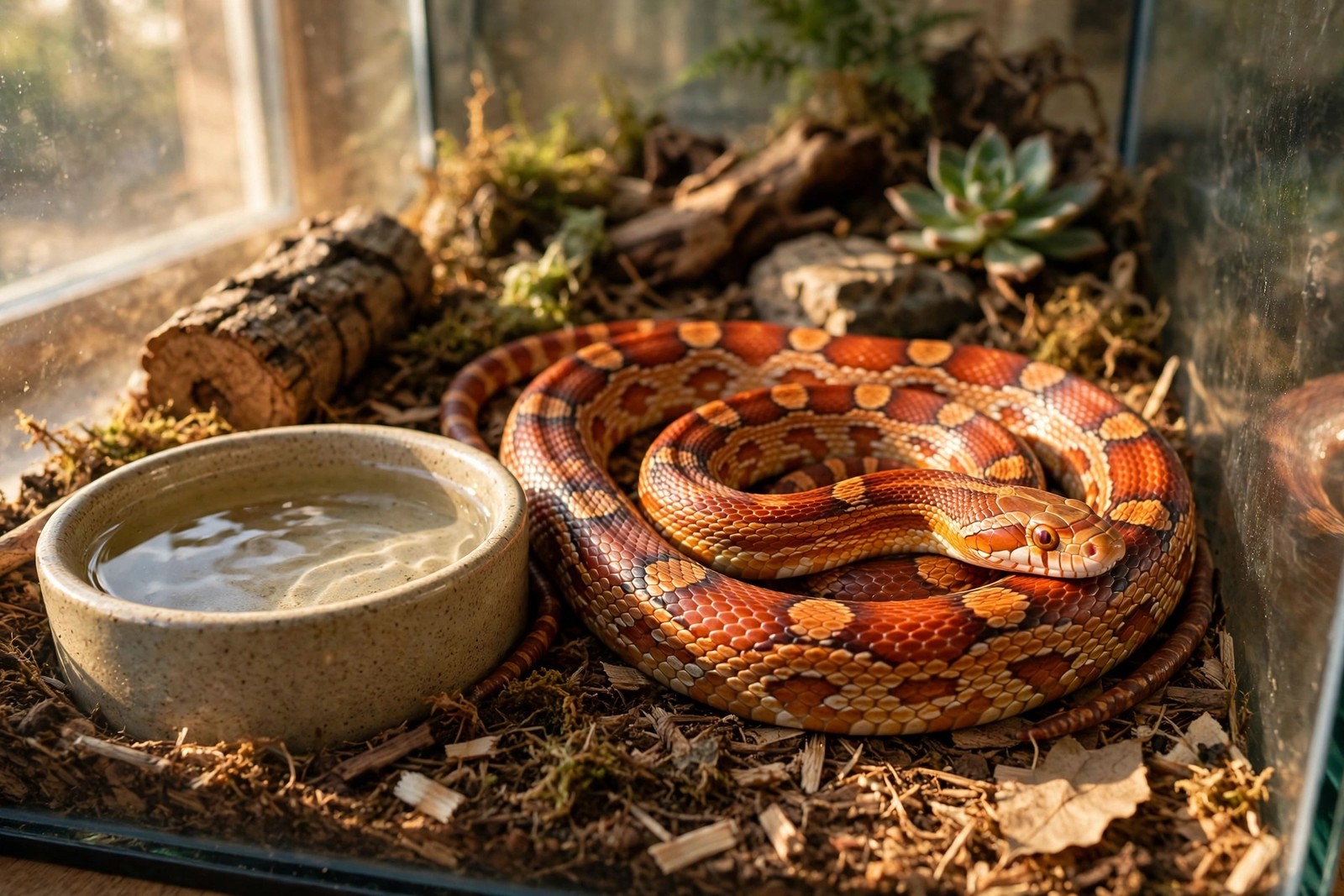
Yes — a healthy older snake eating less often is usually a snake doing exactly what its life stage calls for. Feeding frequency in snakes is driven mostly by growth. A hatchling or juvenile is building body at speed and may feed every five to seven days; a subadult slows; and a mature snake, whose length has levelled off and whose breeding and roaming may also ease with age, needs food only for maintenance. Energy in, for a sedentary ambush hunter with a slow metabolism, goes a long way, so the keeper's job shifts from feeding often to feeding appropriately, which almost always means less frequently than in the snake's youth.
How the Gaps Actually Lengthen
There is no single senior schedule, because species and size set the baseline: a mature corn snake might move from a mouse every week in its youth to one every ten to fourteen days, while a heavy-bodied adult python that once fed fortnightly may do well on a suitably sized meal every three to four weeks. The method matters more than the numbers. Stretch the interval gradually, hold the prey size steady and appropriate — roughly the width of the snake's thickest point is the usual keeper's guide — and judge the result on the snake, not the diary. Many keepers also notice seasonal patterns persisting into old age, with appetites dipping in cooler months or around breeding season even in snakes that have never bred.
Body Condition Is the Real Gauge
An older snake should feel firm and smoothly rounded in cross-section, with the spine neither sharp and tented, which signals a snake too thin, nor buried under soft rolls with stretched, separated scales along the sides, which signals obesity — a genuinely common and lifespan-shortening problem in well-loved pet snakes fed on a juvenile rhythm into adulthood. Weigh your snake every month or two and note the trend alongside each feed, shed, and refusal. A stable weight on lengthening gaps means the new rhythm suits the snake; a steady slide downward on the same rhythm means the gaps have stretched too far, the prey is too small, or something medical is brewing underneath.
Refusals: Normal Fast or Warning Sign
Snakes fast for ordinary reasons at any age: an approaching shed, when the eyes cloud and most snakes want only to be left alone, a cool spell, or simple lack of hunger after a large meal. In a senior, a refusal earns more scrutiny rather than less. Check the enclosure numbers first, because a failed heat source or a drifted thermostat quietly suppresses appetite in an animal who cannot tell you it is cold. Then look at the snake: mouth held slightly open, mucus, wheezing, a lumpy or thinning mid-body, or weight falling away across two or three refused meals all move the situation out of patience territory and into a reptile vet visit, since older snakes have less reserve to spend while you wait.
The difference between a comfortable senior fast and a decline is written in records, and memory alone blurs feeds, sheds, and weights together within a few months. KinsLe Pet Passport gives that history a home, keeping each feed date, prey size, shed, and weigh-in together in one portable packet, so when you sit with a reptile vet you can show exactly how your older snake's appetite has changed instead of guessing.