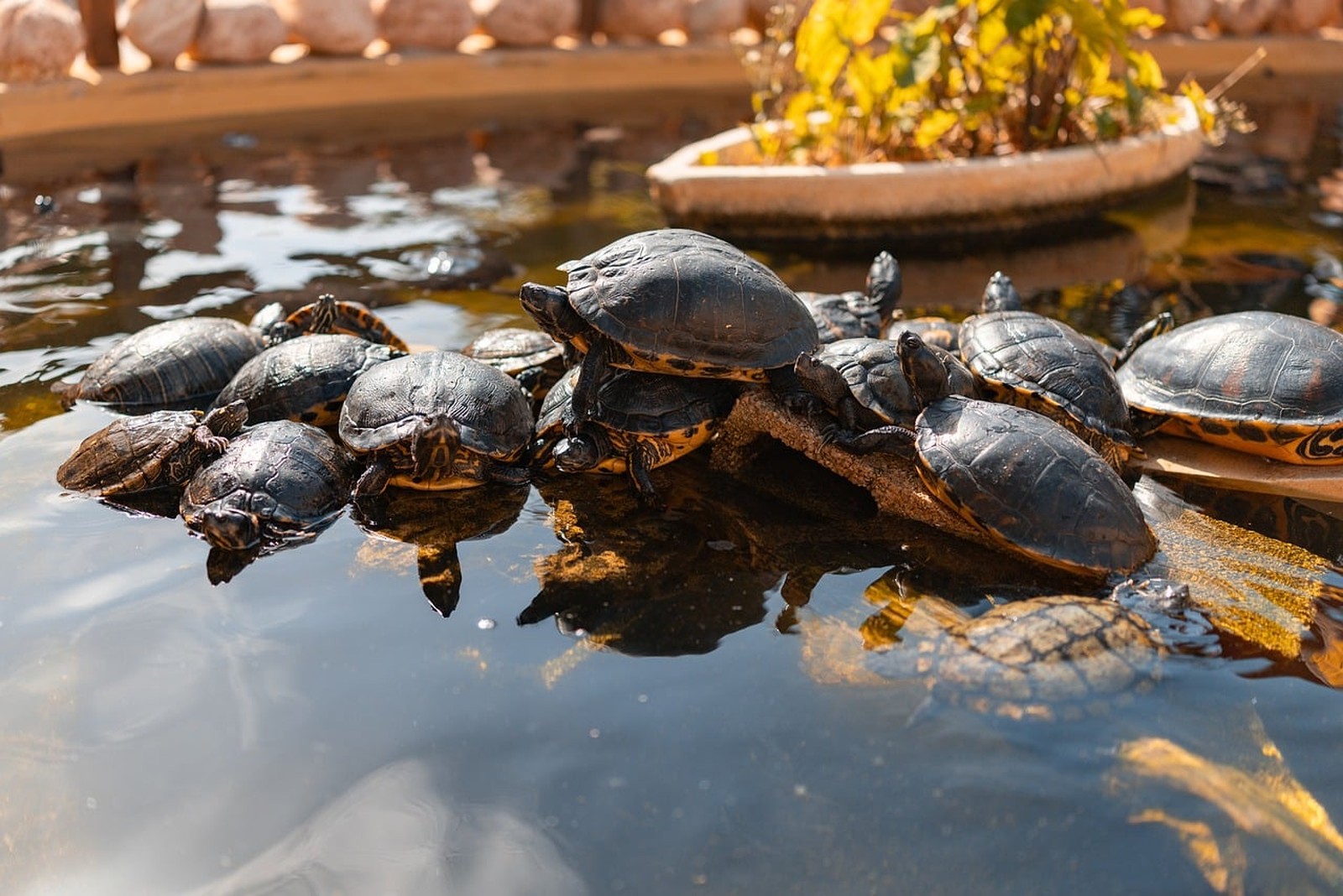
Watch red-eared sliders in a pond and the pattern explains itself: for hours of the day they haul out onto logs and banks and sit in the sun, stacked, stretched, and completely dry. A tank has to recreate that shoreline, because a slider that can never leave the water is missing something as basic as food. Basking is how this turtle regulates its temperature, maintains its shell, and processes the minerals that keep its skeleton hard. Owners sometimes treat the platform as decoration; it deserves the opposite priority. The dry spot is life support, and everything else in the setup works around it.
Why Drying Out Matters So Much
A slider is cold-blooded, so the warmth it basks in sets the speed of everything else: appetite, digestion, immune response, and activity. A turtle that cannot warm up properly often will not eat properly either. Drying is the second half of the job. A shell and skin that stay permanently wet invite the fungal and bacterial growth behind shell rot, and regular complete drying is the straightforward defence a keeper can provide. The third strand is light. Under a proper UVB lamp, a basking slider makes the vitamin D its body uses to take up calcium, and without that cycle the bones and shell slowly soften in the condition keepers call metabolic bone disease.
Building a Spot a Slider Can Actually Use
The platform must sit entirely out of the water, large enough for the whole turtle, shell and tail, to sit on it dry. Texture matters: a surface with some grip stays usable when wet, while smooth plastic can defeat a heavy turtle. Access decides whether the spot gets used at all, so give the ramp a gentle slope and a surface the claws can bite into, and watch your slider climb it rather than assuming it can. Floating docks suit youngsters but can sink or tilt under a large adult, and a big slider needs a fixed, firmly supported platform instead. Position the basking area at one end of the tank so the water offers a genuine gradient, warm at the basking end and cooler at the far end, and check that the turtle can also choose shade and deeper water after warming up.
Heat, Light, and Typical Ranges
Aim, as general husbandry guidance, for a basking surface around 85 to 95 degrees Fahrenheit measured where the turtle actually sits, with the water cooler, typically in the mid-70s to low 80s. Measure at shell height on the platform itself, because the air temperature across the room tells you almost nothing. The UVB lamp belongs directly over the basking spot, close enough to work at the maker's stated distance, and it needs replacing on the maker's rhythm even while it still glows, since UVB output fades long before the visible light does. Then watch the animal rather than the dials: a slider that basks for solid stretches, eats eagerly, and slides back into the water to swim is telling you the gradient is working.
When a Slider Will Not Bask
A turtle that suddenly avoids a spot it used daily is giving you information. Check the simple causes first: a basking zone drifted too cool or hot, a shifted ramp, an aged lamp. Constant basking has a message too, and often points to water that has become too cold. Bullying matters in shared tanks, where one turtle can guard the platform and keep another in the water all day. What should not be troubleshot at home is a slider that will not bask alongside swollen or closed eyes, discharge, soft spots on the shell, or a loss of appetite, because that combination belongs in front of a reptile vet rather than in another week of home adjustment. Setup notes shared by the whole household make those patterns easier to spot early, and KinsLe's Family Sharing holds the lamp dates and temperature readings together for everyone who checks the tank.