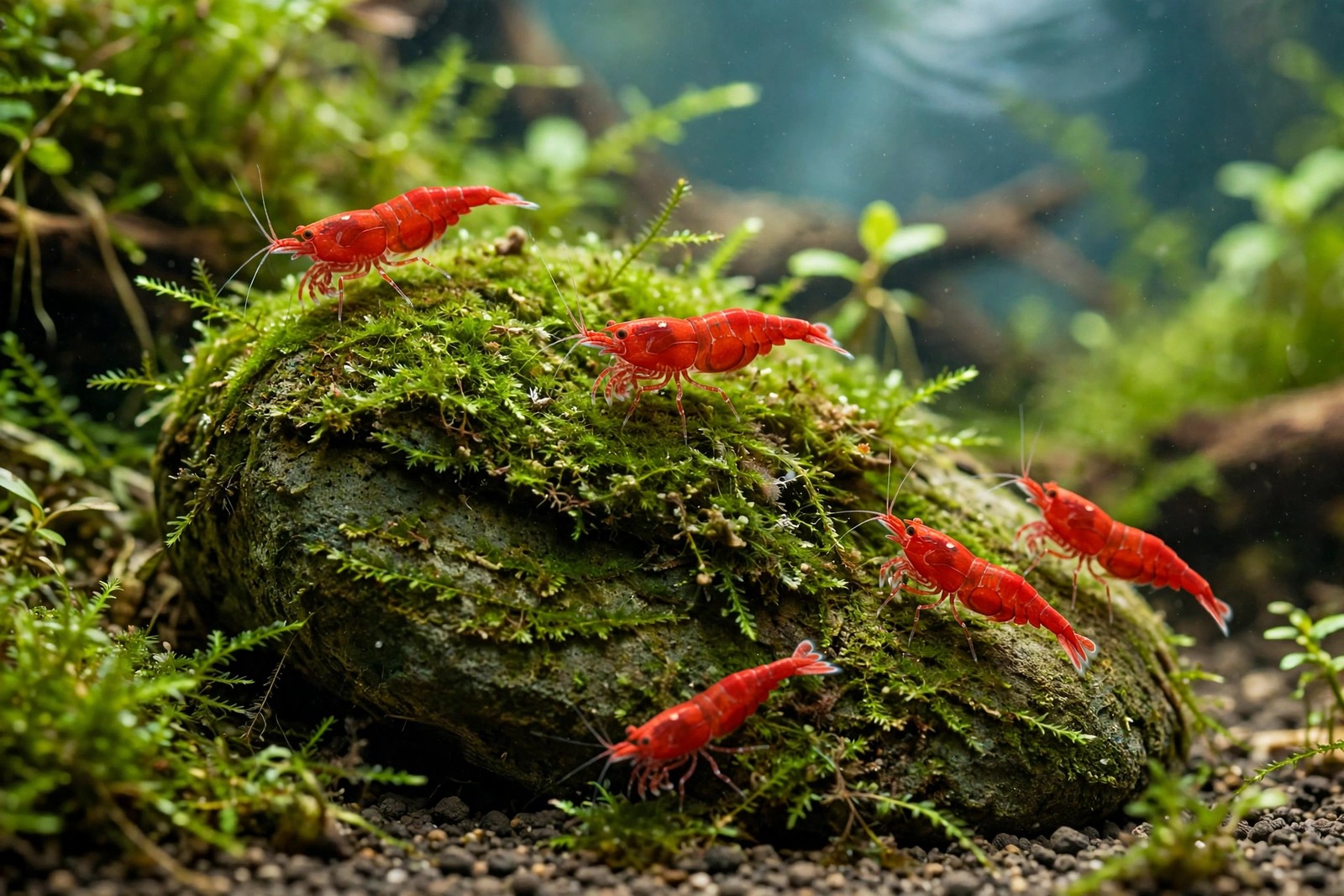
Shrimp are grazers and scavengers by trade. Left to themselves, a colony spends the day wandering from leaf to stone to sponge filter, picking constantly at surfaces with their small claws and eating whatever the surfaces offer. That habit makes new keepers ask whether the tank feeds the shrimp by itself, and the plain answer is that a mature tank does part of the job while rarely doing all of it. What shrimp need is food shaped for grazers: a base to pick at all day, a staple that reaches the bottom, and minerals to rebuild a shell several times a year.
The Base Layer: Algae and Biofilm
The real first course in a shrimp tank is biofilm, the thin living layer of algae, bacteria, and microscopic life that coats plants, wood, rocks, and filter sponges. Shrimp graze it hour by hour, which is why a colony in a settled tank stays busy even on days when no food goes in. This is also why brand-new tanks are hard on shrimp: the surfaces are clean, the grazing is thin, and the colony feels it within weeks. Driftwood, leaf litter, mosses, and a sponge filter all add grazing area worth arranging before the shrimp arrive.
A Staple That Actually Reaches Them
The staple to add is a sinking food made for shrimp: small pellets or wafers formulated for bottom grazers, which land on the substrate and stay there while the colony gathers. Ordinary fish flakes fail shrimp in a shared tank because fish take them at the surface long before anything drifts down. Feed the staple in a small glass dish on the substrate if you can, because a dish shows you exactly how much was eaten and lets you lift leftovers out cleanly. Portions stay tiny. A small colony may need only a pellet or two, a few times a week, adjusted by how fast the dish empties and whether the grazing in the tank is rich or thin. Food that vanishes within a couple of hours is about right; food still sitting there much later was too much.
Vegetables, Leaves, and Calcium for Moulting
Variety covers the gaps the staple misses. Blanched vegetables — a slice of zucchini, a spinach leaf, a piece of green bean, softened briefly in hot water so it sinks — are grazed eagerly and give plant matter the colony would otherwise take from your plants. Dried leaves added to the tank serve twice, feeding shrimp directly as they soften and growing biofilm on their surfaces. Calcium deserves its own mention because moulting is the defining event of a shrimp's life. Each shrimp sheds its whole shell to grow, and the new shell must harden from minerals in its food and water. Mineral-rich shrimp foods and a small piece of cuttlebone in the tank are common ways keepers keep calcium available. A shrimp that repeatedly fails to shed cleanly is often a signal to review feeding and water minerals with an aquatic specialist rather than feeding more.
The Overfeeding Trap
More shrimp die from kindness than from hunger. Their stomachs are tiny, a colony eats far less than it appears to, and every surplus pellet rots in a tank whose residents are unusually sensitive to ammonia and sudden water changes. Excess food also feeds the things you did not invite: planaria, nuisance snails, and cloudy bacterial blooms all thrive on a generous feeding hand. The working rule is to feed less than looks right, take uneaten food back out after a couple of hours, and let grazing fill the genuine gaps. Babies need no special meals in a mature tank, since they feed on the same biofilm their parents do. A light, written rota protects the colony from double feeds on busy days, and that rota runs neatly through KinsLe, where Care Teams shows at a glance who has fed the shrimp and who has not.