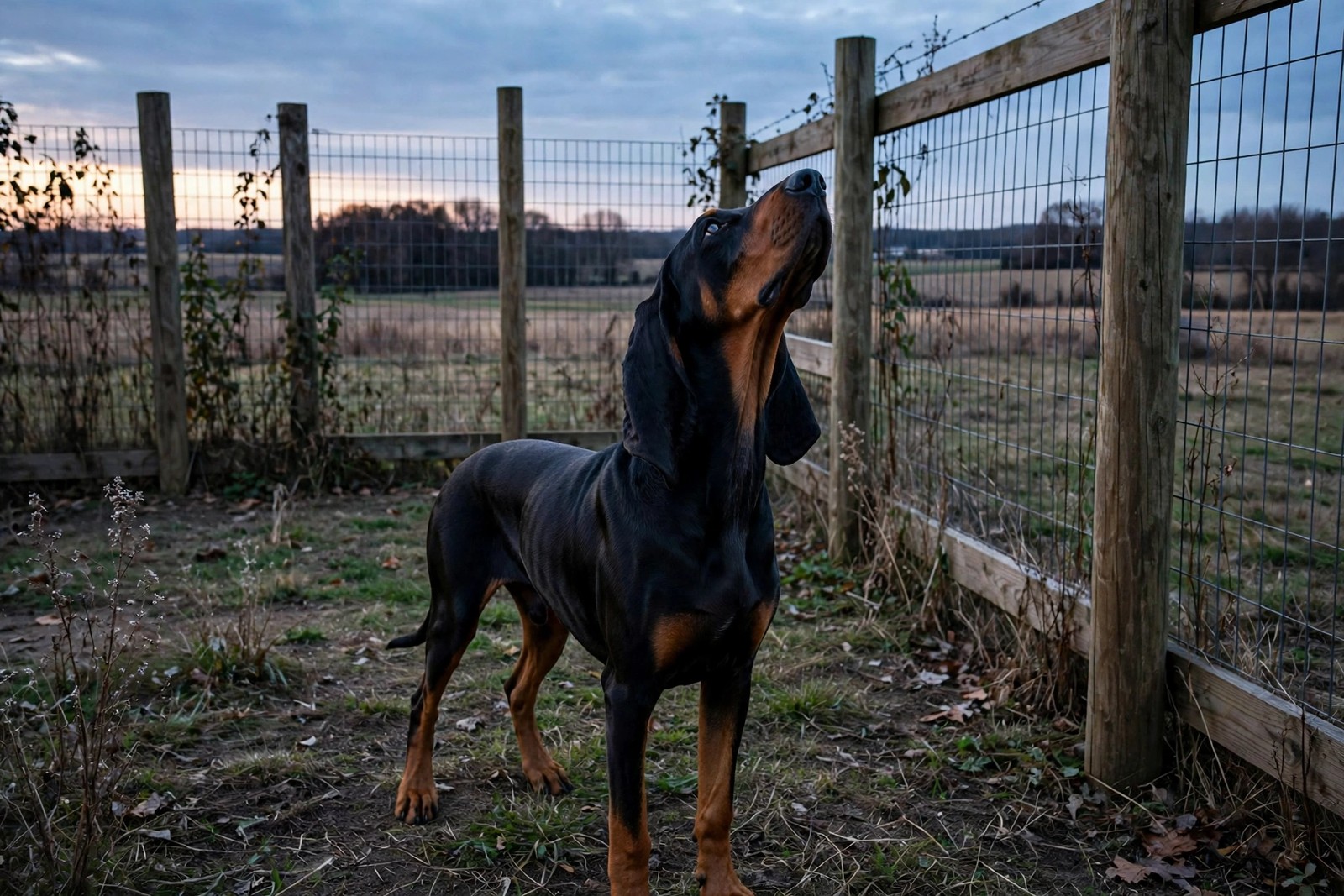
The nose makes the decision
Yes, emphatically. The Black and Tan Coonhound was bred to trail raccoons over rough country at night, working independently of the hunter and announcing progress in a carrying bay. That heritage lives in the pet dog intact: an interesting scent is not a temptation to a coonhound, it is an assignment. Once the nose engages, the dog's awareness narrows to the line of the trail — traffic, fences that can be scrambled, and your voice all recede. No amount of general obedience changes the wiring, which is why the physical barrier, not the dog's intentions, has to carry the safety plan for this breed.
How coonhounds actually get out
Most lost coonhounds were not badly fenced; they were fenced for an ordinary dog. This is a tall, powerful athlete that can clear or climb more than owners expect, push through a gate that flexes, and dig with real purpose at a promising smell on the far side. Scent comes over, under, and through a fence — a raccoon or cat passing at night paints an invitation across the yard, and a bored coonhound left out alone will work the perimeter systematically. The breed's voice is a clue and a warning: a dog baying at one spot on the line has found the weak point before you have.
Fencing for a trail hound
Build for height and for a dog that pushes and digs: a tall fence with no cross-rails on the inside to serve as steps, gates that close firmly against a heavy shoulder, and a bottom edge secured so a determined digger meets resistance rather than soft soil. Clear anything stackable away from the boundary, and bring the dog in when wildlife activity peaks after dark rather than leaving the yard to become a scent trap. Inside, give the nose legal work — scattered food hunts, tracking games laid across the lawn, and long sniffy walks — because a coonhound whose nose is fed at home tests the fence with far less conviction.
Leash rules for a dog bred to range
Off leash, a pet coonhound belongs in genuinely enclosed spaces only; open countryside, however empty it looks, is exactly where this breed was designed to disappear over the horizon following a line. A long line preserves the ranging experience on hikes while keeping you attached to the dog's decisions. Train recall realistically — reward it richly, use it for games, but never test it against a live trail as proof of training. At home, make gate discipline a household habit: this is a dog that will take an open gate as a starting whistle, politely and at speed.
A baying dog is easy to hear, hard to catch
The coonhound's voice helps finders locate it, but a dog on a trail does not stop for strangers, so sightings phoned in quickly are what shorten a search. Keep collar identification current, photograph the dog's markings, and know the direction it usually heads from your gate. When minutes matter, KinsLe's Lost Pet Alert System sends a free alert to nearby Circle of Love members and opens a direct message path from a finder to you, turning a neighbour who heard that unmistakable bay into your fastest route home.