
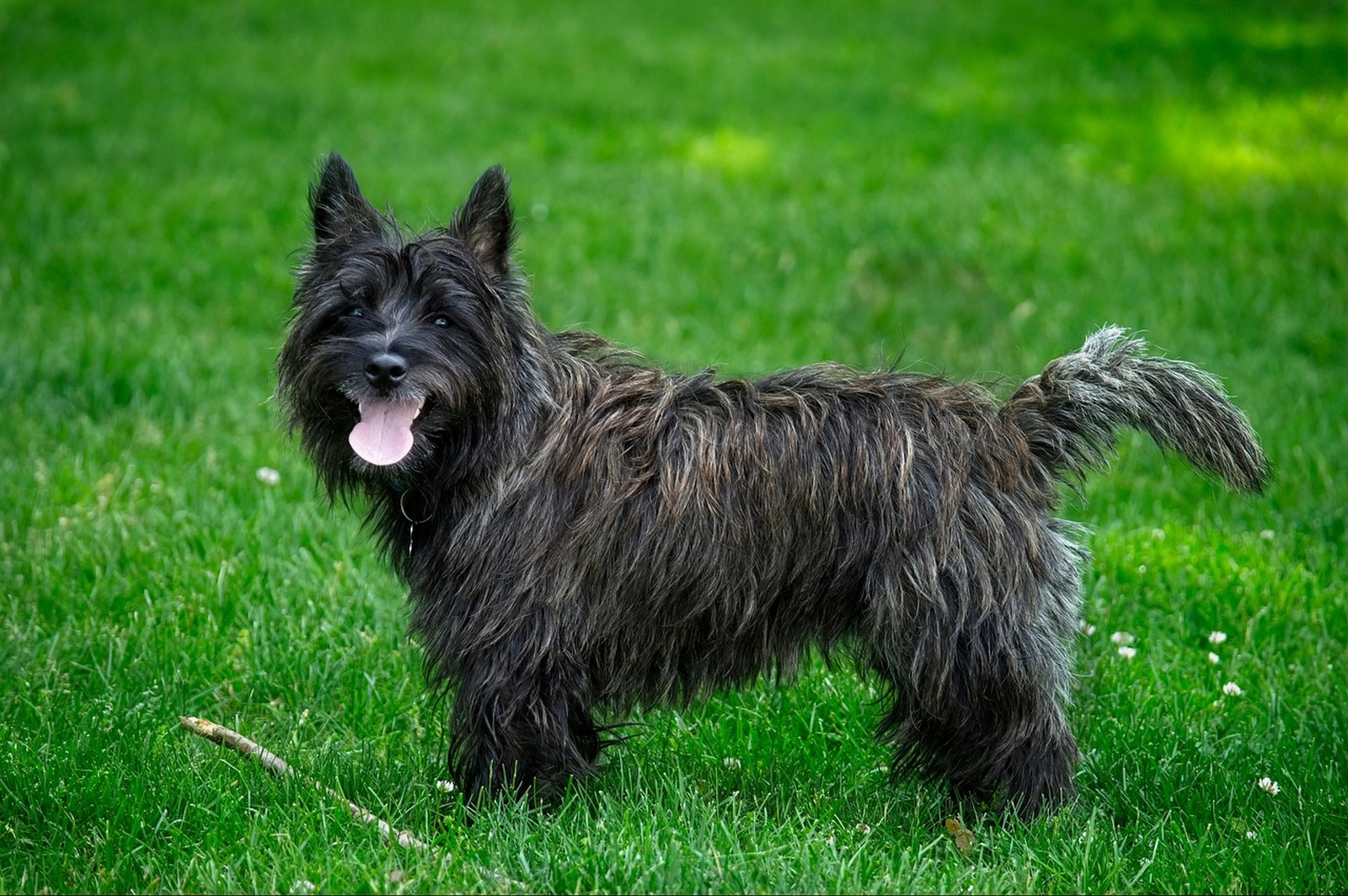
Short answer: yes, and the bottom of the fence matters most
A Cairn Terrier does need a securely fenced yard to stay safe, and with this breed the weak point is rarely the top rail. Cairns are compact, sturdy terriers developed in the Scottish Highlands to work in cairns — piles of rock — flushing out foxes, badgers, and other vermin. That history produced a dog who is fearless for his size, curious about anything moving at ground level, and remarkably good with his paws. Give him a loose board, a gap under a gate, or soft soil along the fence line, and he will treat it as a job to finish.
Unlike a tall, athletic breed, a Cairn is unlikely to clear a standard fence in one leap. His escape routes are lower and slower: digging at the base, widening a gap between boards, or following a chipmunk through an opening you barely noticed. Security for a Cairn therefore means thinking like a small digger, not like a jumper.
Why a Cairn tests boundaries
Prey drive sits at the center of the problem. A rabbit crossing the next yard, a squirrel on the fence, or a mouse in the woodpile can switch a Cairn from relaxed to fully committed in a second, and a terrier in chase mode is famously deaf to recall. Cairns were selected to pursue quarry underground and to keep working independently, so persistence is part of the package — a dog who will worry at a problem for a long time rather than giving up after one attempt.
They are also confident wanderers. Many small breeds stay close out of caution, but a Cairn tends to explore boldly, trotting off to investigate a sound or smell without checking back. That combination — chase instinct, digging skill, and self-assurance — is exactly what a secure fence is designed to interrupt before it reaches a road, a larger dog, or someone's chicken run.
Building a Cairn-proof boundary
Walk the fence line at Cairn height, which means getting low and looking for daylight under gates, space between the bottom board and the soil, and corners where digging has already softened the ground. Close gaps that a stocky small dog could force his shoulders through, and pay special attention to gates, because their swing clearance often leaves the widest opening in the whole run.
Along digging-prone stretches, extend protection below the surface: bury the lower edge of fencing material, add a ground-level barrier along the base, or place heavy stone along favorite dig spots. Check after heavy rain, when softened soil makes excavation easy. Inside the yard, move woodpiles away from the fence so they do not become climbing steps.
Height still counts — a sound fence of moderate height that a Cairn cannot scale using cross-rails is the goal — but a tall fence with a two-inch gap at the bottom is, to this dog, simply a door.
What a fence does not do
A fence contains; it does not supervise. Cairns should not be left alone in a yard for long stretches, partly because a bored terrier manufactures his own projects and digging out is a classic one, and partly because small dogs left outside attract risks of their own, from loose dogs to theft. Regular boundary checks, real exercise and play, and a recall practiced when nothing exciting is happening all support the barrier.
Identification matters as a second layer, because even well-kept fences fail — a storm drops a branch, a visitor leaves a gate unlatched. That backup planning is where KinsLe's Lost Pet Alert System earns its place, sending a free alert to nearby Circle of Love members so a loose Cairn has many watchful neighbors and a finder can reach you directly.