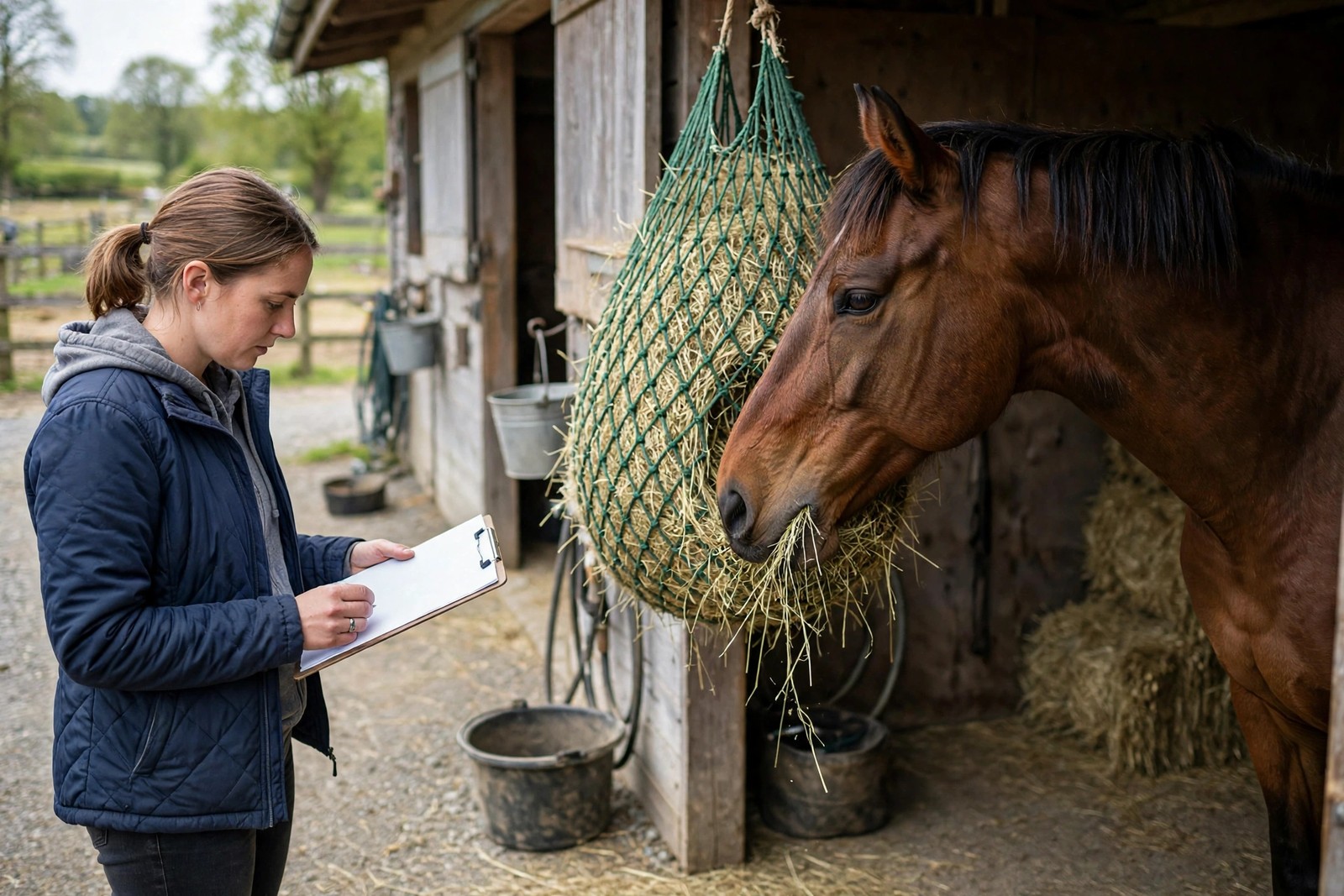
Start with what your horse actually eats all day, because that is where nearly all of his vitamins and minerals come from. Forage — pasture and hay — is the foundation of the equine diet, and a horse on decent grazing or good-quality hay is already taking in a broad spread of nutrients before any bucket feed appears. Many horses also receive a ration balancer, and a balancer fed at its full recommended amount is specifically formulated to supply the vitamins and minerals that forage alone may leave short. A horse in light to moderate work, holding good condition on that combination, very often needs nothing further from a supplement tub. The supplement question, in other words, is rarely a shopping question. It is a gap question, and gaps have to be identified before they can be filled.
Look at the Forage, Not the Marketing
Supplement marketing works by making every horse sound deficient, but real shortfalls depend on your soil, your forage, and your horse. Where it is available, a hay or pasture analysis is the most useful evidence you can hold: it shows what the forage actually provides and what it lacks, and those patterns tend to follow the land the forage grew on. Weigh the analysis against the individual horse — his workload, his age, whether he is growing, breeding, or in hard training, and the body condition he is honestly carrying. A retired horse on rich pasture and a young horse in full work eating late-cut hay are answering the same question with completely different facts. Coat shine and energy anecdotes, by contrast, change with season, grooming, and weather, and make poor evidence either way.
A Balancer and a Supplement Are Different Tools
Confusing these two products causes most of the unnecessary spending. A ration balancer is a concentrated, low-calorie feed designed to be given in small daily amounts alongside forage, delivering protein, vitamins, and minerals without the calories of a full hard feed — it exists precisely to balance a forage diet. A vitamin and mineral supplement is a narrower, more concentrated top-up, meant to correct a specific shortfall or to sit alongside feeds that are not fortified. Problems begin when products are stacked without a plan: a full amount of balancer, a fortified feed, and a general supplement on top can push some minerals well past need while doing nothing for the one that was actually short. Indiscriminate extras can unbalance a diet as easily as fix one, because minerals interact — an excess of one can interfere with how another is absorbed.
Route Real Deficiency Questions to a Professional
If you suspect a genuine deficiency — poor hoof quality that does not respond to good farrier work, a dull coat alongside weight loss, a youngster growing unevenly — that is a question for your veterinarian or an equine nutritionist, who can read the forage analysis, the total diet, and the horse together and say whether a targeted supplement is warranted and which one. Bring the whole picture: forage type, balancer and feed amounts as actually fed, workload, and condition. Once a decision is made, the unglamorous part is follow-through, and that is where the feeding routine held in the Care Teams feature in KinsLe earns its keep, with balancer amounts, any agreed supplement, and condition checks assigned to named people on a set rotation so the plan survives weekends, shows, and help from friends. Diets drift when feeding depends on memory and good intentions; they hold when the plan is written and shared. Follow-through improves when feeding stops depending on memory: in the Care Teams rotation held by KinsLe, every feeder gives the same balancer amount and records body condition the same way, week after week.