
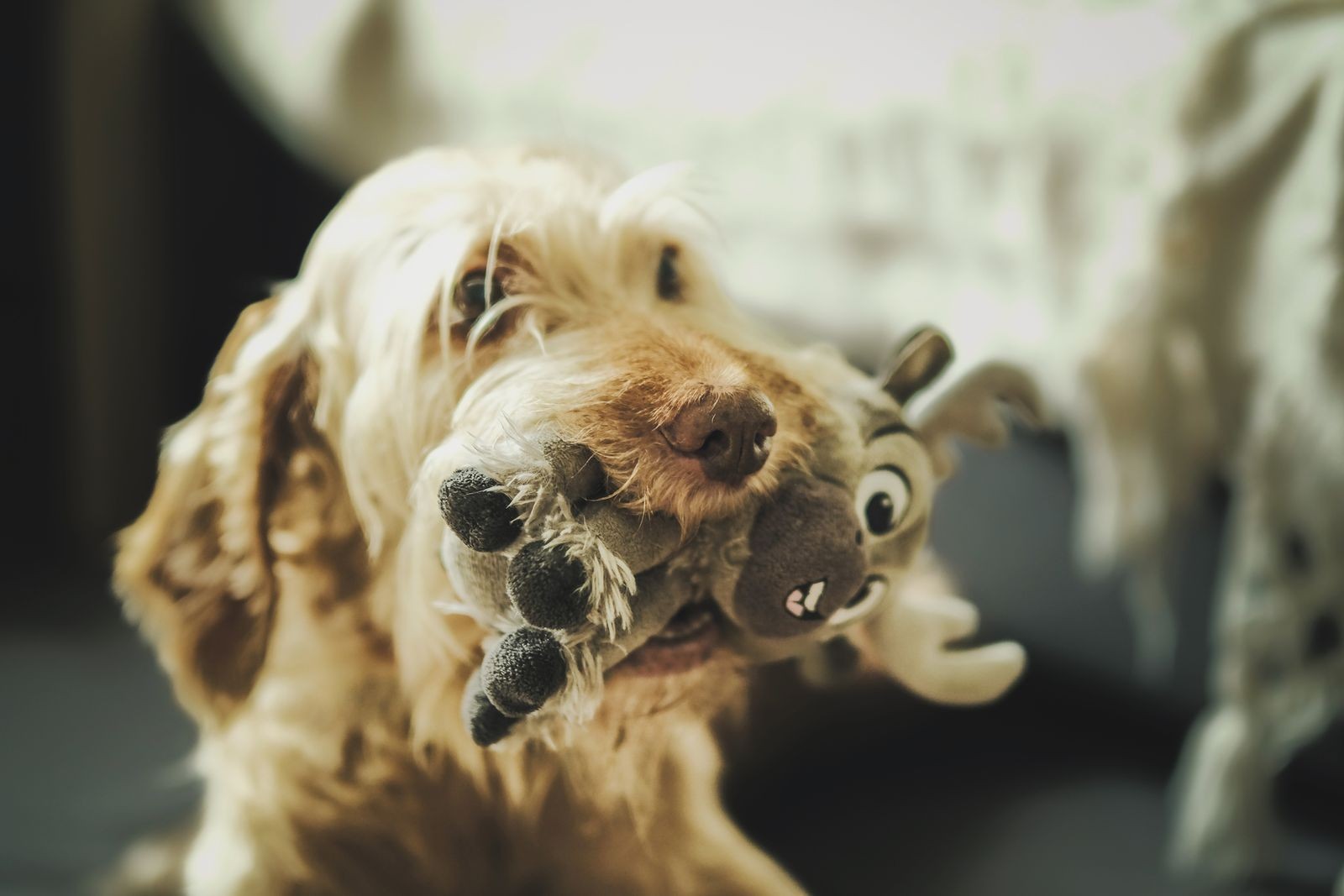
You can exercise your dog well indoors by mixing short, active games with mental work: hallway fetch with a soft toy, controlled tug, scatter feeding in cardboard boxes, and brief training games like spins, hand touches, and name games. Ten to fifteen minutes of focused indoor play, repeated a few times through the day, will not fully replace a long hike, but it takes the edge off a missed walk and gives most dogs a satisfying outlet when weather, illness, or a building without easy outdoor access keeps you inside.
Start with movement that fits your space
Clear a safe lane first: move coffee tables, roll up slippery rugs if your dog scrambles on hard floors, and check that there is nothing breakable at tail height. Hallway fetch works best with a soft ball or plush toy that will not bounce into walls or damage floors — avoid hard balls ricocheting indoors, especially with excitable dogs. Keep throws low and short. For small apartments, trade distance for repetition: roll the toy, ask for a return, add a sit before the next throw, and the game becomes training as well as exercise.
Tug is excellent indoor exercise when it has rules. Use one designated tug toy, teach a start cue and a release cue like drop it, and pause if teeth touch skin or play gets frantic. Many dogs settle beautifully after five minutes of structured tug followed by a calm chew.
Add fitness games that do not need stairs
Skip repeated stair running — it is hard on joints, risky on slippery steps, and over-arousing for many dogs. Safer options include spins in both directions, pivoting around a low platform or sturdy book, backing up for a treat, and hand-target touches moving around the room so your dog walks, turns, and thinks. Cookie stretches — luring your dog's nose gently toward a hip or shoulder for a treat — build flexibility, but keep them slow and stop if your dog seems uncomfortable. Puppies and senior dogs should do fewer repetitions, and any dog with a known joint or back issue should stick to gentle games and follow veterinary guidance.
Scatter feeding turns a meal into a workout for the nose. Sprinkle kibble across a snuffle mat, a rolled towel, or a few cardboard boxes with scrunched paper, and let your dog hunt piece by piece. Nose work tires dogs surprisingly fast because it demands concentration, not just motion.
Structure the indoor day
Spread activity out rather than doing one exhausting hour. A pattern that works for many households is: morning game session, a training snack at midday, a scatter-fed dinner, and a short play-and-settle routine in the evening. End each active session with something calm — a lick mat, a chew, or a few minutes of slow stroking on a mat — so your dog practices coming down from excitement, not just building it. That settle skill pays off on normal days too.
Watch your dog, not the clock. Panting with a loose body and then choosing to rest is a good sign. Frantic behavior or inability to settle after play may mean the games are too exciting or too long.
Safety indoors
Keep small toys and box staples out of reach, supervise shredding so cardboard is torn rather than eaten, and stop games on hard flooring if your dog slips. Puppies tire mentally fast, so keep their sessions to a few minutes.
Swap ideas with KinsLe's Circle of Love
Indoor exercise is a problem every owner solves a little differently, and KinsLe's Circle of Love — the community formed by members, including free users — is a good place to swap what actually worked in a studio apartment, with a senior beagle, or for a restless adolescent shepherd. Seeing another owner's box-game setup or tug routine often sparks the idea your own dog loves most. Fresh indoor games are always circulating in the Circle of Love, where KinsLe members trade what worked in a tiny flat or with a restless shepherd.