
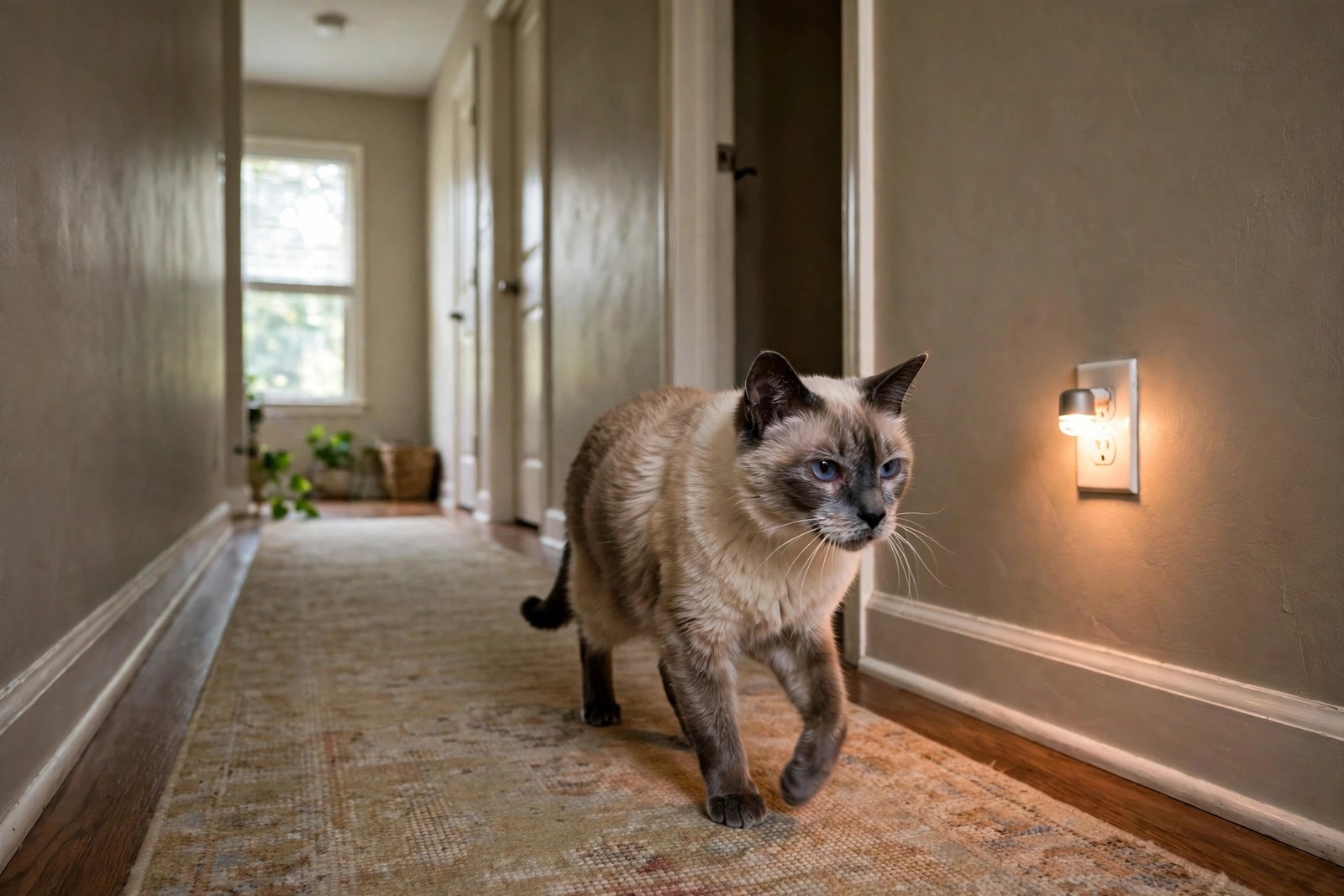
Making your home safer for an ageing cat is mostly about removing small obstacles she used to handle without thinking: slippery floors, dark routes, steep jumps and essentials placed where balance or stiff joints now make them hard to reach. Think like a cat who is slower, less steady and possibly seeing less well than last year, then walk her daily routes — bed to food, food to litter box, litter box to favourite window — and fix every friction point you find along the way.
Light the routes and steady the footing
Add night lights along the route to the litter box, the water bowl and her bed, especially in hallways and near stairs. Senior cats with reduced vision navigate by memory and contrast, and a dim corridor at 3 a.m. is where accidents and falls happen. Keep that route clear of shoes, bags and charging cables every night, not just on tidy days.
Secure rugs so they do not slide: use non-slip backing or tape, and remove lightweight mats that bunch underfoot. On smooth floors, a runner along her main path gives claws something to grip. Check that her bed, carrier and any ramp stay put when she leans her weight on them, and lower favourite perches or add a stable step so she is not launching herself from heights she misjudges more often now.
Keep essentials on the floor she actually lives on
Keep food, water and bedding on the floor level your cat prefers, ideally all on one level so she never has to choose between a drink and a painful stair climb. Raise food and water bowls slightly if your vet suggests it for a cat who struggles to bend, but keep the setup stable and spill-proof. Place an extra water bowl where she sleeps; seniors drink more reliably when water is simply nearby.
Block off steep stairs if balance is wobbly, using a secure gate she cannot slip through, while making sure everything she needs is on her side of it. If she is determined to keep one upstairs spot, supervise the climb and consider a ramp with a grippy surface rather than pretending the habit will stop.
Keep the layout familiar and the hazards boring
Familiar layouts help ageing cats enormously, so avoid rearranging furniture often, and when you must move something, do it one piece at a time and let her investigate. Keep dangling cords tied up, hot pans and open flames behind normal kitchen caution, cleaning chemicals locked away, and washing machine and dryer doors closed — a sleepy senior seeking warmth is less able to react if a cycle starts.
Check windows and screens she leans against, secure tall furniture that a climbing attempt could tip, and keep small objects she might chew off low tables. A calm, predictable house is a safety feature in itself: fewer surprises means fewer startled jumps and falls.
Noting home comfort details in Care Pass for house-sitters
Your careful setup only protects her if the next person in the house understands it. With KinsLe, your cat's Care Pass — a temporary, scoped link a house-sitter can open without needing an account or the app — can note these home comfort details: which stairs are blocked and why, where the night lights and extra water bowl belong, which floor holds her food and bed, and which furniture layout should not be moved while you are away.
KinsLe's Care Pass gives a named house-sitter a scoped view of those night-light routes and single-floor essentials, limited to the dates you set, so the safe layout you built stays exactly as you left it.