
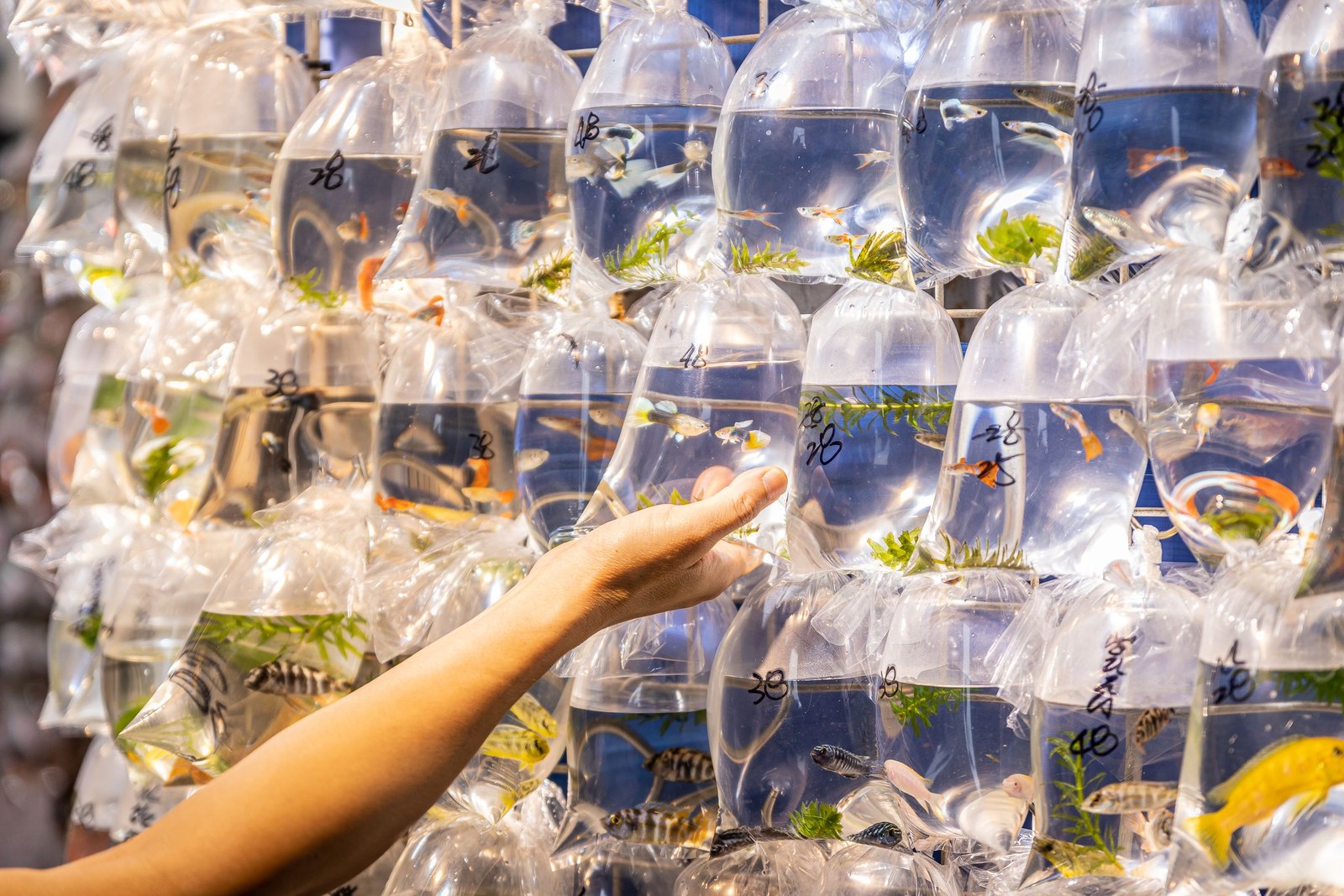
Before buying, check four things: adult size, temperament, temperature range, and water chemistry needs. Peaceful community fish of similar adult size with overlapping temperature needs are the safest mix for beginners. Beyond that, avoid pairing known fin-nippers with long-finned fish, and research whether a species needs a group or claims a territory.
Start with size and mouth
The bluntest compatibility rule in the hobby: if one fish can fit another in its mouth, eventually it will. Angel fish grow to the size of a saucer and will eat neon tetras they were sold alongside as juveniles. Gouramis, larger cichlids, and even big barbs can harass or swallow small tank mates once mature. Always compare adult sizes, not the cute juveniles in the store tank. A good target is keeping every species within roughly a factor of two in body length, with the smallest species no tinier than a large mouthful for the largest.
Temperament: the personality check
Temperament categories are the fastest compatibility filter. Peaceful schoolers (tetras, rasboras, danios, corydoras) mix freely with each other. Semi-aggressive species (tiger barbs, many barbs, some gouramis) need robust tank mates that will not be bullied — not slow, long-finned fish. Known fin-nippers should never share a tank with bettas, angelfish, or fancy guppies; the flowing fins are irresistible targets. Territorial species like dwarf cichlids or breeding pairs claim zones and need enough space and sight-line breaks to defend without dominating the whole tank.
Temperature and water chemistry must overlap
Two peaceful fish still fail together if they need different water. White cloud mountain minnows thrive in cool water around 68°F while discus need 84°F+ — no compromise temperature keeps both healthy. Similarly, livebearers prefer harder, alkaline water while tetras and many South American species want soft, acidic conditions. Pick a temperature and chemistry your current stock needs, then filter new candidates by that range. One shared parameter set is non-negotiable.
Groups, numbers, and the odd-one-out problem
Many "problem" fish are simply lonely. Tiger barbs kept as a pair nip everything; a group of eight spreads the energy and they mostly chase each other. Single schooling fish kept alone get stressed and aggressive, which owners misread as a bad temperament. Research the minimum group size before buying, and budget tank space for the group, not the individual. Conversely, some species — male bettas, breeding cichlid pairs — want to be the only one of their kind and will fight any same-species company.
Quarantine the new, then watch the first week
Even a perfect match deserves a two-week quarantine in a separate tank: it protects your established fish from disease and lets you confirm the newcomer eats and behaves normally. Introduce new fish with the lights off, rearrange a decoration or two to break existing territories, and watch feeding time closely for the first week. Mild chasing that settles in a day or two is normal; sustained targeting of one fish is not.
Learn from keepers who have tried it
Store advice is hit or miss, but hobbyist experience is gold. KinsLe's Circle of Love connects you with other fish keepers who can share which combinations actually worked in real home tanks — the pairings that stayed peaceful for years, and the ones that looked fine at the store and fell apart by month three.
Compatibility is research, not luck — check the four factors, quarantine, and watch. Through the Circle of Love on KinsLe, you can hear firsthand from keepers whose years mixing tetras, barbs, and corydoras taught them which pairings stay peaceful long after quarantine ends.