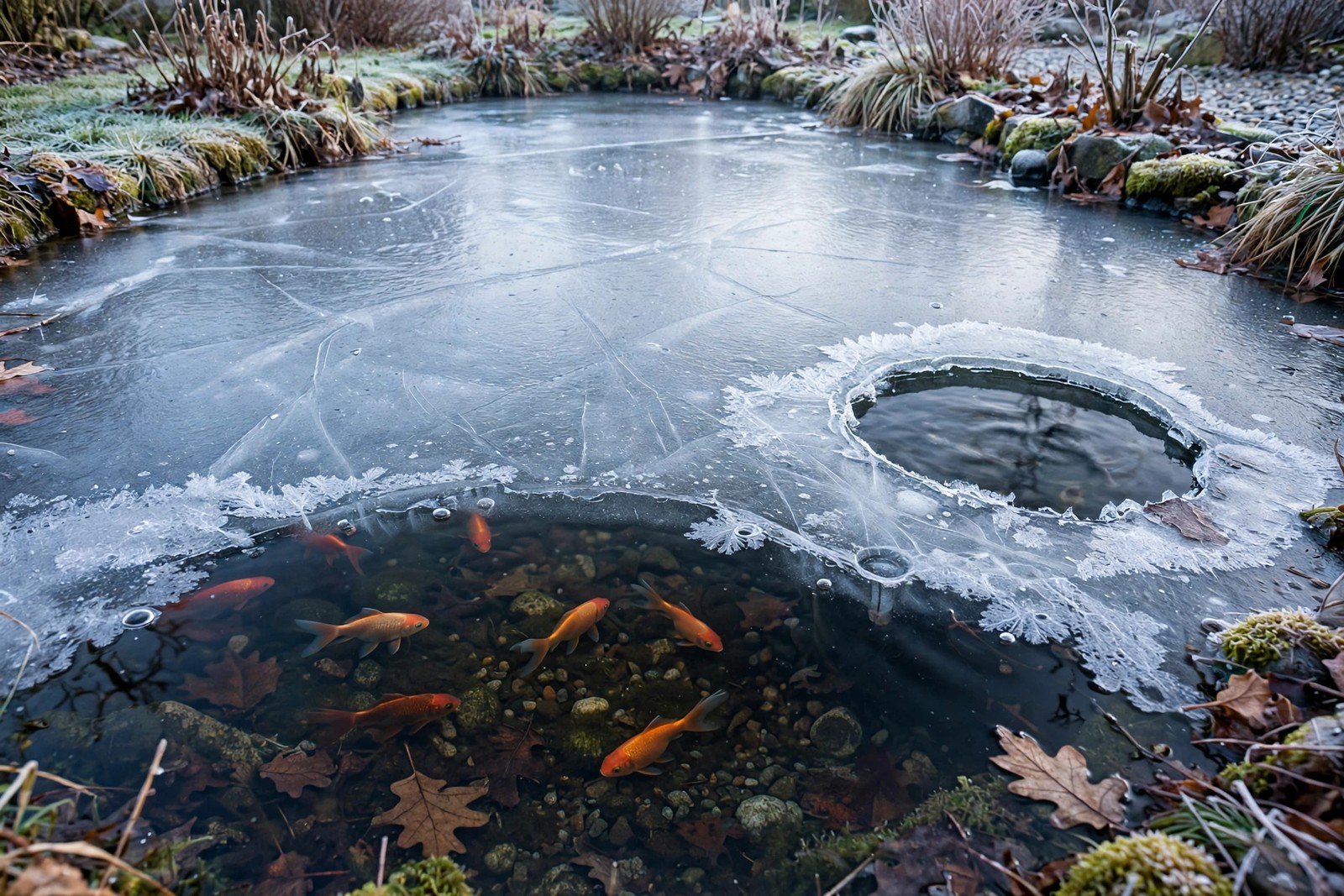
For a goldfish pond in a climate with real frosts, make the deepest zone about 80 cm to 1 m deep (about 32 to 40 inches), and deeper where winters are severe. The figure is not about swimming space. It is about leaving a layer of water at the bottom that never freezes, where goldfish can rest through the coldest weeks while ice forms above them. A pond that freezes to the bottom, or nearly to the bottom, leaves the fish no living space at all.
Why Depth Protects Fish in Winter
Water behaves helpfully in winter. As a pond cools, the coldest water rises and freezes at the surface, while slightly warmer water sinks and collects at the bottom. Goldfish settle into that bottom layer, their metabolism slows sharply in the cold, and they live quietly on body reserves, moving little and needing no food. Ice on top actually insulates the water below, provided the pond is deep enough that the ice layer stays a lid rather than becoming the whole pond.
That is why a shallow ornamental pond that delights in summer can kill in midwinter conditions. Match depth to your own climate: the deeper end of the range suits places with weeks of hard frost, a mid-range depth suits milder districts, and a very shallow pond in a cold district is a summer-only home whose fish need indoor quarters for winter. If you are digging a new pond, dig the deep zone generously and add gently sloping shelves above it for plants, rather than making the whole pond one shallow basin.
Keep an Opening in the Ice
Depth solves freezing; it does not solve gas exchange. Decaying leaves and plant matter release gases into pond water all winter, and a pond sealed by continuous ice traps those gases while fresh oxygen cannot enter. Keep a small opening in the ice throughout the frosty period. A floating pond heater that warms only a small circle, or a small pump or air stone that keeps water moving at the surface, can hold that opening without heating the whole pond, which the fish do not need and which would disturb their winter rest.
Never break thick ice by striking it. The shock wave from a hammer blow travels through water far more powerfully than through air and can injure or kill resting fish. Melt an opening instead with a pan of hot water set on the ice, and repeat the gentle method whenever the opening closes over.
Autumn Preparation and Winter Routine
Winter success is decided in autumn. Net fallen leaves off the surface before they sink and rot, trim back dying plant growth, and check that the deep zone is clear of sludge build-up. Stop feeding once the water turns cold and the fish lose interest, because uneaten food rots and the fish cannot digest meals properly at low temperatures. In winter itself, the routine is light but regular:
- Check that the ice-free opening is still open, daily during hard frosts
- Confirm any heater, pump, or air stone is still running after storms or power cuts
- Watch for a fish trapped in shallow water or showing damage, and act gently if you find one
- Leave resting fish undisturbed and resist feeding on a single mild day
Spring Wake-Up
As the water warms, fish rise and begin to move before they are ready for full feeding. Resume food gradually with small amounts once the fish actively seek it, test the water as feeding restarts, and remove winter debris before it rots in warmer water. A fish that surfaces with sores, fungus patches, or laboured movement after winter deserves prompt advice from a veterinarian who treats fish or an experienced aquatic specialist.
Because winter checks are brief, easy to forget, and vital during a hard week, KinsLe Care Teams lets you assign each pond check to a named family member and see it marked complete with a timestamp, so the ice-free opening never depends on one person's memory.