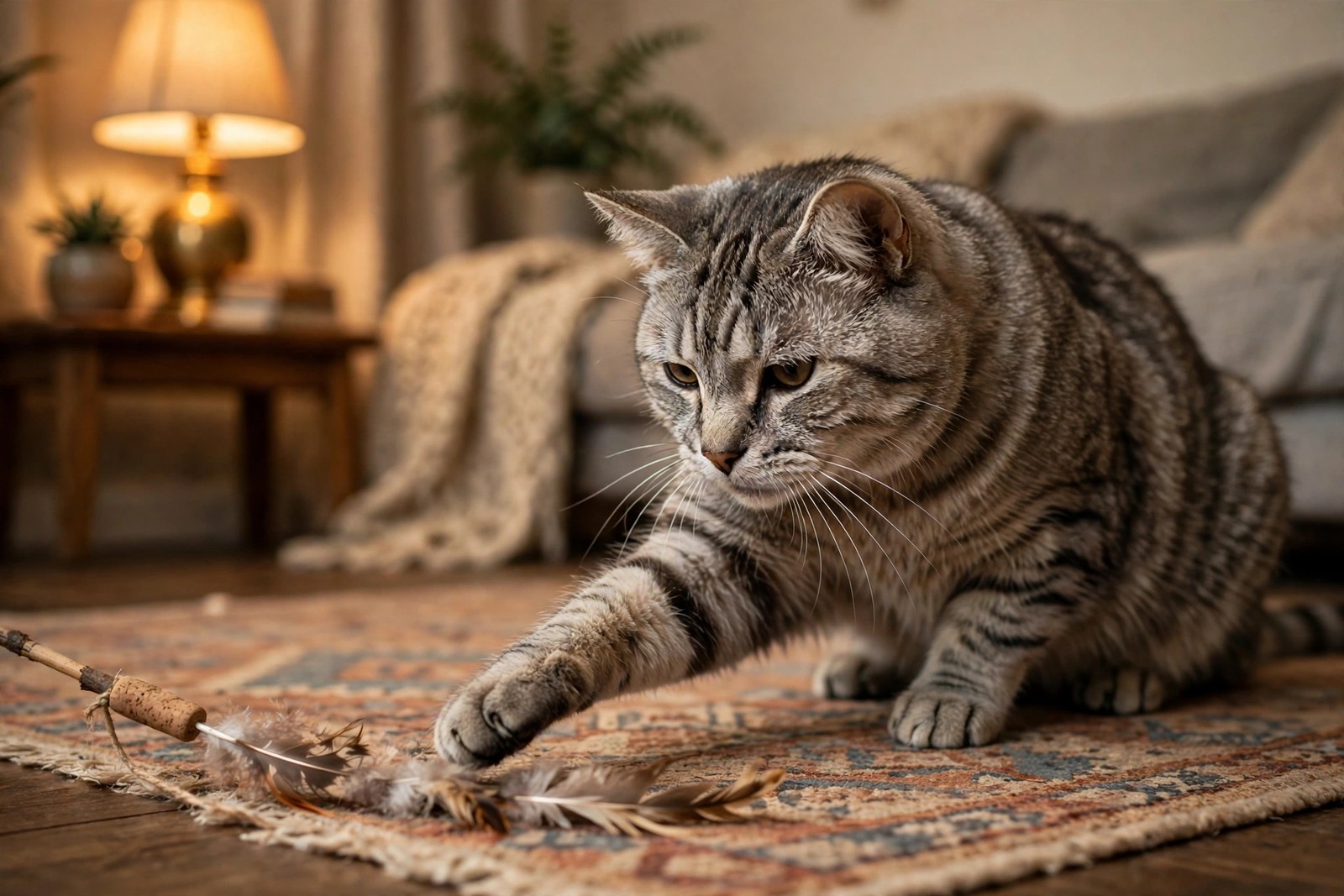
The spirit is willing long after the leap is gone. A senior cat who still tracks a feather wand with shining eyes is telling you play still matters — for muscle, for joints, for mood, and for the simple dignity of still being a hunter. The adapted game keeps everything the cat loves about the wand and removes the one thing aging joints can no longer pay for, and played thoughtfully it can remain a daily pleasure for years.
Bringing the Wand Down to the Floor
Reimagine the feather as ground prey. Trail the wand along the floor in slow sweeps, let it scurry around furniture legs, pause it half-hidden under the edge of a rug, and drag it away in short, tempting runs when the cat commits. The pauses are the game: a senior cat's stalk — the crouch, the wiggle, the careful advance — is satisfying hunting in itself, and a ground-level pounce onto a catchable target completes the sequence without a single leap. Keep the wand tip on the floor or barely above paw height at all times; the moment a well-meaning hand lifts it overhead out of habit, the game asks for the jump you have agreed to retire.
Warm-Up, Surfaces, and Session Shape
Old muscles appreciate a ramp, not a cliff. Open with a minute or two of gentle movement — the wand moving slowly a few feet away, easy turns, nothing sudden — before the pace rises to whatever the cat offers that day. Play on carpet, a rug, or another soft, grippy surface, never on slick hard flooring where aging legs splay and landings jar, and keep the play area clear of obstacles a stiff cat cannot dodge. Sessions should be shorter than in the cat's prime and stopped while interest is still keen.
The Next Day Is the Feedback
Judge each session by the morning after. A cat who played well moves the next day much as usual; a cat who comes out stiff, reluctant to start, slow on the stairs, or quieter than the household norm is reporting that yesterday's session was too much, and the honest response is to trim the next one — shorter, slower, more pauses — rather than to retire play altogether. This feedback loop is where senior play becomes senior care: you are measuring out effort by observation, week by week, against the individual cat in front of you rather than against a memory of the cat at five years old.
When Play Raises a Health Question
Some changes should leave the living room and go to a veterinarian. If reluctance to leap is new or sudden, if the cat stops mid-game with a hunched, guarded posture, if the face changes during play — ears flattened, whiskers fanned, eyes squinting into the tight expression pain produces — or if appetite, grooming, or litter habits shift alongside the mobility change, those are observations a veterinarian needs, because arthritis and other conditions are possibilities only an examination can weigh. Never push a stiff cat through a session to prove the game still works; willingness on a good day is information, and refusal on a bad one is too.
Recording Play in the Health Record
Play is measurable health data for a senior cat, and it belongs with the rest of the medical picture. A few lines after notable sessions — how long enthusiasm lasted, which movements were avoided, how the next morning went — build into exactly the timeline a veterinarian wishes every owner kept. That running note belongs in the Pet Passport on KinsLe: the health and records packet, where play capacity and mobility changes sit alongside conditions, weights, and visit notes, ready to be read as one story at the appointment. Kept current visit by visit, that play history becomes evidence at the next senior check, and KinsLe's Pet Passport holds it alongside the rest of the health record where a veterinarian can read the trend at a glance.