
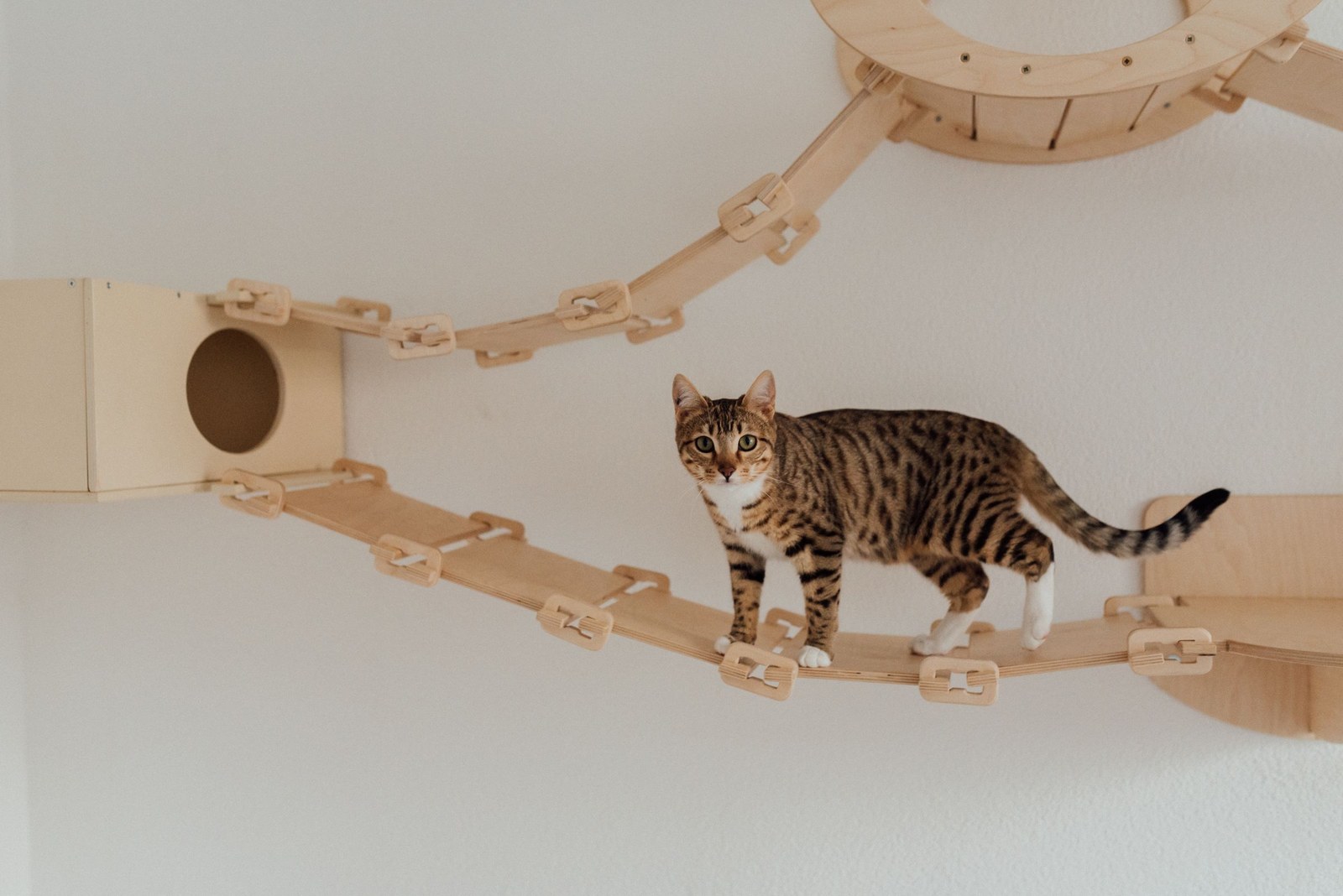
In a tiny home, the fastest way to double your cat's territory is to think upward: add wall shelves with grippy surfaces, clear the top of a bookcase as a perch, or place a tall cat tree by a window. Make everything rock-solid stable, and plan the route up and down as easy hops — ideally no single jump much larger than your cat can handle comfortably — rather than one big, risky leap.
Plan the Route Before You Drill Anything
Start by watching where your cat already tries to go. Most cats have a preferred window, a favourite high corner, or a path along furniture they repeat daily. Build around those instincts. Sketch a simple circuit: floor to chair or low shelf, to a mid-level perch, to the highest lookout, with a different or shared way back down so she never feels trapped at the top.
Spacing matters. Place shelves roughly a comfortable hop apart both vertically and horizontally for your cat's age and mobility. A young, athletic cat handles wider gaps; a senior cat or a kitten needs closer, lower steps and non-slip surfaces on every landing. Carpet tiles, sisal pads, or textured shelf liner prevent the sliding that makes cats distrust a new perch.
Safe, Renter-Friendly Ways to Go Vertical
Stability is non-negotiable — a wobbling shelf teaches a cat to avoid vertical space entirely and can cause injury. Anchor wall shelves into studs where possible, test each one with firm hand pressure before inviting your cat up, and check brackets monthly. For renters, alternatives include a tall, heavy-based cat tree, a tension-mounted floor-to-ceiling post if your lease allows it, or freestanding bookcases secured against tipping.
Ideas that work especially well in tiny homes:
- A window-height shelf with a washable cushion for bird-watching and sunbathing.
- The cleared top of a wardrobe or bookcase, reached via one intermediate shelf.
- A corner cat tree that uses vertical height instead of floor footprint.
- A shelf over a doorway or along a hallway wall, turning dead space into a cat highway.
Keep perches away from kitchens hazards, dangling cords, and fragile items you would mourn, and leave human storage out of the topmost landing so it truly belongs to her.
Keep High Spaces Interesting Over Time
Cats abandon boring perches. Refresh them the way you would rotate toys: move a cushion, add a cardboard scratch pad on one level, tuck a catnip toy up there for a day, or shift a lightweight perch to a new window as seasons change. A bird feeder outside the glass can transform an ordinary shelf into the best seat in the house.
Also think about what each level is for. The highest spot is usually for surveying and solitude, mid-levels for passing through and play, and lower spots near you for social lounging. If two cats share the home, provide at least two routes and more than one prime perch so no cat can guard the only good seat.
Check older cats regularly for changes: hesitating before a jump, choosing lower spots, or struggling to land can signal stiffness or pain worth mentioning to your veterinarian.
Let Kinny Help You Keep It Fresh
It is easy to install shelves and then forget them for months. Kinny, the built-in AI assistant on KinsLe, can help with gentle nudges and reminders — prompting you to rotate toys, refresh those vertical spaces, check fixings, or schedule a play session when life gets busy. A quick reminder on your cat's profile keeps the small jobs that keep a tiny home exciting from slipping through the cracks.
Vertical space is the cheapest square footage you will ever add for your cat, and she will use it every single day. If stale perches need new life, you can consult the Kinny assistant on KinsLe with follow-up questions about shelf routes or toy rotation, and its guidance comes from the library that backs KinsLe Answers.