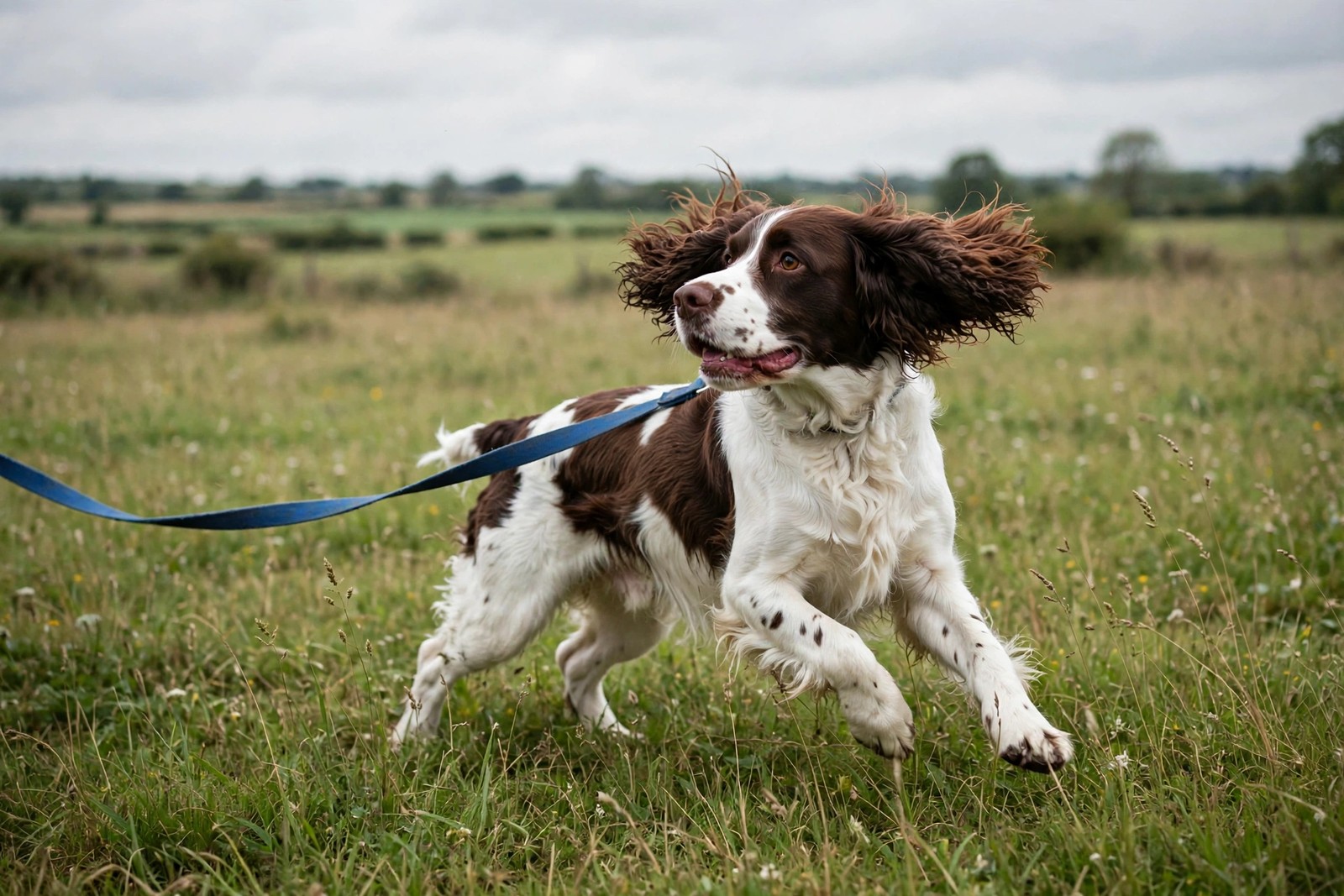
A Springer Spaniel who vanishes after birds is not ignoring you out of spite; flushing game is the job the breed was built for, and the burst of a bird from cover is a stronger reward than most owners are carrying in a pocket. Focus work therefore has two halves. You must make checking in with you pay unusually well, and you must give the hunting drive a structured outlet, because suppressing it entirely leaves a dog who rehearses it without you at every chance.
Start Where Birds Are Not
Build the component skills in boring places: a snappy name response, a hand touch, a recall to a whistle, and above all the voluntary check-in, where the dog glances back at you unasked. Reward every check-in during ordinary walks as if it were the best decision of the day, with high-value food or a thrown ball, whichever your dog values more. Then move to fields and woods with little game scent, working on a long line of about nine metres (roughly thirty feet) trailing or held, so the dog feels free but cannot actually self-reward by chasing. Only when recall and check-ins are reliable there do you train, still on the line, in ground where birds sometimes appear.
Work With the Pattern, Not Against It
Springers naturally hunt in a quartering pattern, zigzagging across the wind in front of the handler. Shape that instead of fighting it: reward turns at the edge of an imaginary beat, practise a sit to a raised hand or whistle at short distances while the dog is calm, and build stop-and-look-back as a game long before you need it near game. The classic sequence is turn, stop, recall, each first taught without scent, then with scent, then with a thrown dummy as the distraction, and only much later with real birds. A thrown dummy is a useful middle step because you control when the exciting thing appears, and the retrieve itself becomes the payment for stopping and watching.
Give Hunting a Legal Address
- Run dummy retrieves several times a week, including hidden retrieves the dog finds by scent, so searching ends with you and a job done.
- Scatter food or a favourite toy in long grass and send the dog to hunt it on cue, nose down, in partnership with you.
- Play tug and chase-you games as rewards, letting the dog win often enough to stay invested.
- Keep off-lead freedom in high-game areas off the table until the line work is genuinely reliable; every successful wild chase pays the wrong behaviour generously.
Expect this to take a season, not a fortnight, and expect adolescence to test it. If your dog has already chased livestock or wildlife into danger, or recall collapses completely outdoors, a gundog trainer who uses reward-based methods can assess the dog in real terrain. The end goal is not a Springer who ignores birds, which would be a different dog entirely, but one who hunts in conversation with you. KinsLe Care Teams helps households sustain that long build by assigning focus practice and dummy sessions to named people with timestamped completion, so the ladder is climbed steadily rather than in occasional hopeful leaps.