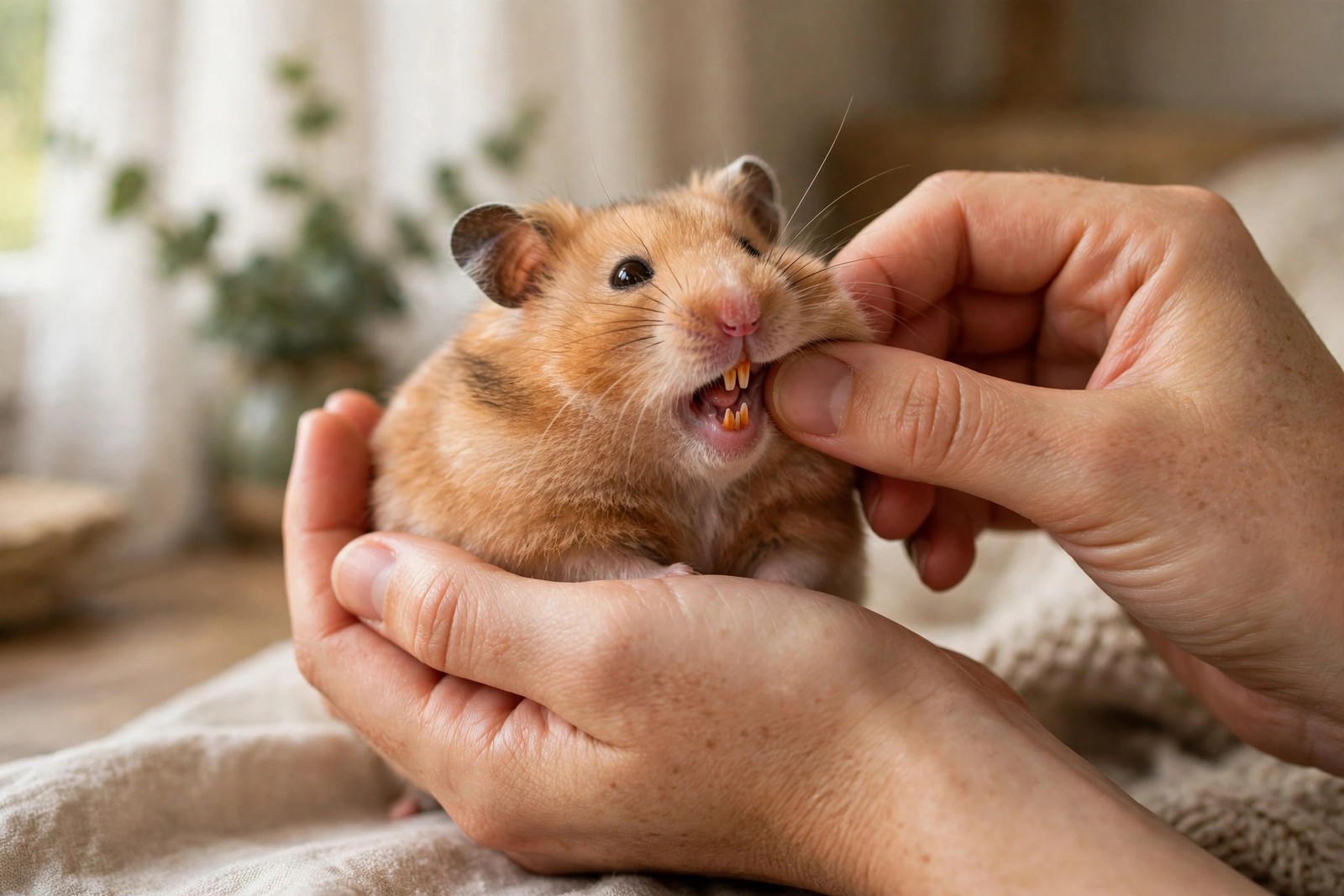
A hamster's front teeth grow continuously throughout its life, worn down by gnawing and by the incisors rubbing against each other. When that wear goes uneven — a broken tooth, a jaw knocked slightly out of line, a diet too soft to gnaw — the teeth overgrow fast and a hamster can quietly stop being able to eat. A ten-second check once a week catches the problem while it is still simple, and most hamsters tolerate it easily once it is routine.
Getting a Clear View
Work in the evening when your hamster is naturally awake; never wake it from daytime sleep for a check. Let it settle first — cupped in both hands against your body, or sitting in a familiar playpen with you beside it. With the hamster supported, use the fingertip of each hand to draw the lips gently back and up on either side of the mouth, the way you would show a horse's teeth in miniature. You only need a second or two of exposure. If your hamster objects, use the no-hands method: hold a favourite treat just above its head so it stretches up and opens its mouth in a wide 'yawn,' which displays the incisors clearly. Scruffing is unnecessary for this check and stresses the hamster.
What Healthy Incisors Look Like
You are looking at four teeth: two upper incisors and two lower, with the lowers naturally about twice the length of the uppers — that difference is normal, not overgrowth. Healthy teeth are a yellow-orange shade (white teeth actually suggest a young hamster or a nutritional issue), straight, smooth-edged, and they meet their opposite partner squarely so the biting edges line up and wear evenly. There should be no sideways crossing, no tooth growing at an angle, no curling back toward the mouth, and no chipped or blackened section.
Warning Signs That Need a Vet
Book a vet if you see one incisor clearly longer than its partner, teeth that cross, splay, or grow inward, a broken tooth, or a mouth the hamster will not close properly. Behaviour often reports the problem before your eyes do: drooling or a wet chin, dropping food it has picked up, chewing on one side, pouching less, preferring soft food it previously ignored, or losing weight despite a full bowl. Do not try to trim a hamster's teeth yourself — incisors can split lengthwise into the root, and the underlying cause, often misaligned back teeth you cannot see at home, needs a vet's examination and correction.
Keeping the Wear Even
Prevention is mostly gnawing opportunity: constant access to hay, safe untreated wood and other suitable chew items, and a good-quality diet with hard pieces to work on. A hamster fed only soft foods loses its main wearing tool. Note the date and result of each weekly check somewhere simple, because slow overgrowth is a trend — comparing this week with last month is what reveals it.
A weekly habit shared across a household is easy to forget and easier to duplicate, so set it in KinsLe Care Teams: the teeth check becomes an assigned weekly duty for your hamster, marked complete with a timestamp, and any carer can see when it was last done and what was found.