
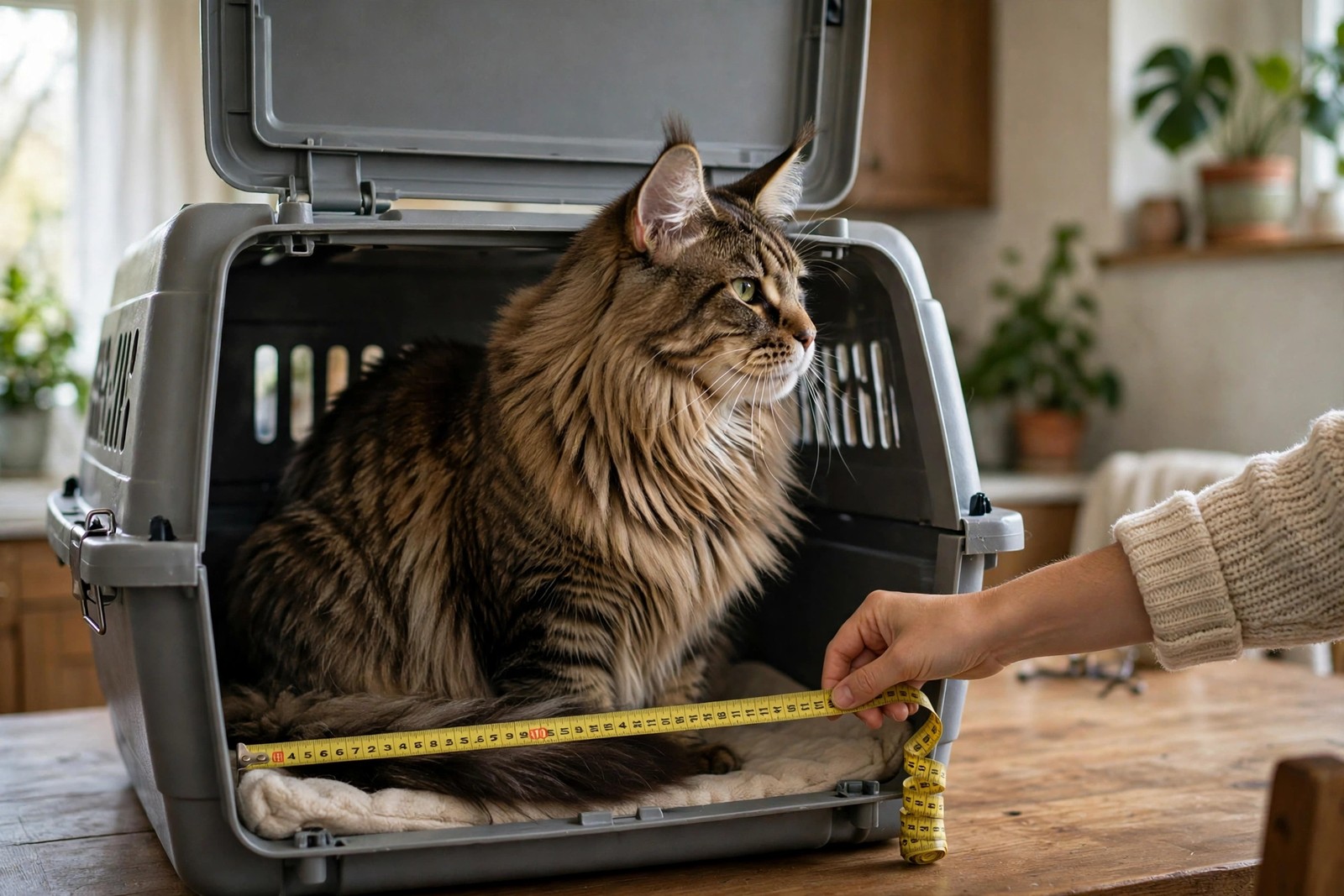
The right carrier lets your cat stand up without crouching, turn around fully, and lie down stretched or curled — with only a little room to spare. That snug fit is a feature, not a compromise: cats feel safer in a contained space and slide around less in the car. Measure your cat from nose to tail base and from floor to the top of her head or ears, then add a few centimeters to each measurement when comparing carrier sizes.
Why Bigger Is Not Better
Owners often buy a carrier a large cat could host a party in, imagining kindness. In practice, an oversized carrier lets a cat be thrown from side to side at every corner, which is a major reason car rides become miserable. A snug carrier works like a den — enclosed, darkened, and stable — which matches how cats seek safety. There is a limit, of course: a carrier so small she cannot turn or must sit hunched is a welfare problem and will make vet handling harder. The sweet spot is "her own size, plus a hand's width." If you are between sizes for a big breed like a Maine Coon or a Ragdoll, size up; for a petite cat, trust the smaller option.
Measuring Your Cat (Without a Wrestling Match)
Measure while she is relaxed, using treats as payment:
- Length: Nose to the base of the tail while standing — add roughly 8–10 cm for carrier interior length.
- Height: Floor to the top of her ears while standing — the carrier's interior height should clear this comfortably.
- Weight: Check it against the carrier's rated limit; sturdy construction matters more as weight rises, especially in soft carriers with shoulder straps.
If she will not stand still, measure her sleeping stretched out and add a little — close enough beats not measuring at all.
Features Worth Paying For
A carrier with both a top opening and a side door is worth it: many cats tolerate being lifted out through the top far better than being pulled through a front door, and vets love them for the same reason. Look for secure latches that a determined paw cannot nudge open, good ventilation on at least two sides, a washable interior pad, and a solid base that does not sag when carried. Hard carriers suit nervous or strong cats and stack safely; soft carriers are lighter and fine for calm cats on short trips, but check the frame holds its shape. Whatever you choose, thread the car seatbelt through the handle or use a strap so the carrier cannot slide off the seat.
Sizing for Kittens and Multi-Cat Homes
Buy for the adult your kitten will become if she is a large breed, but block off extra space with a rolled blanket while she is small so she still gets the snug effect. Kittens who are littermates sometimes travel happily together when young, but adult cats — even friends — usually travel better in separate carriers, since stress turns small irritations into fights in a confined space.
Preparing Her for the New Carrier
A new carrier should appear days before it is needed, not the morning of a trip. Set it out open with familiar bedding inside and let her investigate it as furniture first; treats that appear inside it turn suspicion into routine, and a carrier that already smells of home reads as one more resting place rather than a warning. Whoever is home can share that setup, because the work is simply leaving the carrier available. If her measurements leave you torn between the smaller and larger option, put a follow-up question to KinsLe's Kinny; he answers using the KinsLe Answers library.