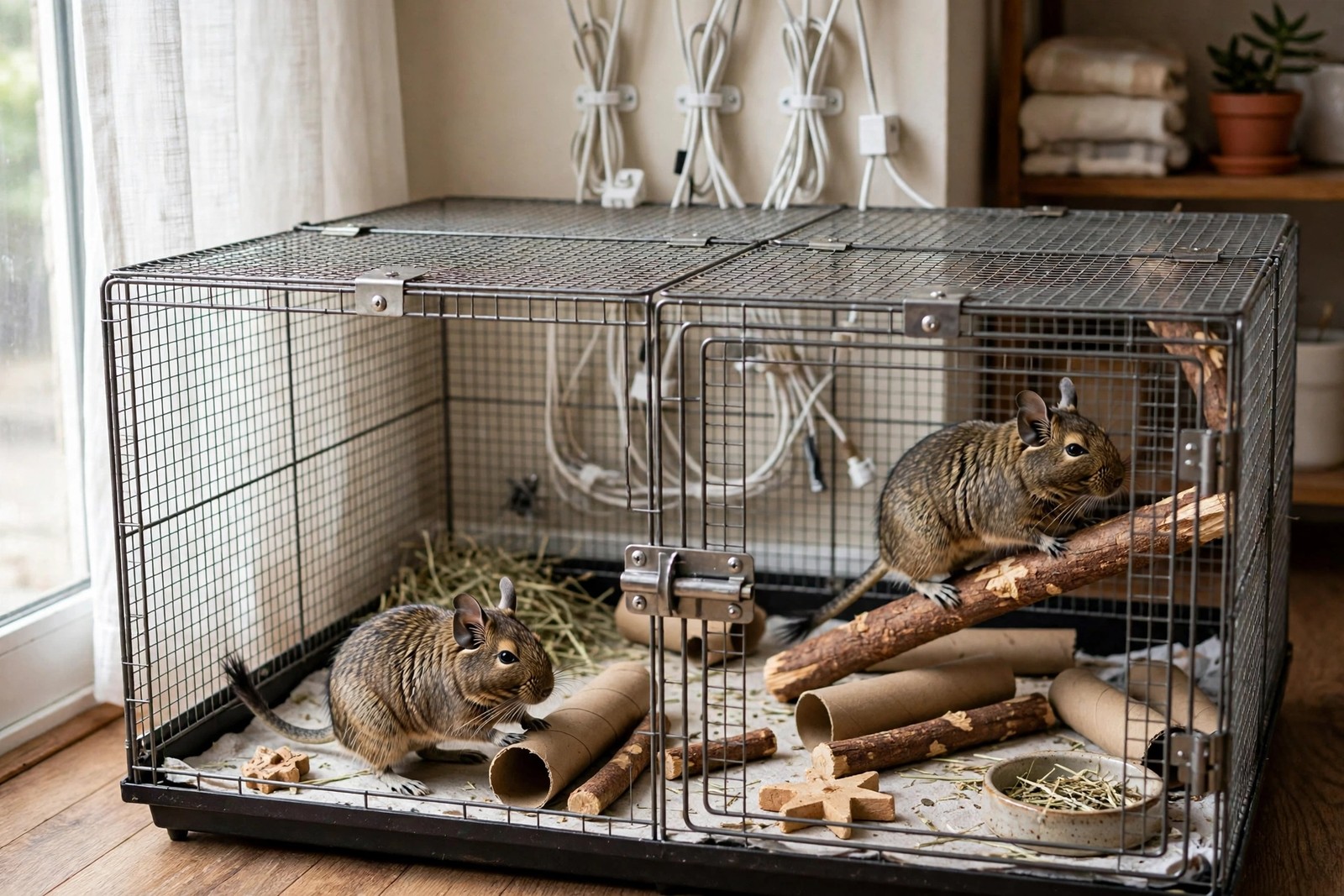
A degu play space has to defeat three talents at the same time. Degus jump with real height and accuracy, they chew constantly because their teeth never stop growing, and they pour themselves through gaps that look far too small. Proofing that handles only one or two of those will be found out, usually within the first few sessions. Work through each talent in turn, then make the finished check a household habit.
Proofing Against the Jump
Degus jump surprisingly high for their size, judging a launch from the highest thing they can climb first, so a low barrier beside a sofa or a box is no barrier at all: the furniture becomes the step up and over. Either use a playpen with a secure cover fitted, so height stops mattering, or clear the room so nothing climbable stands near the walls and barriers. In a cleared room, move boxes, stools, and storage away from the edges, and check low furniture tops as well, since a degu who reaches a shelf will use it as a springboard.
Stay in the space for the whole session; supervision is part of the proofing, and the person in the room spots the new launch route or the worked-loose barrier before either becomes an escape.
Proofing Against the Chew
Degus chew to live, and the play space has to assume everything in it will be tested with teeth. Keep plastic out of the space entirely rather than sorting it into safe and unsafe piles. A chewed piece of plastic can be swallowed, and a swallowed fragment is a blockage risk, so plastic toys, storage boxes, cable tidies, and children's playthings all leave the room before the degus come out.
Cables get the strictest treatment. Chargers, lamp cords, and speaker wires are either removed from the room, lifted completely out of reach, or run inside rigid armored covering that teeth cannot work through. A cable draped behind furniture is not out of reach to an animal who explores behind furniture as a first choice.
Then give the chewing somewhere legal to go. Wooden chew items, willow sticks, and cardboard tubes placed around the space occupy the teeth you have just denied everywhere else. Replace them as they are worked down.
Proofing Against the Squeeze
Work on the keeper's rule of thumb: a degu fits through any gap its head fits through, because the rest of the body follows with very little argument. Get down to floor level and look at the room as a degu meets it. The gap under the door, the space behind a bookcase, the opening where pipes or cables pass through a wall, and the hollow underside of furniture are the usual exits. Seal door gaps with a fitted guard or a rolled draft blocker that stays in place during play, block behind-furniture voids with boards or boxes the degus cannot shift, and close off any hole you would not want a small body exploring.
Test the room empty first: sit in the middle, scan every edge, and push on each barrier. If a gap surprises you, it would have delighted a degu.
One Checklist for the Whole Household
Degus usually have more than one person letting them out, and a room proofed by memory gets proofed differently each time: one person forgets the door gap, another forgets the charger behind the sofa. Write the proofing down as a short checklist: barriers and launch furniture, cables and plastic, gaps and door, chew items placed, supervisor present. The household shares that checklist through the Family Sharing tools on KinsLe, so the list itself lives in one place, gets updated when the room changes, and is checked the same way by a partner, a teenager, or a visiting grandparent. New chew marks or a shifted blocker get recorded on the list for the next session.
When the whole household works from one shared proofing list in the Family Sharing space on KinsLe, the room gets checked identically before every session, no matter who sets it up.