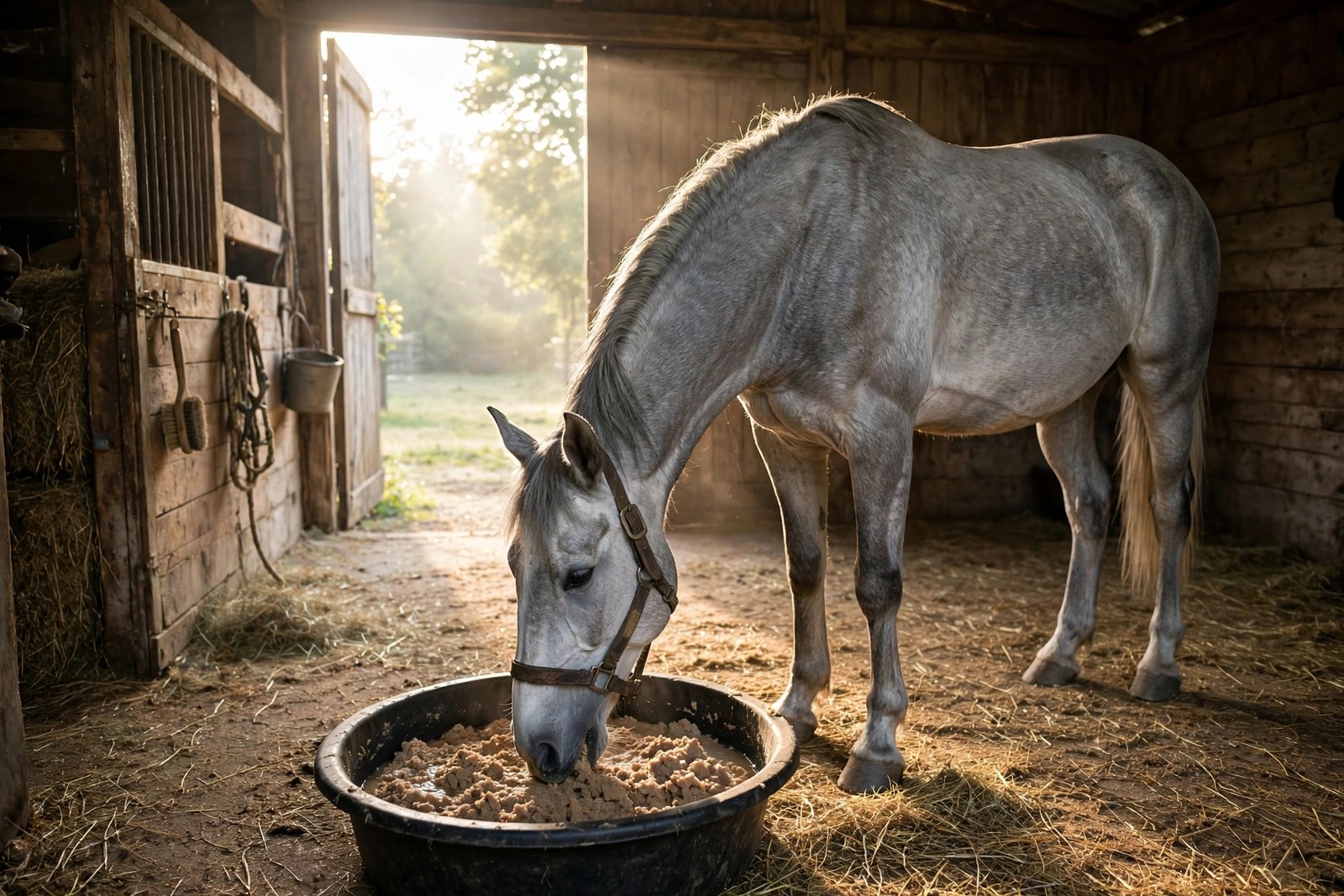
Start with the mouth, not the feed bin. A senior horse who struggles with hay often has worn, loose or missing teeth, sharp points, or a sore mouth, and no ration change fixes that. Book a dental examination first, watch for quidding — wet, chewed balls of hay dropped on the ground — and note whether he eats slowly, tilts his head, or leaves long stems untouched. Those signs tell your vet where the chewing problem sits and whether soaked forage alone will be enough.
Replace Long Hay With Forms He Can Manage
Long-stem hay asks for grinding his teeth may no longer do, so swap the form before you cut the forage. Soaked hay cubes or hay pellets, softened in water until they fall apart into a loose, damp fibre, give him forage without long stems. Chopped forage, sold in bags as short-cut chaff, is another step between hay and mash for a horse who can manage short pieces. A complete senior feed, soaked into a soft mash, can fill more of the ration when chewing is very poor, because it is formulated to be fed without hay alongside it. Introduce each new form gradually over several days, mixing increasing amounts into what he already accepts, so his gut adjusts without loose droppings.
Build the Day Around Small, Soft Meals
Divide the daily ration into three or four small meals rather than one or two large ones. Smaller meals are easier for an older gut to handle, and a horse who eats slowly is less likely to be pushed off his feed by younger companions. Feed him separately, in a quiet space with a wide, shallow tub at ground level, and give him unhurried time to finish. Soak cubes and pellets fresh for each meal rather than in a large batch, check that the mash is soft all the way through with no hard centres, and discard sour leftovers instead of leaving them to ferment in the tub. Keep clean water beside the feed at all times, and offer it slightly warm in cold weather if he drinks reluctantly, because a dehydrated senior handles fibre poorly.
Watch Weight, Droppings and What Is Left Behind
Your daily evidence is in the stable. Droppings that contain long, undigested hay stems suggest he is swallowing forage he has not ground down. A dropping weight, ribs becoming easier to see, or a dull coat despite a full ration all mean the replacement diet is not delivering enough, and the ration needs adjusting with your vet rather than simply adding more of the same. Weigh or condition-score him on a regular rhythm, write the result down with the date, and record exactly what he was fed, how much he left, and whether quidding increased or eased. Photograph him from the side in the same light when you score him, because gradual loss is hard to judge from memory alone. If he chokes, coughs repeatedly over feed, loses weight quickly, or stops eating, treat that as a prompt call to your vet rather than a feeding problem to solve alone at home.
Keep the Record With the Horse
Feeding a horse whose mouth is changing is a moving target: the ration that held his weight this season may need softening again after his next dental check. Keep the dental findings, the current ration, soaking instructions and the weight notes in one place that a yard manager, a relief feeder or a new vet can read without guessing. KinsLe's Pet Passport holds that dental, ration and weight history together in one portable packet, so whoever feeds or examines him next works from the same recorded facts.