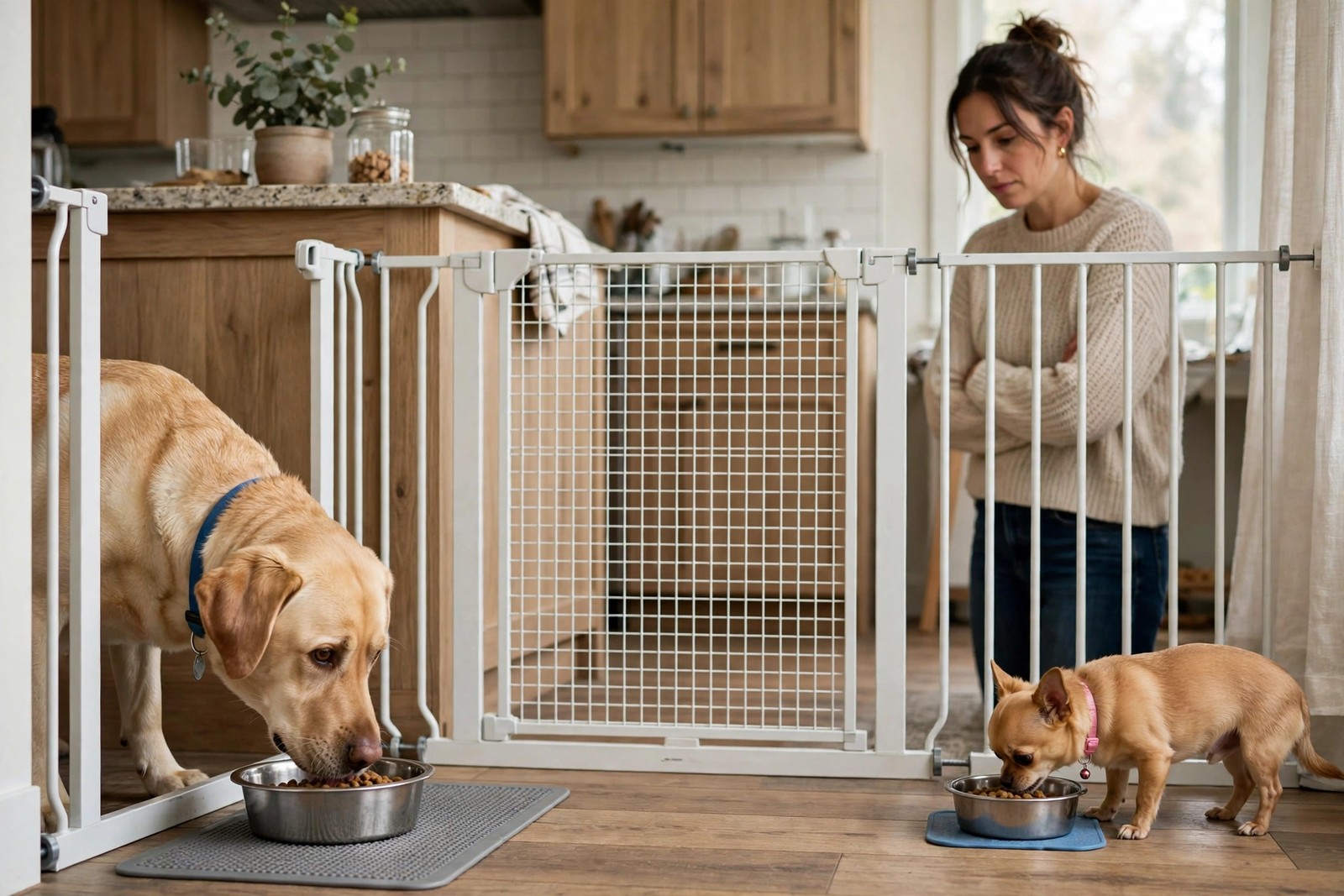
A household with a 35-kilo Labrador and a 4-kilo toy breed is running two completely different feeding programmes at the same mealtime. The Labrador's single meal can be most of the small dog's entire day, and the small dog's picky leftovers are a free snack the Labrador will always find. The system that works is simple to describe: separate stations, portions measured per dog, and nothing left down between meals.
Separate the Stations, Every Single Meal
Physical separation is the foundation — training alone will not hold a hungry big dog off a small dog's bowl forever. Feed in different rooms with the door shut, on either side of a baby gate, or with the smaller dog in a pen or crate he is already happy in. Give each dog a fixed spot that never changes, serve the slower eater first so he gets a head start, and stay in the room until both are finished. Beyond weight control, separation protects the relationship: a small dog who must guard his bowl from a looming companion twice his height eats under stress, and food guarding between mismatched dogs is how mealtime bites happen.
Portion for the Dog in Front of You
Eyeballing fails hardest across a size gap, because the same scoop looks modest in one bowl and enormous in the other. Weigh each dog's food, at least until the correct amount is familiar, and portion from the feeding guide for that dog's weight, age and activity, adjusted by body condition — you should feel ribs under a light covering, not hunt for them. Revisit portions monthly: a growing youngster, a newly neutered adult and an ageing dog all drift. Treats count too, and they must scale — the corner of a biscuit is a treat for the Labrador and a meal's worth of calories for the toy breed, so keep pea-sized rewards for the small dog.
Choose Foods and Kibble Sizes That Fit
Dogs of very different sizes often do best on different foods, not just different amounts. Kibble size is practical, not cosmetic: large, hard pieces can be a genuine choking and tooth risk for a tiny mouth, while a giant breed fed entirely on small kibble tends to gulp it unchewed. Puppies at opposite ends of the size scale diverge further — giant-breed puppies need controlled growth feeding because they grow for well over a year, while toy puppies need small, frequent, energy-dense meals and must never go long stretches unfed. If either dog is on a vet-directed diet, separation stops being about weight and becomes about health, and the rules tighten to no sharing at all.
Lift the Bowls and Guard the Gaps
When both dogs are done, pick every bowl up, finished or not, and wash them. Free access between meals quietly destroys the whole system: the big dog grazes the small dog's leftovers, the small dog raids the big dog's bowl in instalments, and neither dog is actually eating his measured ration. Apply the same thinking outside mealtimes — store the food bags where neither dog can self-serve, watch dropped treats and children's snacks, and ensure visitors know the small bowl is not a starter course for the big dog. Posting both dogs' portions, foods and feeding spots on their profiles through KinsLe's Family Sharing means a partner, teenager or pet sitter feeds the pair exactly as you do, with no guesswork across the size gap.