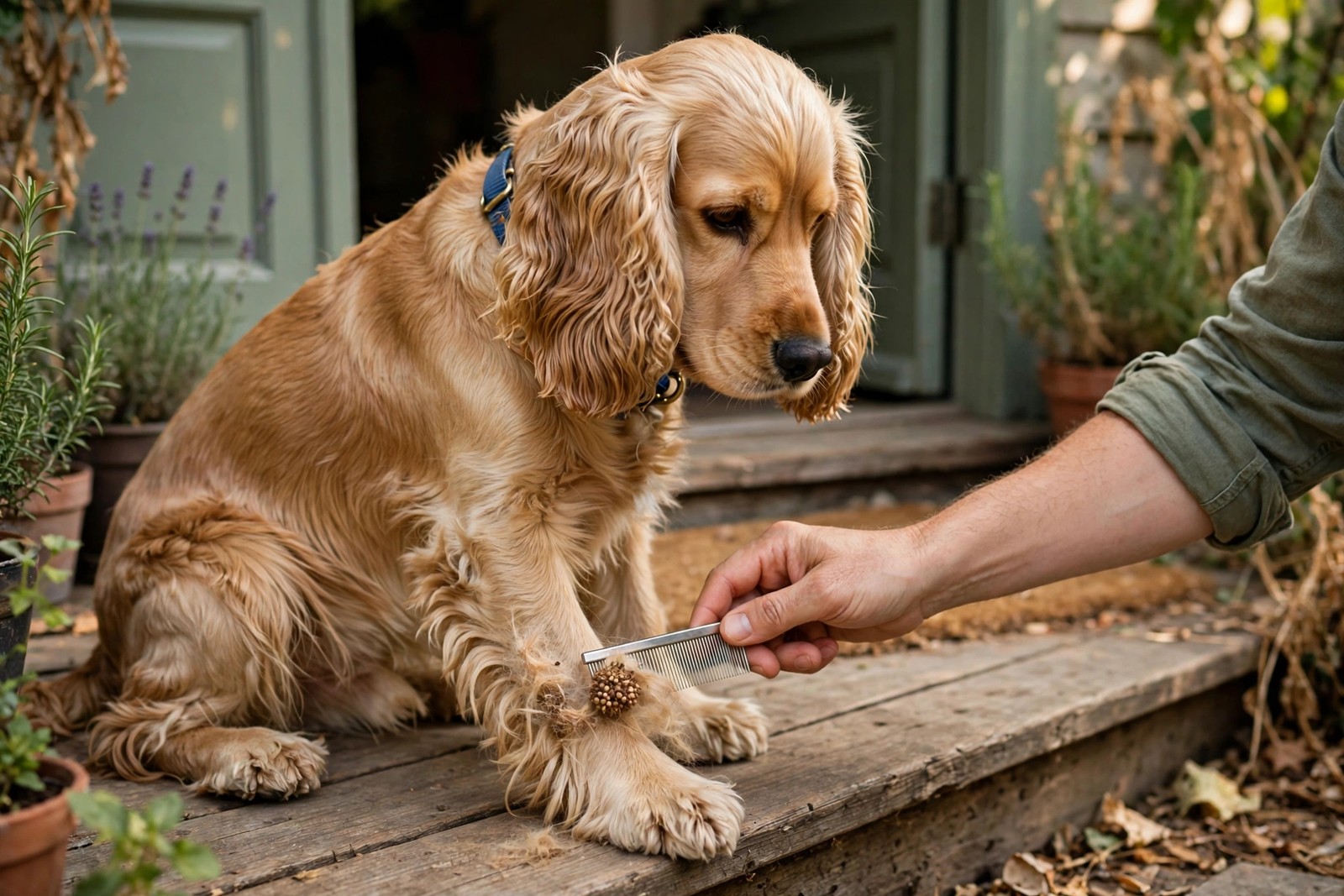
A burr is a small hook-covered trap, and yanking it out tears hair, hurts skin, and teaches a dog to dodge the comb for a month. The whole technique rests on three things: slip, so hooks release hair instead of gripping it; support, so pulling force lands on your fingers rather than the dog's skin; and patience, because burrs surrender strand by strand and almost never all at once.
Soften First, Pull Second
Settle the dog somewhere well lit, with treats arriving at intervals, and look before you touch: a coat check by eye and hand tells you whether you face three burrs or thirty, and where the worst of them hide. Into each burr and the hair knotted around it, work a little food-safe oil or a detangler made for dogs, massaging gently so the coating reaches the centre of the tangle. Give it a minute. Oil changes the physics of the job: hooked barbs slide along oiled hair instead of locking onto dry shafts, and matted strands separate under your fingers rather than snapping.
Tease Out One Burr at a Time
Pinch the hair between the burr and the skin firmly with one hand, close to the skin, so that hand takes the strain of everything you do next. With the other hand, pick the burr apart from its outer edge inward, freeing a few strands at a time with fingers first and then a comb drawn through the loosened edge. Break a big, hard burr into pieces with your fingers if it will crush, since fragments release more easily than one solid ball, and work the comb in short strokes from the tips of the hair toward the burr rather than dragging from the skin outward. Wash the oiled areas with your dog's usual shampoo once the coat is clear, because oil left in a coat collects dust and gives tomorrow's burrs a head start.
A burr matted flat against skin with hair wound tight around it is the one case for clippers or scissors in careful hands, guarding the skin with a comb as a barrier, and a dog who cannot tolerate work near a tangle should meet a groomer rather than a struggle.
Seeds Play by Different Rules
Loose seeds sitting in the coat brush out during the same session, but pointed grass seeds are travellers: their shape lets them move one way, inward, through hair and toward skin. That is why the finishing check matters as much as the combing. Run your hands deliberately over the ears and under the ear flaps, into both armpits, along the groin, and between every toe, spreading the toes and looking as well as feeling, since a seed wedged between toes announces itself mainly by a dog licking one paw on the drive home. Remove any seed you can see lying on the surface with fingers or tweezers drawn along the hair, never digging beneath it.
Keep the boundary firm: a seed you suspect has entered an ear canal, or a dog who shakes his head repeatedly, tilts it, paws at an ear, or cries when an ear is touched, is not a home grooming problem. Stop, leave the ear alone, and contact your veterinarian, because probing after a seed inside an ear risks pushing it deeper and injuring a canal you cannot see into.
Make the Check a Habit of the Route
The cheapest burr session is the thirty-second one at the car or the front door, while seeds still sit on the surface and burrs have not been slept on and ground into mats. Keep a comb and a small cloth by the door during seed season, run the same hand-check in the same order after every grassy walk, and shake out bedding where a travelling dog sleeps, since seeds shed indoors migrate to the next coat that lies down there. Care Teams on KinsLe keeps a short note of where seeds clustered, helping the next walker choose a cleaner line through the field.