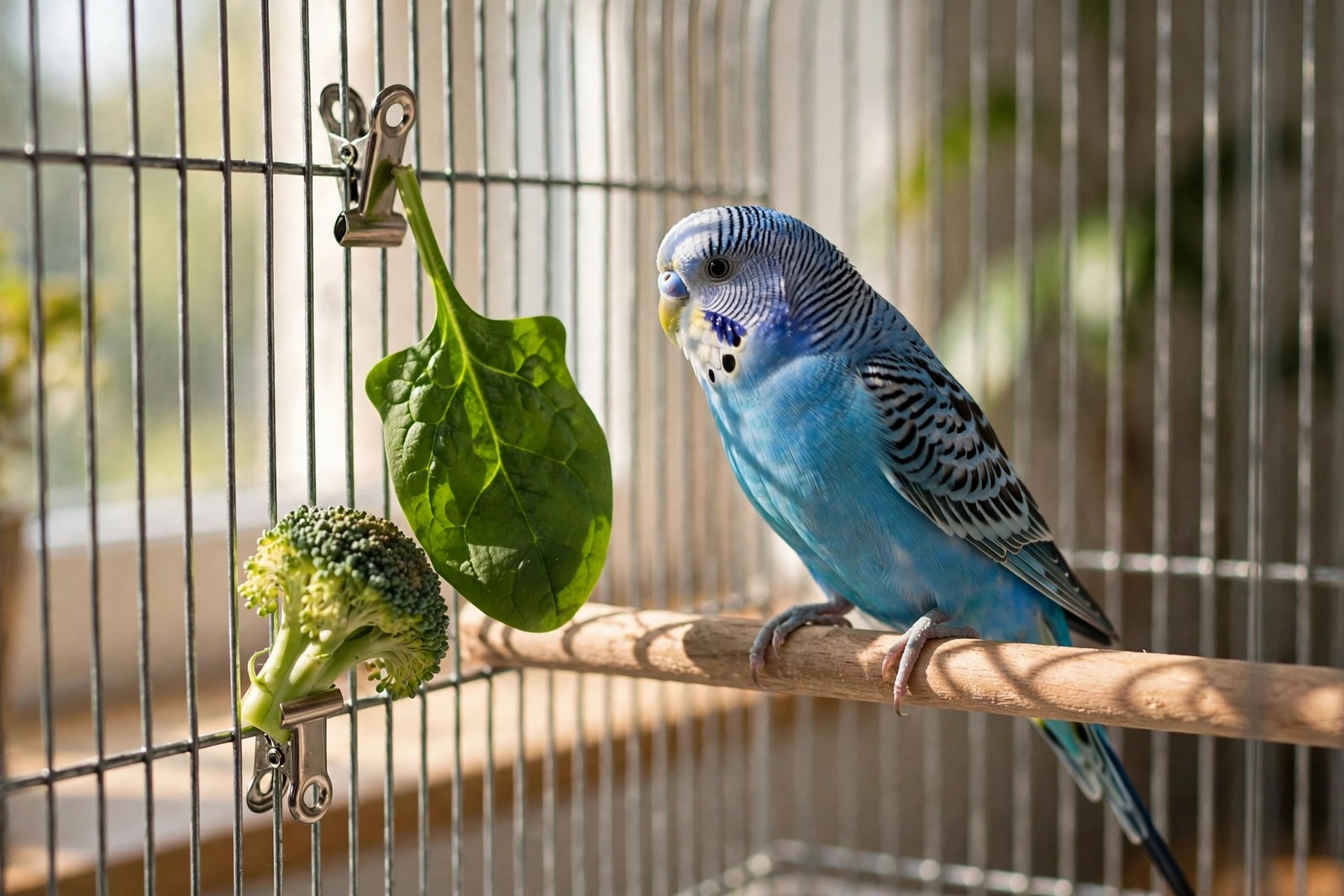
A budgie that ignores vegetables is not being stubborn. In the wild, budgies learn what is safe by watching flock mates eat, and a cage bird raised on seed has simply never learned that a green lump is food. Your job is to teach that lesson slowly, through presentation and repetition, without ever letting the bird go hungry in the name of conversion. Keep the normal diet available throughout; vegetables are added alongside it, never swapped in as an ultimatum.
Start With Vegetables Budgies Accept Easiest
Sweetcorn kernels, peas, grated or finely chopped carrot, broccoli florets, and leafy greens such as spinach, kale, or lettuce are the usual first successes. Broccoli has a special benefit: its tiny buds resemble seeds, so many budgies pick at it before they will touch anything flat or wet. Cooked sweet potato in small mash-like pieces also tempts some birds. Avoid avocado and onion entirely, as both are unsafe for birds, and wash everything, removing uneaten fresh food after a few hours so it cannot spoil in the cage.
Offer vegetables first thing in the morning, when the bird is at its hungriest and most active. An evening offering to a bird that has eaten seed all day is usually ignored, and repeated ignoring can look like failure when it is really timing.
Presentation Tricks That Actually Work
Chop it through the seed. Finely chopped carrot, greens, or broccoli mixed into a small dish of seed forces tastes with every peck, and many birds convert by accident this way. Reduce the seed in that dish gradually over weeks as the vegetable share is eaten more willingly.
Clip it up. A whole leaf or a strip of pepper clipped to the bars near a favourite perch becomes a toy to shred, and shredding leads to tasting. Budgies investigate things at head height far more readily than food sitting in a dish on the cage floor, which many instinctively distrust.
Skewer it. Pieces of corn, carrot, and broccoli threaded on a hanging skewer turn feeding into play, and several pieces in a row give the bird repeated small tastes in one session. Eating alongside helps too: have your own salad or vegetables where the budgie can watch you eat, then offer a piece from the same type of food. Flock logic is powerful in a species built to copy companions.
The Persistence Part Nobody Warns You About
Expect weeks, not days. A common pattern is total indifference for a fortnight, one experimental nibble, then slow acceptance of one favourite while everything else is still refused. That is success. Build outward from the accepted vegetable, offering one new item at a time in the same winning presentation, rather than presenting a mixed bowl of strangers.
Watch droppings and weight rather than the dish. A bird that is tasting will show flecks of colour in droppings and small beak marks in clipped leaves long before it eats a visible portion. Never withdraw seed to force hunger: small birds have fast metabolisms, and a budgie that will not eat the new food can genuinely harm itself by not eating at all. If your bird loses weight, stops eating, or seems unwell, return fully to the familiar diet and talk to an avian vet.
Once one or two vegetables are accepted, rotate a short list through the week so the habit sticks and the diet widens naturally, and use KinsLe's Care Teams to assign each morning's vegetable prep to a named person, with completed tasks marked by timestamp, so a busy household offers the new foods every single day instead of whenever someone remembers.