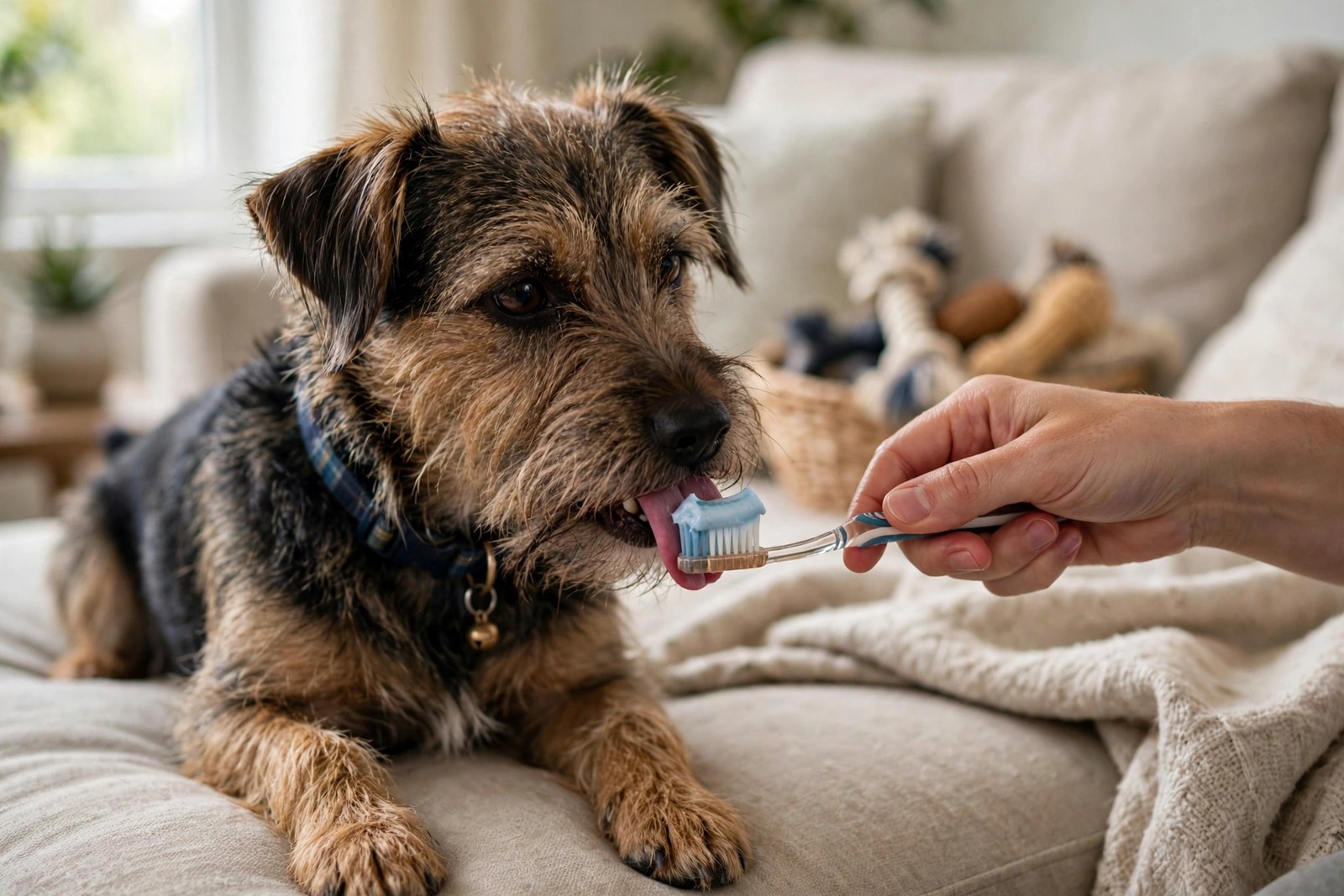
A dog who clamps his mouth shut and retreats from a toothbrush is not being stubborn. He has learned that the object predicts an invasion, and each forced attempt teaches the lesson harder. Desensitisation reverses that prediction in small enough steps that the dog never needs to panic, and it works in one direction only: forwards is earned, never taken.
The Steps, in Their Fixed Order
Run the steps in exactly this sequence, staying on each one until it looks boring. Step one: the brush appears, he sniffs it, a reward lands, and the brush goes away. Step two: toothpaste made for dogs goes on the bristles and he licks it off while you hold the brush still, so the brush becomes a flavour he seeks rather than a tool used on him. Step three: the brush, with paste, touches his lips and the outside of his closed mouth for a second, then withdraws, then pays. Step four: a lip lifts briefly and the brush strokes the outer surface of a few teeth, the big canine and the teeth you can reach without prising anything open. Only when step four looks relaxed do you add teeth, a few at a time, across later sessions. Never use toothpaste made for people; formulas for dogs are made to be swallowed safely and taste like food to a dog, which is half the persuasion.
The Finger Brush Stepping Stone
Many clamped dogs accept a finger long before they accept a brush, because a finger is familiar, warm, and honest about pressure. A finger brush worn on your fingertip, or a soft cloth wrapped around the finger, lets you rub paste along the outer gumline while feeling his jaw tense a half-second before he pulls away, and that warning lets you stop while you are still winning. Work the stepping stone for as long as it takes, daily and briefly, and reintroduce the handled brush later by returning to the lip-touch step with it, rather than assuming finger success transfers automatically. Some dogs finish their training doing their whole clean on a finger brush, and clean teeth reached calmly that way beat a perfect brush technique achieved by force.
Session Rules That Protect Progress
Keep every session short enough to end early — under a minute at first, in the same quiet place, at the same point in the day, ideally when he is already mellow rather than wound up. The ending rule matters most: stop before panic, not after it. The moment you see the warning stack — turning the head, leaning away, licking lips, the jaw setting hard — the session closes on the last easy step with a reward, so his memory of the encounter is success followed by supper, not escape from a struggle. Skipping backward a step after a bad day is training working as designed, not failure; the staircase is climbed at the speed of the slowest step, and rushing a step usually costs three.
Praise and payment should be generous and immediate, a favourite soft treat delivered the second the brush withdraws, so the association lands on the brush rather than on the ordeal ending.
When the Mouth Itself Needs Checking First
A dog who has previously tolerated handling and now clamps, flinches, or backs away may be protecting pain rather than expressing an opinion about brushes. Bad breath that has worsened, red or bleeding gums, reluctance to chew hard food, or pawing at the mouth all justify asking your veterinarian to examine the mouth before you invest weeks in training around a sore tooth. Clear the medical question first where those signs exist, then desensitise a mouth you know is comfortable. Care Teams through KinsLe keeps sessions short on paper too, with one line per day showing the furthest calm step reached.