
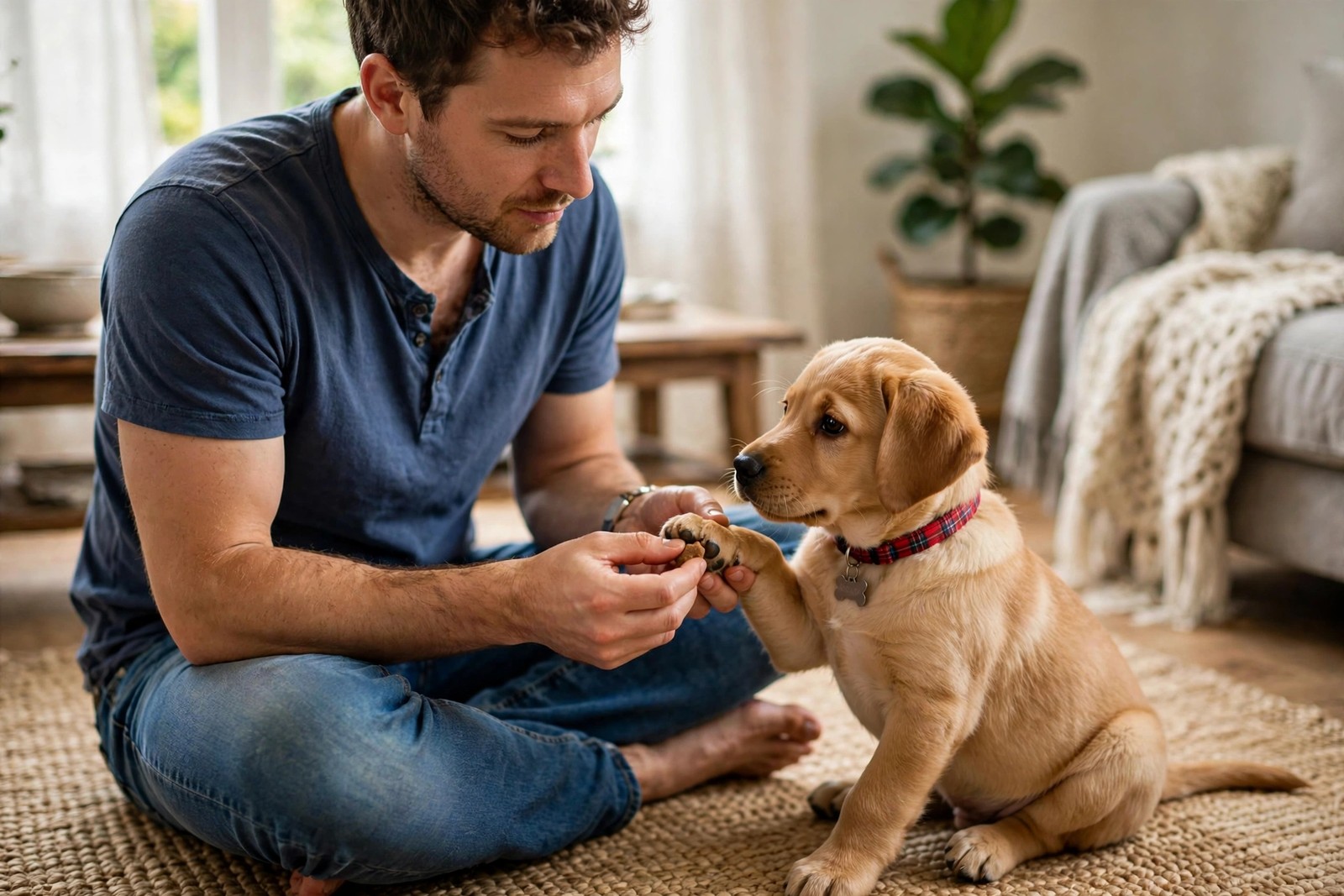
The secret to a puppy who calmly accepts paw, ear, and mouth handling is tiny, boring repetitions paired with food: touch briefly, treat immediately, stop while it is still going well. Done a few times a day in sessions under a minute, this builds a puppy who grows into a dog that nail trims, ear checks, and vet exams barely register for.
Why this matters more than almost any trick
Handling is not really about grooming. It is about every future moment someone needs to touch your dog's body: the vet palpating a sore ear, the groomer clipping nails, you extracting a thorn from a paw pad on a walk, a child grabbing an ear before you can intervene. Dogs who learned early that these touches predict treats tolerate all of it with a loose, relaxed body. Dogs who meet these touches for the first time as adults, usually when something already hurts, often panic — and a frightened 30-kilo dog is a genuine safety problem for everyone in the room.
A simple session, step by step
Work when your puppy is calm but not asleep — after a play session and a toilet break is ideal.
- Touch one paw for one second. Treat.
- Lift the paw gently, hold two seconds. Treat.
- Press the paw pad lightly, as a nail trim would begin. Treat.
- Peek inside one ear, lifting the flap. Treat.
- Lift a lip and glance at the teeth for a second. Treat, then finish.
That is the whole session. End there even if it is going beautifully — stopping while your puppy still wants more is what makes them keen tomorrow. Over a few weeks, stretch the durations: hold the paw for five seconds, touch each toe, look in the ear a little longer, run a finger along the gumline.
Troubleshooting the wiggles
If your puppy mouths your hand, pulls away, or gets wound up, you have asked for too much too fast — not a naughty puppy, just information. Shrink the step: touch the shoulder instead of the paw, or the side of the ear instead of lifting it, and rebuild. A lick mat with a smear of soft food stuck to the floor or a tiled wall is a wonderful cheat code here; while the puppy licks, their body stays still and your touches pair with something delicious.
Never chase a puppy to finish a handling session, and never scold mouthing during one. The emotional lesson you are installing is "hands near my body mean snacks and calm," and any tension from you rewrites that lesson instantly.
Generalize beyond you
Once your puppy is relaxed with your handling, recruit calm friends and family to run the same micro-sessions, so the lesson becomes "people handling me is fine," not just "my person handling me is fine." Keep visitors' sessions even shorter and treat-heavy. Children should only take part seated, supervised, and with the puppy free to walk away — an honest exit route is what keeps the puppy choosing to stay.
Set up the first professional experiences
All this practice pays its biggest dividend at the first groomer and vet visits, where a puppy who accepts handling can be worked with gently instead of restrained. When you are ready to book that first groom, KinsLe's Pet Services Directory helps you find local groomers, vets, sitters, and trainers — and you can tell the groomer exactly what your puppy already knows, so they can go slowly and build on it. For that first grooming appointment, search the Pet Services Directory on KinsLe for puppy-friendly professionals nearby, then tell your chosen groomer which paw, ear, and mouth touches already earn treats at home.