
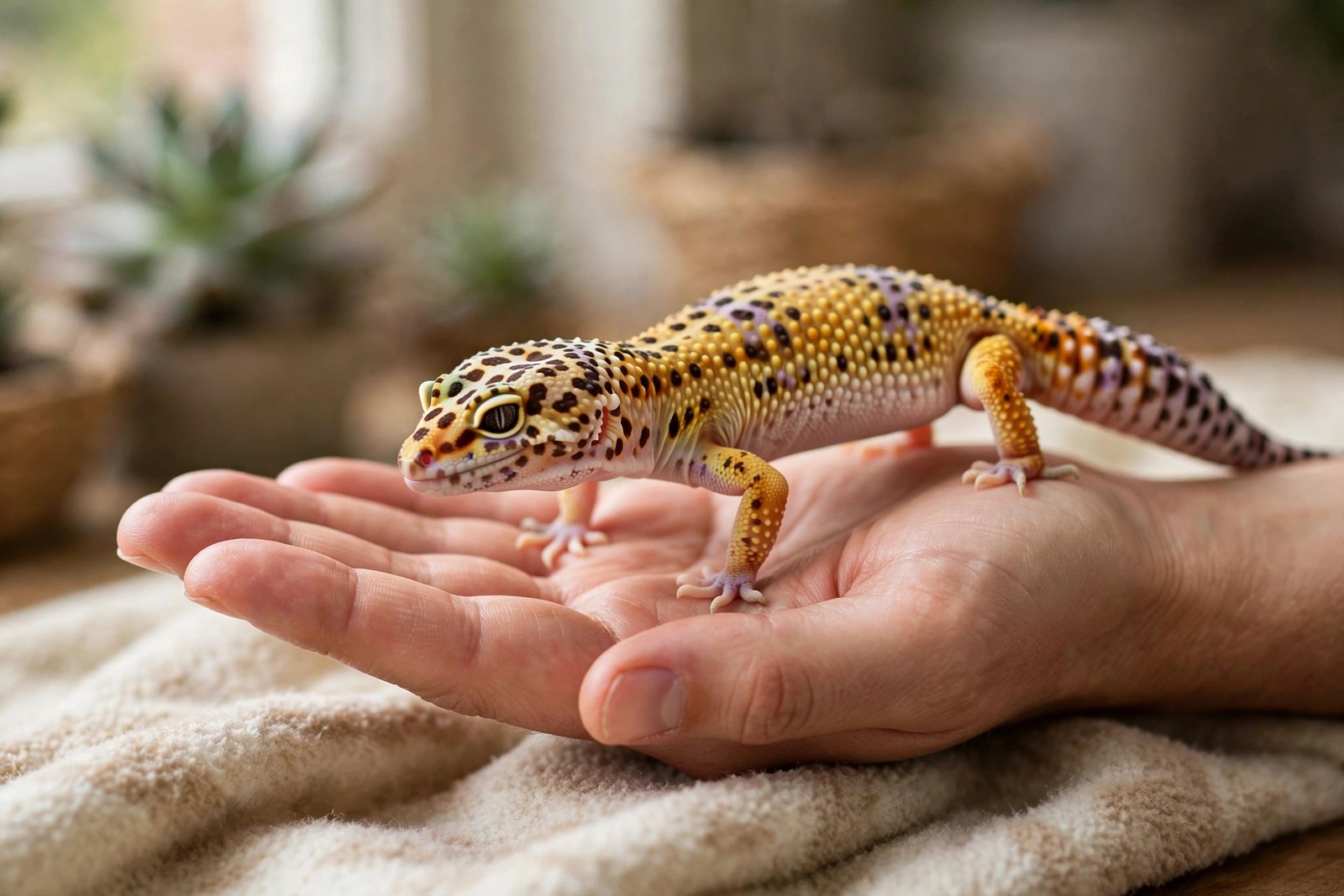
To handle a leopard gecko without hurting its tail, let it walk onto your flat, low hand on its own, support its whole body once it is aboard, and never pick it up by the tail — leopard geckos can drop, or autotomize, that tail when they feel grabbed or threatened. A dropped tail will regrow, but it is stressful, costs the gecko its fat store, and is almost always avoidable with a slower approach.
Why the Flat Hand Works
A gecko that chooses to step onto your hand feels in control; a gecko scooped from above feels hunted. Place your hand flat inside the enclosure or just in front of the gecko, low and still, and let it investigate and climb on. A gentle guide from behind with your other hand is fine — pressure on the body is not. Once it is settled, cup your second hand loosely over or beside it as a safety rail rather than a lid, and lift slowly.
Keep everything close to a soft surface — a bed, sofa, or your lap — especially with young or new geckos, because leopard geckos can dart without warning and a short drop onto something soft is a scare, while a fall to a hard floor can be an injury.
Session Length and Timing
Keep sessions brief while your gecko is young or new to you, and build up gradually as it relaxes. A calm gecko moves steadily, licks and explores, and settles on a warm hand; a stressed one freezes, squeaks, arches, or tries to bolt repeatedly — all reasons to end on a quiet note and try again another day.
Evening sessions usually go best, since leopard geckos are crepuscular and more naturally active then. Avoid handling during shed, right after a move, or when your gecko is clearly hiding to sleep, and wash your hands first so you do not smell like food or another pet.
Tail Safety Rules Worth Memorizing
- Never grab, pinch, or lift by the tail — even a quick reflex grab can trigger a drop.
- Do not let children hold a gecko unsupervised, and have everyone sit down first.
- Keep other pets out of the room; a cat's stare alone can terrify a small gecko.
- If the tail does drop, stay calm, return the gecko to a clean enclosure, and keep the area clean; mention it to a reptile vet if the site looks irritated or the gecko stops eating.
A regrown tail looks shorter and smoother than the original, which is normal. What matters is preventing a repeat by slowing every future pickup down.
Handling Notes Are Care, Too
Feeding schedules get written down, but handling quirks often live in one person's memory: this gecko darts left, that one only steps on willingly after lights dim. Those details protect the tail just as surely as technique does when a partner, older child, or sitter is the one doing the handling that week.
Coordinating It All With KinsLe Care Teams
KinsLe Care Teams let you assign feeding, walks, medications, and grooming duties — and for a gecko, handling notes belong right alongside its feeding and enclosure-cleaning duties. A team member assigned to evening feeds can see "flat hand only, never the tail, ten minutes maximum" before they open the enclosure, and completed duties are marked with a timestamp so you know what was actually done. Everyone handles your gecko the safe way, not just you. Put the flat-hand warning where evening feeders will actually see it, using the Care Teams duty list on KinsLe, so nobody lifts your gecko by its tail while you are away.