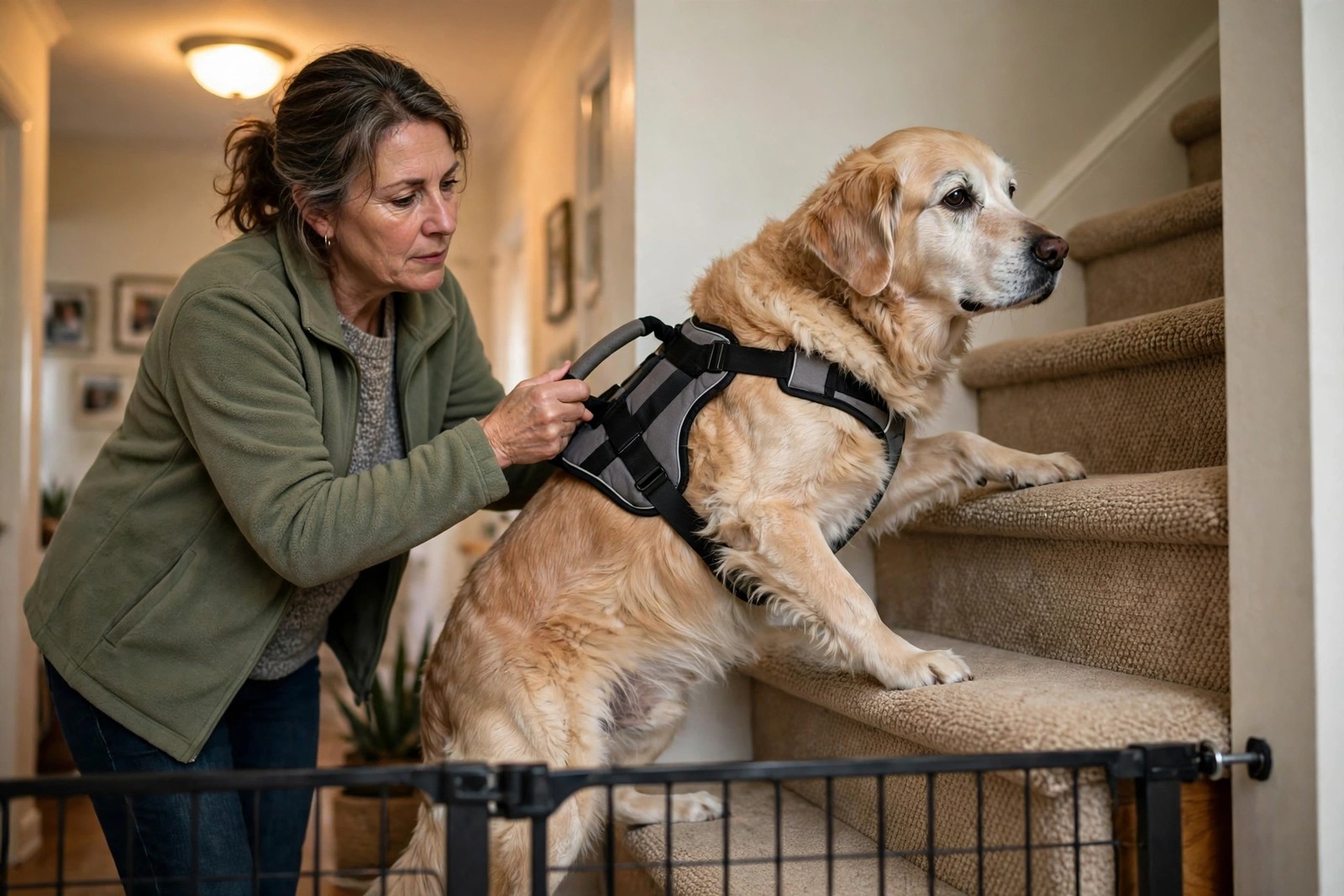
Stairs ask a senior dog for everything ageing takes away: strength to push up with the hind legs, flexibility to reach the next tread, balance, depth perception, and confidence on a surface where a slip has consequences. Good management does not just help him up the stairs — it redesigns the day so stairs become rare, supervised, and as safe as you can make them.
First, Reduce How Often Stairs Are Needed
If your dog's bed, food, water, toys, and access to the garden can all live on one floor, most stair journeys simply disappear. Many owners move their own evening routine downstairs for a while, or set up a genuinely comfortable downstairs bed rather than a token cushion he ignores in favour of following you up. What matters is that he stops making lone trips because his favourite people are upstairs. If he has always slept in your room, weigh that attachment honestly and plan supervised, supported trips rather than pretending a dog who has climbed stairs for twelve years will quietly accept exile.
Block unsupervised access with a secure gate at the bottom, and, where he could turn and descend, at the top as well. A gate is kinder than a closed door for a dog who likes to see and hear the household, but it must be fitted so he cannot push through or attempt to jump it.
Make Each Step Grippier, Brighter, and Slower
Bare wood and laminate stairs are skating rinks for old paws. Fit adhesive treads or a secure runner on every step, keep nails trimmed and the fur between his pads clipped short so his pads make contact, and consider non-slip socks or boots only if he tolerates them without an altered, stressed gait. Improve lighting at the top, bottom, and any turn, and leave a low light on at night, because senior eyes adapt slowly and a shadowed staircase invites a misjudged step.
When stairs are necessary, use a support harness with handles over the shoulders and hips. Walk beside or just behind him going up, taking some hindquarter weight as he steps, and in front of him going down, letting the harness slow and steady each step rather than letting momentum build. Move one step at a time, pause on landings, keep the lead short but loose, and never pull upward by a collar or drag a reluctant dog. If another person is available, one guides and one supports until the routine is known.
Know When Stairs Should Stop
A dog who bunny-hops both hind legs together, sits down partway, cries, trembles, or arrives at the top panting and distressed is telling you the current arrangement is beyond him. So is a dog who begins avoiding the stairs he used daily. Mention the change to your veterinarian rather than simply training harder, because stair difficulty in a senior dog is meaningful information about pain, weakness, eyesight, and general health, and there may be help available once the picture is understood.
Carry small senior dogs on stairs if you can do so safely, supporting chest and hindquarters with a level spine, and do not let children carry him. In KinsLe, Care Teams can hold the gate-check duty, the named person for accompanied stair trips at bedtime, and a note of any new difficulty spotted, so his stair support is a shared, written plan rather than a hope that someone was watching.