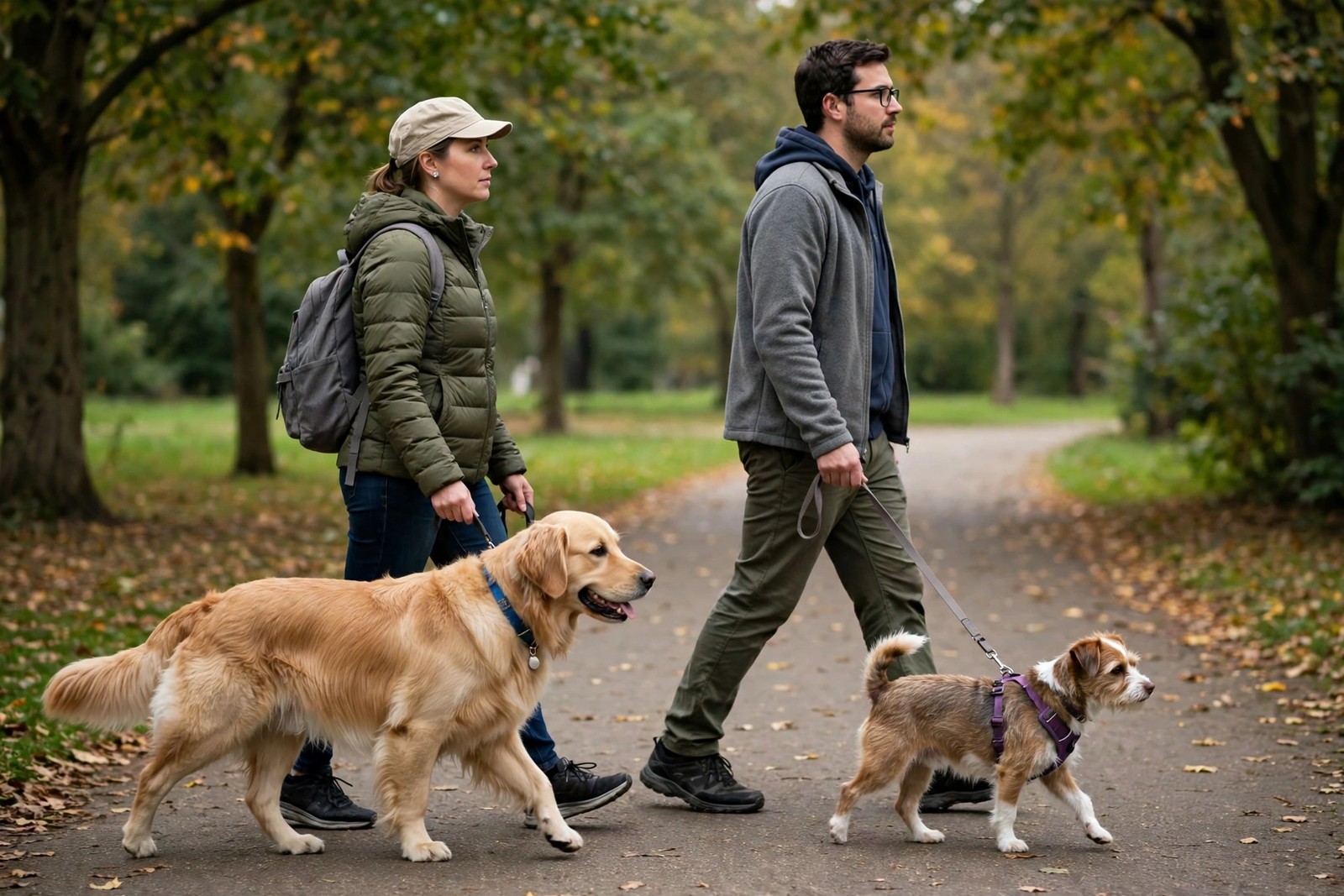
Your resident dog did not choose a housemate, and the foster dog is arriving stressed, overtired, and fresh from transport or kennels. A good introduction protects both: it happens away from your front door, it gives the foster dog time to decompress before any social demands, and it keeps every resource, from dinner to the best sleeping spot, uncontested while the two dogs work each other out.
The First Meeting: Not at Your House
Meet on neutral territory such as a quiet street or park neither dog claims. Each dog needs its own handler, a well-fitting lead, and enough distance at the start that they can notice each other without staring, lunging, or dragging toward one another. Walk in parallel in the same direction, letting the gap narrow gradually only while both dogs stay loose-bodied, sniff the ground, and glance away easily.
Allow a brief sniff of a few seconds, ideally approaching from the side rather than head-on, then call away cheerfully and keep walking. Repeat a few times. Loose wiggles, play bows, and soft, curved body language are encouraging; hard staring, freezing, raised hackles that do not settle, or one dog persistently pinning or mounting the other are reasons to increase distance and end on a walk rather than push for closeness. Walk them home together if it is going well, but enter the house in a managed way, resident dog settled or foster dog taken straight to their prepared area, rather than both bursting through the door at once.
Decompression and Separation at Home
The foster dog needs their own zone for the first days: a separate room or gated area with bed, water, bowls, and chew items, where they can sleep undisturbed. Many foster dogs sleep enormously in the first 48 hours; that is decompression, not laziness. Rotate garden access, keep doors and gates closed between the dogs when you are not actively supervising, and let them learn each other's household sounds and smells through the barrier before building shared time.
Feed all meals separately behind a closed door, and pick up bowls afterwards. Keep high-value items such as bones, long-lasting chews, and favourite toys out of shared spaces entirely in the early period; most early foster friction is not about temperament, it is about a tired new dog guarding the first good thing it has been given.
Building Shared Time
Start with short, supervised sessions in the largest, least valued space, often the garden, with leads trailing so you can intervene without grabbing collars. Watch for the pattern over days rather than one good afternoon: both dogs choosing to rest in the same room, relaxed body language around doorways and water, and play that swaps roles and pauses naturally. Grow the sessions gradually, keep your resident dog's original routine, privileges, and one-to-one time intact, and separate again without drama if either dog stiffens, guards, or cannot settle.
Expect the foster dog's behaviour to shift after the first week or two as confidence grows; a dog who was shut down and angelic may start testing boundaries, and that is a normal stage to manage, not a failed introduction. If there is a fight, repeated guarding, or your resident dog stops eating or relaxing in their own home, separate fully and talk to the rescue organisation supporting the foster placement for a behaviour plan.
Foster care runs on small tasks done at the right times by different people, and KinsLe Care Teams lets you assign the foster dog's separate feeds, garden rotations, and rest periods alongside your resident dog's normal routine, each marked complete with a timestamp so the two schedules never collide.