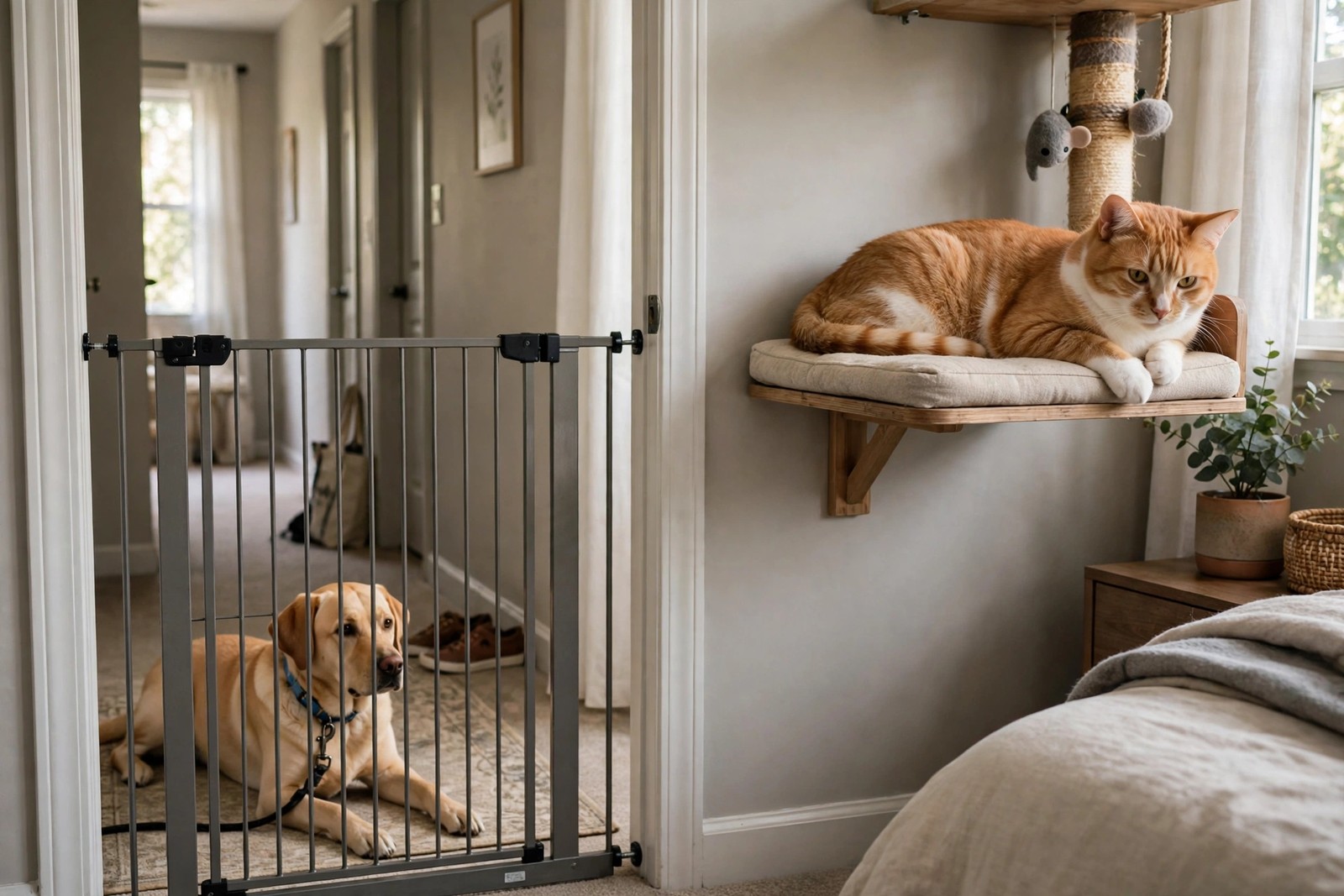
This introduction has a complication a single-owner household does not: two owners, two loyalties, and a cat who never agreed to a dog. It succeeds when the humans settle the rules before the dog walks in, including whose animal gives ground, where the cat's untouchable territory is, and the honest answer to what happens if the pairing does not work.
Before the Dog Moves In
Choose your cat's sanctuary room now, ideally the room where your cat already sleeps and where you spend your own time, often your bedroom. Move or confirm the full setup inside it: litter tray, food, water, scratching post, hiding place, and a perch. Fit a gate or plan for a door that stays closed, and make sure the cat can live comfortably in that room for weeks if needed, because that room is the foundation every later stage builds on.
Agree the household rules in plain terms with your roommate: the dog is never in the sanctuary room, the dog is on a lead or behind a gate in shared spaces during the introduction period, and nobody carries the cat to meet the dog for a cute first moment. If the dog has a known history of chasing or harming cats, stop here and have a frank conversation about whether this living arrangement is safe at all; management can reduce risk, but it cannot rewrite a determined, practised cat-chaser.
Scent First, Then the Door
For the first several days the animals do not see each other. Swap bedding between the sanctuary and the dog's sleeping area, and feed both animals on their own side of the sanctuary door, moving bowls gradually closer to the door only while both eat calmly. Your cat eating, toileting, and relaxing normally in the sanctuary is your readiness signal. A cat who stops eating, hides constantly, or toilets outside the tray is stressed, and the correct response is more distance and more time, not a quicker push to face-to-face meetings.
Let them hear and smell the household's new rhythm settle. Dogs are loud, clumsy housemates at first, and many cats accept the idea of the dog in stages simply because nothing bad has happened at the closed door for a week.
Gated Meetings and Shared Space
Begin visual contact through a sturdy gate at the sanctuary door or across a hallway, dog on a lead held by your roommate, cat free to approach or retreat. Keep meetings to a few minutes. Your roommate rewards the dog for noticing the cat and turning back to them, for sitting, and for settling; you watch the cat, ending the session while the cat is still choosing to be there. Gradually extend sessions, then move to shared-room time with the dog on a trailing lead, the cat's escape routes open, and high perches and a gate gap the dog cannot fit through available at all times.
Shared space without the lead comes last, after weeks of relaxed meetings, and unsupervised shared access comes later still, if ever. Many shared houses keep the sanctuary door rule permanently, and cats thrive under it; the cat keeps a kingdom, the dog keeps the run of the rest, and the humans keep the peace.
Two owners means two chances for a rule to slip, so KinsLe Family Sharing lets you and your roommate keep the cat's sanctuary rules, current introduction stage, and notes on each meeting in one shared profile both of you check, rather than relying on a hallway conversation one of you half-remembers.