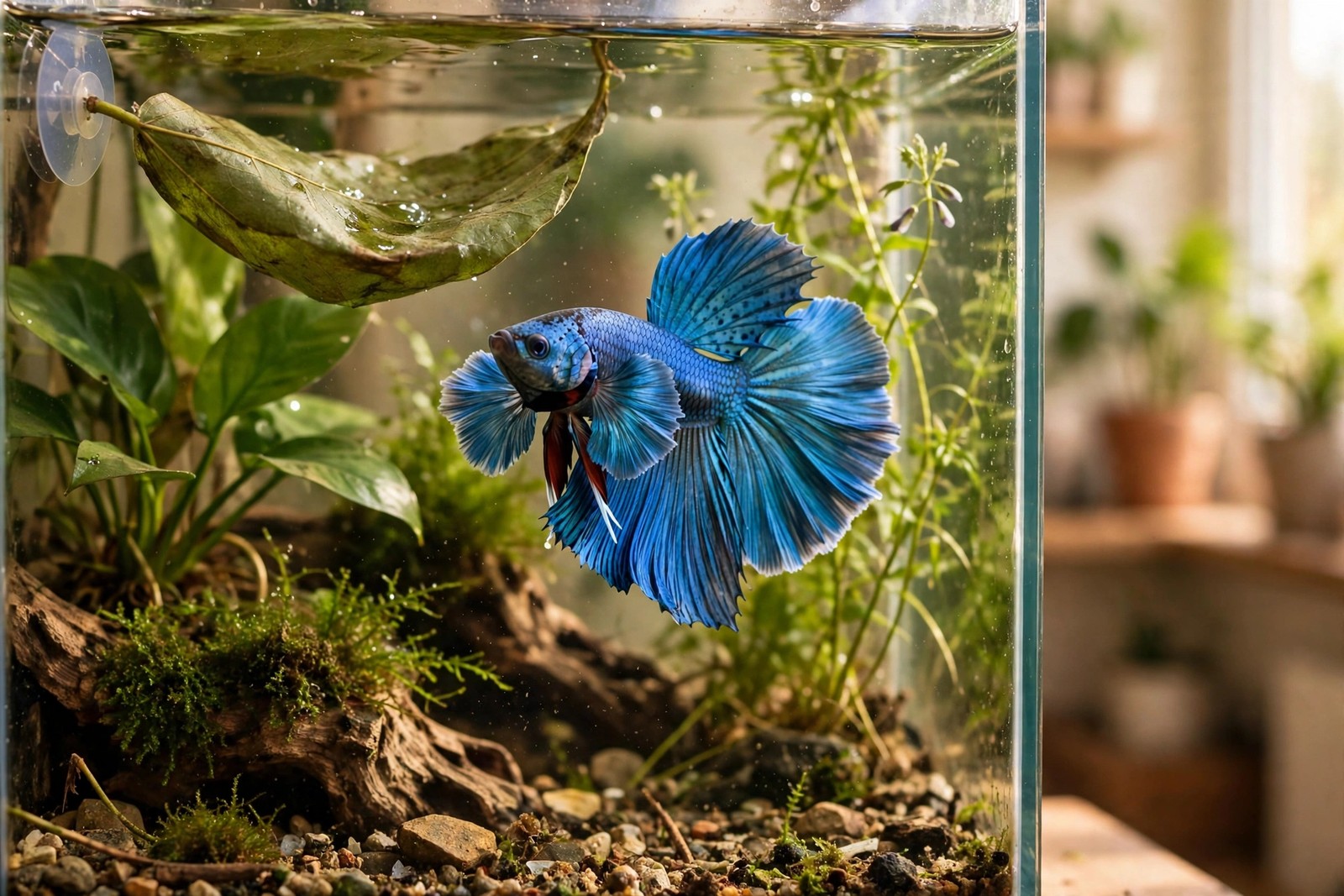
A betta in a bare bowl has nothing to do, and boredom in a betta looks like glass-surfing, listless hovering, fin-nipping, or a fish who only moves at feeding time. Bettas are curious, territorial patrollers by nature. Entertainment for them is not toys in the human sense; it is a tank with territory worth inspecting, surfaces worth resting on, and small changes that reward a fish for exploring its own home.
Build the Interest Into the Tank
Plant the tank properly. Live plants are ideal, and soft silk is the safe alternative; avoid hard plastic, which can tear long fins. Give your betta plants of different heights, a hiding spot such as a smooth cave or coconut hut with no sharp edges, and open swimming space at the front so the tank has distinct zones to patrol. Bettas breathe at the surface and rest near it, so a floating log or a leaf hammock fixed just below the waterline is used daily, especially by long-finned males who tire quickly hauling their fins around.
Keep the environment stable while you enrich it: a heated, filtered tank with gentle flow, since strong current exhausts a betta and turns enrichment into endurance. Dim, plant-shaded areas alongside brighter ones let the fish choose its light level through the day.
Small Changes, On Rotation
Novelty is the enrichment. At each partial water change, move one piece of decor to a new position, swap in a different plant arrangement, or rotate which hide is in the tank. One change at a time is enough; a betta re-patrols a rearranged tank thoroughly, investigating what moved. A clean ping-pong ball floated on the surface for a short session gives some bettas an object to nudge and inspect; remove it afterwards so it does not foul the water or become permanent clutter.
A mirror held outside the glass for a few minutes triggers the famous flare display, gills out and fins spread, which is natural territorial exercise in a brief dose. Keep it to a few minutes, a few times a week at most, and never leave a mirror against the tank permanently; a betta who believes a rival never leaves lives in constant stress, and constant flaring can damage fins. A dry-erase pattern drawn on the outside of the glass, or your finger traced slowly along it, gives curious fish something to follow without the rival message.
Feed Like a Hunter, Watch Like an Owner
Rotate foods so feeding itself becomes activity: a quality pellet as the staple, with live or frozen bloodworms, daphnia, or brine shrimp a few times a week, scattered so the fish searches rather than waiting at one corner. Some owners move the feeding spot around the tank deliberately, letting the betta hunt for where today's meal appears.
Enrichment also doubles as a health check. A betta who stops exploring, ignores a decor change, or abandons a favourite resting leaf has told you something changed, and water testing is the first response, before assuming the fish is simply bored. Active patrolling, nest-building in males, and eager feeding are your signs the setup is working.
Rotating decor and feeds is easy to forget in a busy house, and KinsLe Care Teams lets you schedule enrichment swaps, plant checks, and varied feeding days for each person who cares for the tank, timestamped when done so the betta gets variety without being disturbed twice in one day.