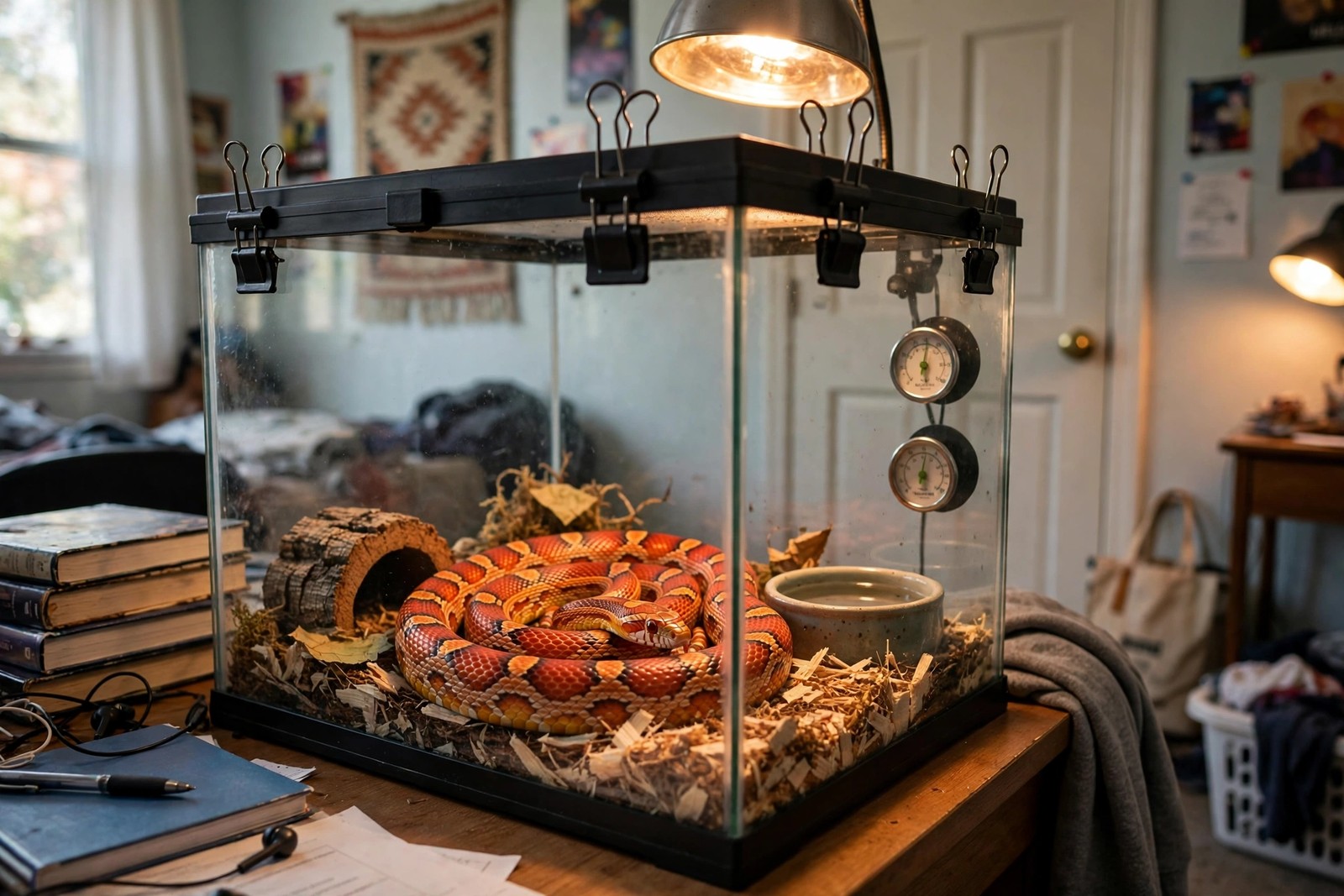
A student house share is close to a corn snake's ideal escape environment: doors opening at all hours, guests who have never kept a snake, and a room that is also a corridor to somewhere else. Corn snakes are not strong or destructive escapers — they are patient, slender opportunists. Security comes not from one heavy lock but from a short chain of habits, held by everyone in the house.
A Snake That Tests Every Lid
Understand the animal first. A corn snake pushes upward at lids with its nose, tests corners, and explores any seam where two surfaces meet, and it can squeeze through a gap far narrower than its resting body suggests — keepers often say a gap a finger would not notice is a doorway to a corn snake. That exploration is not misbehavior and it never switches off; a well-fed, calm snake still patrols its edges at night. So the question is never whether the snake will try, only whether the enclosure gives the trying anywhere to go. Every measure that follows serves that one fact: lids, seals, and doors are not precautions against a freak event, they are the standing answer to behavior the snake will repeat for its entire life.
Clips, Seals, and the Every-Time Check
Make the lid incapable of casual failure. It should be clipped or locked down, not merely resting in place or weighted with a book that a housemate can move and forget. Then attach the rule that does the real work: the lid is checked every time it is closed — a physical tug or a run of the fingers around the rim after every feeding, every water change, every handling session, with no exceptions for being in a hurry. The check has to live at the moment of closing, because an unnoticed half-latch is discovered by the snake hours later, not by you. Next, walk the enclosure's edges and seal the gaps around cable entries and fittings, where thermometer probes and heat cables pass through; those factory holes are the classic exit, and they close with simple sealing described in the house note so any housemate can repair one the same way.
One Door, a Short Roster, and a House Briefing
The enclosure sits in a room whose door stays shut, and that shut door is the second barrier that turns an escape into a room search instead of a house search. In a share, a door stays shut only if everyone treats it as a rule rather than a preference, so brief the whole house at the start: the snake exists, the room door closes behind you every time, and the enclosure is opened by named people only — the owner and, at most, one or two housemates who have been shown how. Guests do not open it, ever, however confident they sound after a party. Put that roster in writing in the Family Sharing house note on KinsLe, alongside the lid check, because a share house runs on turnover and memory; the written note survives the housemate who moved in last month and the one who was out when the briefing happened.
If the Snake Gets Out Anyway
Even a good chain can drop a link, so the house should know the search pattern before it is needed. Start close to the enclosure and work outward, thinking like the snake: warm, dark, low, and tight. Behind and under appliances, along the warm run of pipes, inside shoes and bags left on the floor of that room, and along baseboards before anywhere high. Most escaped corn snakes are found surprisingly near home, often in the same room, because they settle into the first snug darkness they reach. Search quietly at nightfall if the day search fails, when the snake is likelier to move. An escape is reported immediately, without blame; the first hour of searching matters more than embarrassment.
Post the agreed escape rules through KinsLe's Family Sharing and every housemate, however late home, closes up by the identical checklist.