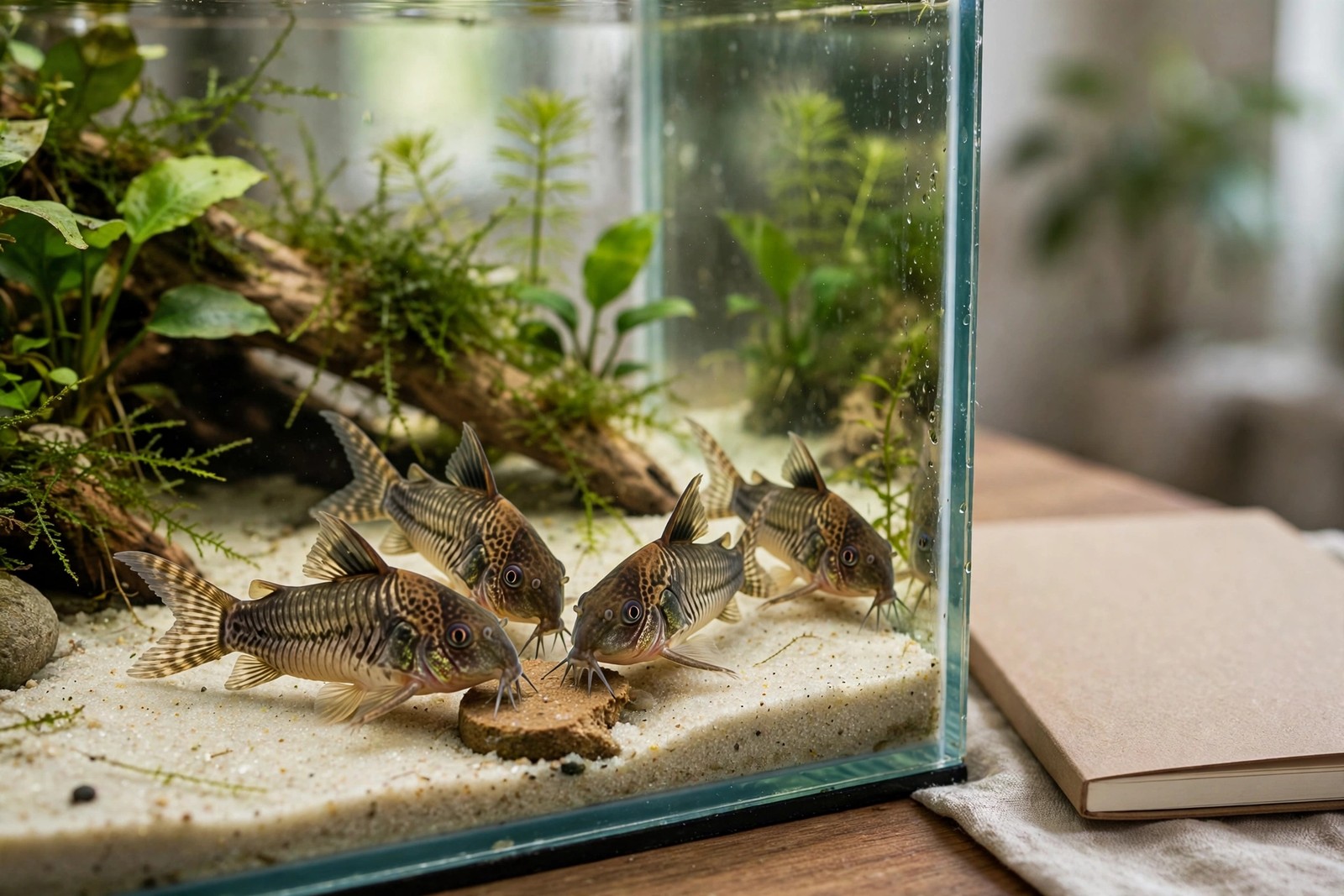
Corydoras are bottom feeders in a tank where other fish feed higher up, so the diary has a specific job: proving that food reached the bottom, in the right amount, and was actually eaten by the corydoras rather than stolen, buried or left to rot in the substrate. A rotation of several bottom foods makes that harder to judge from memory, which is exactly why the diary needs a fixed format instead of occasional notes.
One Line Per Feeding, Five Fields Every Time
Give every feeding a single line with the same five fields: date, food offered, amount offered, amount eaten or left, and notes. Amount offered needs units you can repeat — one sinking wafer, half a wafer, a small pinch of pellets, one thawed cube of frozen food — not a vague handful. Amount eaten is judged after the food has had time to be worked over: check the feeding spot, note whether the wafer was finished, partly eaten or untouched, and record whether you removed leftovers. The notes field carries what numbers cannot: whether the group fed eagerly or slowly, whether one fish hung back, whether the upper-level fish reached the food first, and whether the substrate around the feeding area looked fouled the next day. Five fields, kept in that order, make a month of lines readable at a glance.
Plan the Week on a Rotation Grid
Lay the week out as a grid before you fill in a single feeding, with one planned bottom food per day across seven days. A workable pattern is sinking pellets on the first day, a sinking wafer on the second, pellets again on the third, thawed frozen food on the fourth, pellets on the fifth, a vegetable-based sinking food on the sixth, and a lighter pellet feeding or a rest from rich foods on the seventh. The grid matters because rotation drifts without one: the food the fish enjoy tends to be offered again, the ignored food quietly disappears, and variety — the point of rotating — is lost. Record the actual feeding beside the planned one whenever they differ, and mark the substitution rather than rewriting the plan, so the diary shows both your intention and what really happened.
Review Weekly and Adjust Amounts, Not Just Foods
Read the week's lines together once a week. A food repeatedly recorded as partly eaten or untouched is either offered in too large an amount or is one your group does not take well from the bottom, so cut the amount first before you drop the food entirely. Leftovers noted on several days in a row mean the total ration is too large for the group, however varied it is, and uneaten bottom food decays where you can least see it. Eager feeding, clean substrate and active foraging between meals suggest the rotation and the amounts are close to right. Keep the diary in one place by the tank, and write each line while the food is settling rather than reconstructing the week from memory later. Note appetite changes against other tank events in the same diary — a water change, a new tankmate, a temperature shift — because a corydoras group that suddenly leaves food is often reacting to the tank, not the menu, and that pattern is worth showing to an aquatic vet if it continues. KinsLe's Pet Passport stores that weekly feeding diary with your corydoras group's tank and health records in one portable packet, so a sitter can follow the rotation exactly and a vet can see the appetite history behind any concern.