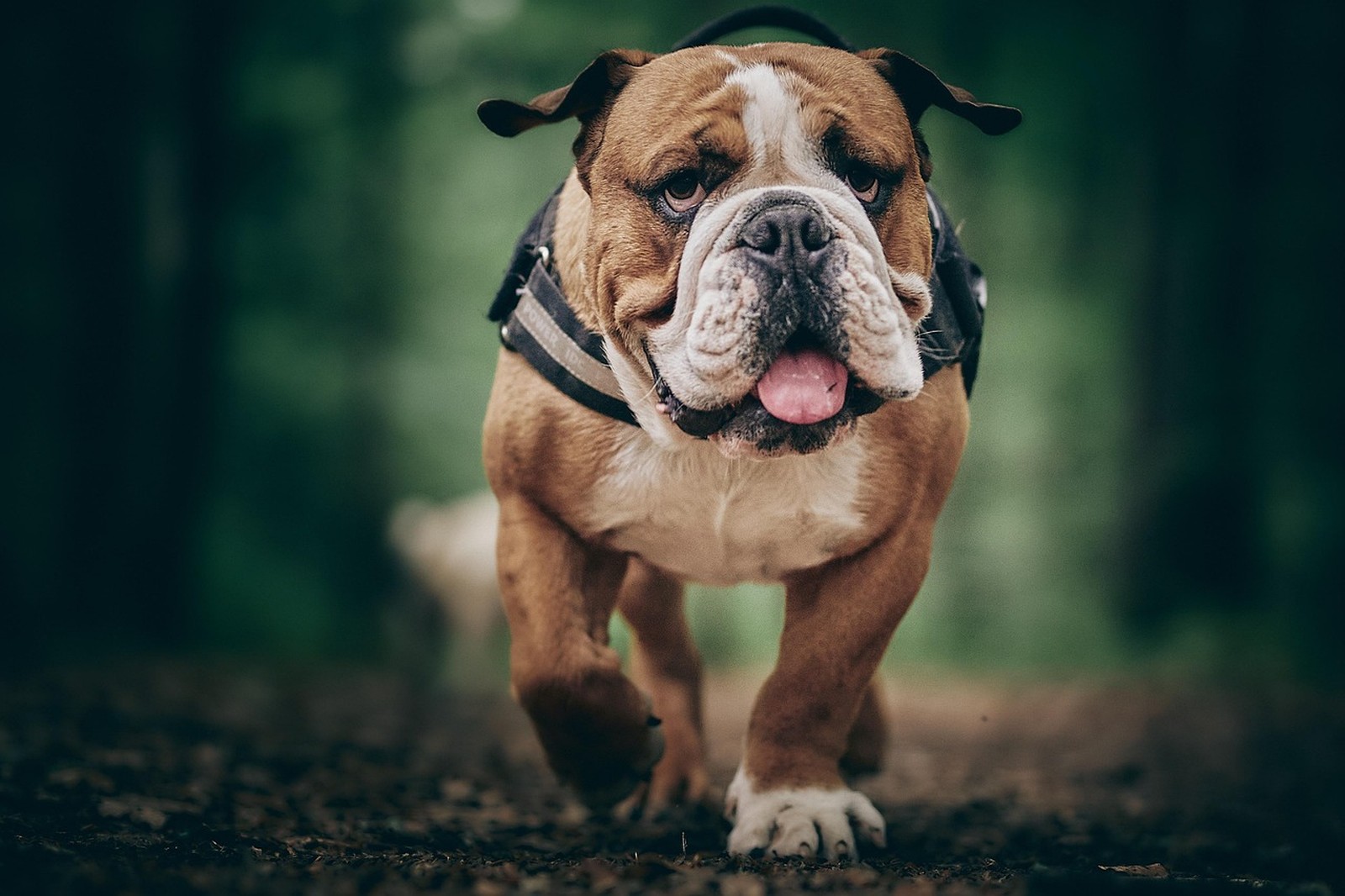
The Breed With the Least Margin of All
If any common breed should be wrapped in caution during a heatwave, it is the Bulldog. His very flat face, narrow airway, and the extra tissue in his throat make every breath harder work than it is for a longer-nosed dog, and panting — already his only cooling tool — moves too little air to keep pace with rising temperature. Add a heavy, low-slung body and a short coat over skin folds that trap warmth, and you have a dog whose safe window in summer is measured in minutes, not hours.
Many Bulldogs also snore, snort, and breathe audibly on a normal day, which tempts owners to treat noisy breathing as just his soundtrack. In a heatwave that assumption is dangerous. The question is never whether he is noisy, but whether the noise is new, harder, or failing to settle when he rests.
Redefine the Walk Down to Almost Nothing
On hot days, a Bulldog's walk is a dawn toilet outing: five to fifteen unhurried minutes on a harness, on grass or shaded pavement, with water carried and an immediate return home. On the hottest or most humid days, a shaded garden break replaces even that, and skipping the walk is a success, not a failure. Evenings are only an option once the air has genuinely cooled; a warm, sticky night is not a safe substitute for morning.
Never walk him in the middle of the day, never let him pull against a collar, and never add excitement — greeting favourite people, chasing a ball, playing with another dog — to a summer outing, because exertion and excitement stack heat onto a dog who cannot clear it. If he plants himself, sits, or lies down mid-walk, he is done: rest in shade, cool him, and carry him or fetch the car rather than coaxing him onward.
Build an Indoor Day He Can Actually Enjoy
His heatwave home is a cool room with airflow or air conditioning, a hard floor or cooling mat to sprawl on, and water within a few steps in more than one place. Bulldogs are homebodies at heart; a day of dozing near his people, a frozen chew, food scattered for slow sniffing, and a gentle fuss suits him well and keeps his temperature where it belongs. Keep visitors' play expectations low and supervise children, who may not read his breathing.
Attend to the folds while the weather is humid. Wipe and thoroughly dry his facial wrinkles and any tail fold daily, since warm, damp skin folds irritate and infect readily in summer, and raise persistent redness or odour with your vet. A paddling tray he can stand in helps some Bulldogs; soaking and then leaving him damp in still air does not, so dry him and give him the fan afterwards.
Treat Breathing Changes as the Emergency They Are
Louder or more laboured breathing that does not ease within minutes of rest, a tongue turning dusky or pale, drooling, retching, panic, staggering, or collapse means act now: move him to the coolest place available, wet him with cool water, offer small drinks if he can take them, and contact your vet immediately, following their instructions on travelling. Do not wait for him to improve on his own — a Bulldog in respiratory distress has very little reserve.
Because his checks are constant, they should never depend on one person being home and remembering. Using KinsLe Care Teams, you can assign the dawn outing, the midday breathing and water checks, and the evening fold care to different family members, each task marked with a timestamp, so your Bulldog's heatwave watch runs all day even when the household is stretched.