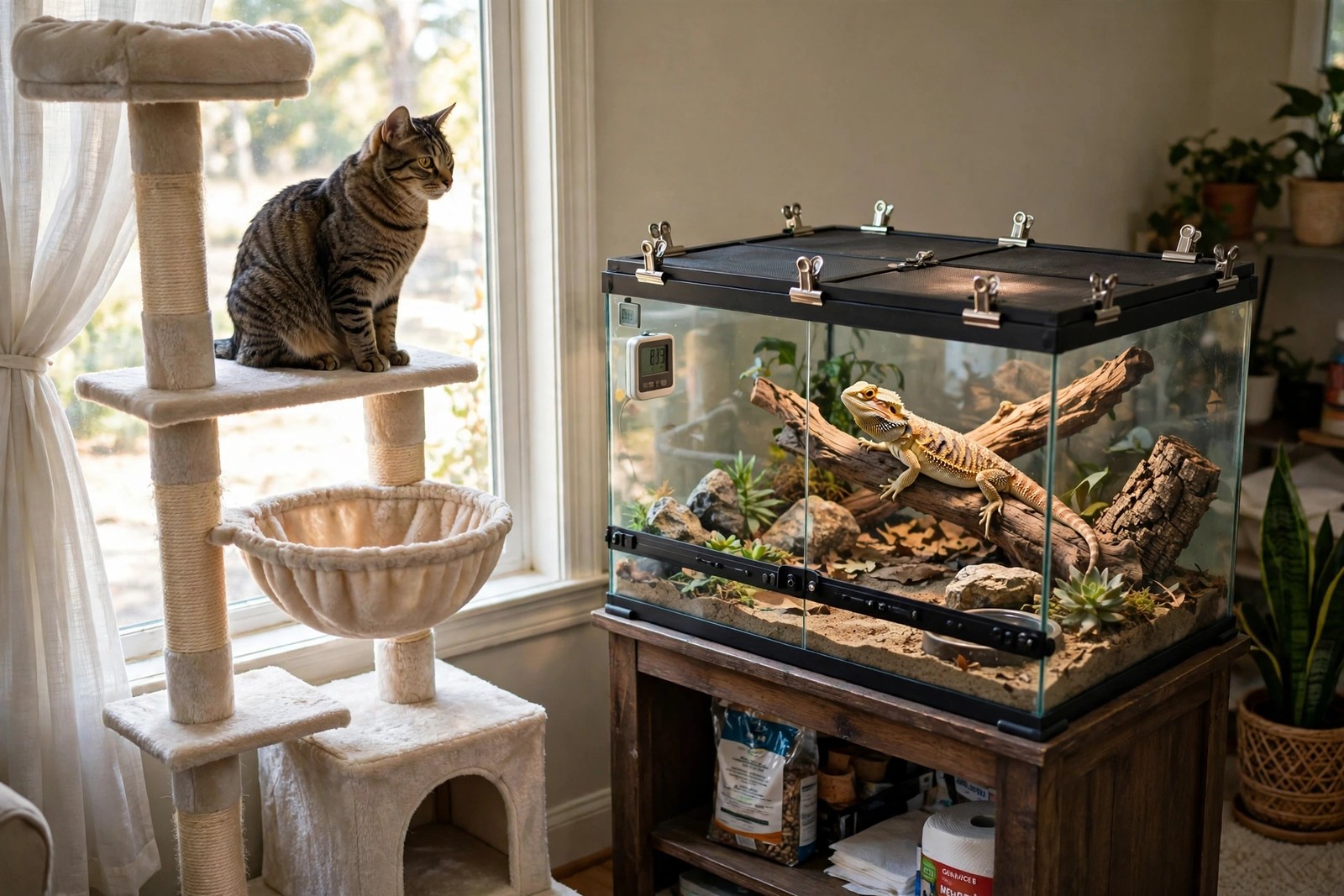
A cat on a vivarium lid is drawn by three things: height, warmth rising from the heat lamp, and a front-row view of something that moves like prey. The cat is also a genuine risk. A lid that flexes can drop the cat into the enclosure, a heavy cat resting over a lamp can overheat, block ventilation, or knock fittings loose, and the reptile below lives under a predator's silhouette — many lizards and snakes eat poorly and hide under that pressure. Shouting the cat down fixes none of the three attractions, so change the setup instead.
First, Make the Lid Cat-Proof
Fit a rigid metal mesh lid sized for the enclosure, secured with locking clips on all sides so it cannot slide or flex inward under the cat's full weight. Test it by pressing firmly across the middle before trusting it. Keep any heat lamp mounted so the mesh cannot sag onto the bulb, and check the temperature gradient after changing the lid, because denser mesh can alter airflow and basking heat. Replace screen tops that have thin or damaged mesh, plastic-framed lids, and any lid the cat has already bent. If it sits on a stand, confirm the stand is rated for the filled vivarium's full weight and cannot rock when a cat lands.
Block the Launch Routes
Cats rarely levitate onto tanks; they jump from something. Move shelves, bookcases, desks, and cat furniture away so there is no stepping stone within leaping distance, and keep the enclosure away from a sofa back or windowsill the cat patrols. If the layout still makes the tank reachable in one jump, use a closed door: keep the reptile in a room the cat does not enter, with the rule understood by everyone and by guests. A door removes the problem entirely, and for a determined cat or a stress-prone reptile, it is the honest answer.
Offer a Higher, Warmer, Better Seat Nearby
Redirection works when the alternative beats the tank. Place a tall cat tree or sturdy shelf perch close to — but not within jumping range of — the vivarium, ideally beside a window, higher than the tank's top, with a soft bed on it. Put treats on it, play with the cat there, and give them the attention they sought from the tank top. Every time you find the cat on the lid, lift them down calmly — a big reaction is still attention — carry them to the perch, and reward settling. Consistency across a few weeks retrains the habit; one scolding does not.
Watch the Reptile for Stress While You Retrain
While the cat still has access, monitor the animal underneath: a lizard who stops basking, a snake who refuses food or stays in the cool hide all day, a tortoise who retreats at movement above. Those signs mean access must end now with the closed door, not after perch training works. Never allow the cat to stare into the enclosure at eye level, or be in the room while the vivarium is open for feeding, cleaning, or handling — a fast reptile, a startled cat, and your hands are a bad combination.
What Not to Rely On
Skip tricks that annoy the cat briefly without reducing risk. Foil on the lid and sticky tape usually stop working once a determined cat tests them, and tape residue near vents is hard to clean. Citrus sprays and essential oils are a poor choice around reptiles: strong scents in an enclosure can irritate a reptile's breathing, and the cat returns when the smell fades. Motion-activated alarms startle the reptile underneath as often as the cat. Stacking books or boards on the lid adds unstable weight and blocks airflow and heat. Lifting the cat off each time, with no stronger lid, blocked access, or better perch, also fails — the warmth and height wait for you to leave.
Household rules only protect the reptile when every person follows the same ones, and KinsLe Family Sharing lets you share the reptile's profile — lid checks, the closed-door rule, and handling notes — with everyone who helps, so the system survives guests and busy days.